
The Approach Through the Limestone Maze
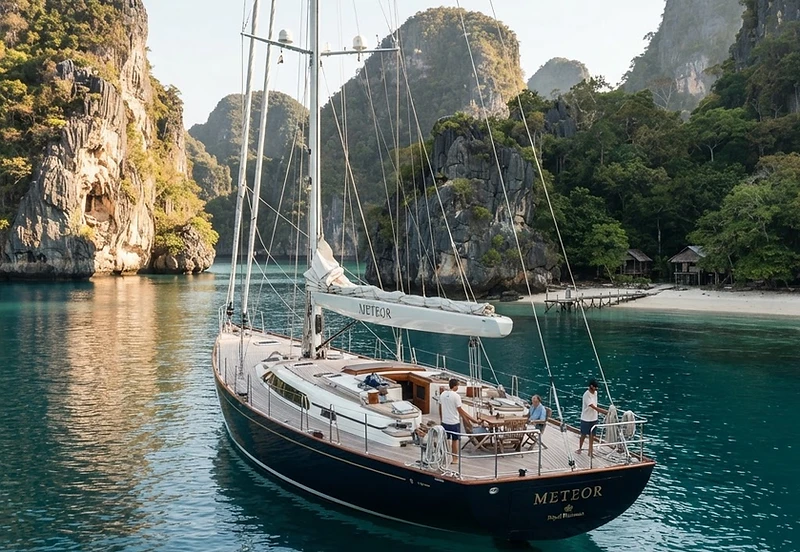
The dawn in the Mergui Archipelago does not break with a flourish; it seeps into the cockpit of the Royal Huisman schooner, a grey-gold light that seems to rise from the very sediment of the seabed. We were four days out from Kawthaung, the steady, rhythmic thrum of the engine finally yielding to the silence of the Andaman Sea against the teak-clad hull. Approaching this private, nameless speck—a jagged crown of jungle and quartz-sand tucked behind a screen of larger, treacherous karsts—demands a navigator’s visceral intimacy with the charts. The depth sounder fluctuates with nervous intensity as we pick our way through a labyrinth of coral heads, our draft requiring a feather-light touch on the throttle until the bay suddenly releases into a perfect, glassy amphitheater. The yacht is not merely our transport here; it is the front door, the primary interface between the volatility of the open ocean and the singular, grounding stability of the sand.
The Ritual of the Transom
Life aboard this vessel is governed by the lunar cycle and the deliberate transition from brine to shore. By mid-morning, the aft deck has been transformed into a staging ground, stripped of artifice and focused on the essentials of passage. The crew moves with the near-silent, choreographed efficiency of a master-crafted complication, lowering the tender until its white hull gleams against the deep, verdant emerald of the water. Breakfast is a disciplined, sensory affair: cool slices of local papaya and firm, lightly seared river prawns served on the cooling teak table, the air thick with the scent of damp earth and crushed limestone drifting from the island’s canopy. This is the authentic rhythm of the charter, a conscious slowing of pace that prioritizes the sensory over the schedule. We do not merely go ashore; we carry the vessel’s internal composure with us, a quiet, portable sanctuary that anchors our presence even as we walk the tide-line of a place that remains absent from every commercial map.
Anchored in the Solitude
As the sun dips behind the western spires of the archipelago, the light shifts from gold to a bruised, magnificent violet. Returning to the yacht feels like a homecoming, an act of restoration even in waters thousands of miles from any familiar port. Standing on the swim platform, the water is still holding the day’s heat, a silken weight against the skin. There is no conversation required in these moments; the wind has abandoned the bay, and the only sound is the subtle, rhythmic pulse of the generator deep in the bilges and the distant, lonely call of a Brahminy kite. We exist here as guests of the sea, hosted by a machine of iron, composite, and wood, waiting for the moon to climb over the limestone rim. We know that tomorrow, with the turn of the tide, we will simply weigh anchor and let the Andaman current dictate the next horizon.
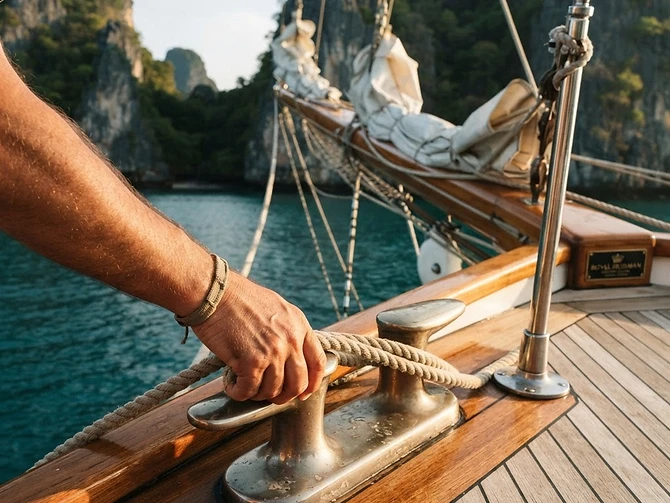
The anchor chain grinds briefly against the roller, a metallic rasp that echoes off the cliff face before falling into the deep. As the schooner swings to face the moon, the dark water mirrors the stars, and the island dissolves into shadow, leaving only the soft glow of the deck lights to mark our presence in the void.






