
The Salt and the Soil
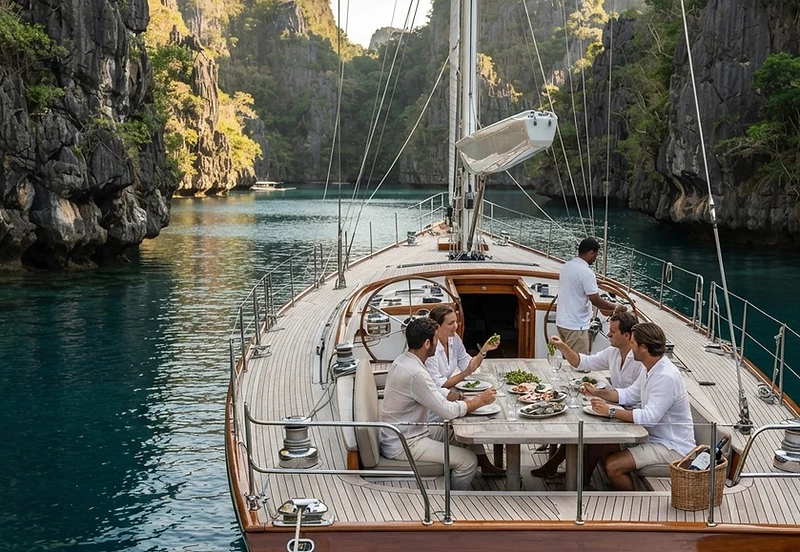
The 45-meter Royal Huisman, Athena’s Whisper, moved through the Sulu Sea with a tactile grace that only a cold-molded hull can command. We were three days out from Puerto Princesa, tracking the deep cobalt currents toward the Calamian Islands. The morning light was absolute, a crystalline clarity that rendered the surface of the sea into a sheet of polished glass. Our captain, a man who reads the temperament of these limestone reefs with more accuracy than any GPS chart, kept us tight to the towering walls of the Coron archipelago. There is a specific acoustic to a vessel of this pedigree under light wind: the tension in the rigging, the rhythmic, hollow slap of water against the teak transom, and the distant, ever-present hum of the engine room cycling in the quiet.
We brought her to anchor in a hidden lagoon, the water shifting from a bruised navy to a luminous, translucent jade. The transition from the stability of the main deck to the movement of the tender is always a sensory recalibration, but here, the tropical humidity carried the heavy, complex scent of wet limestone and wild jasmine. We were heading inland, not for the usual technical dive, but to reach a private estate that had begun a cautious experiment with micro-viticulture on the leeward side of the cliffs. It was a study in geological contrast: the mineral-heavy, iron-rich earth of Palawan, usually reserved for native flora, now nurturing imported vines under the persistent, humid sun.
A Service at the Edge of the Reef
The oppressive heat broke slightly as we climbed the terraced slopes. Standing among the vines, the view back toward the water revealed the startling scale of our solitude. The Athena’s Whisper sat anchored in a natural cathedral of rock, her silhouette dwarfed by the karsts. The estate manager, Elias, poured a sample of his latest harvest: a crisp, unaged white that possessed a distinct, saline finish, as if the terroir itself were exhaling the surrounding sea spray. It was a visceral, honest vintage; it did not attempt to replicate the classical terroir of the Gironde, but instead leaned into the humid, salt-sprayed identity of the Philippine coast. It was sharp, unapologetic, and inextricably linked to the geography of the islands.
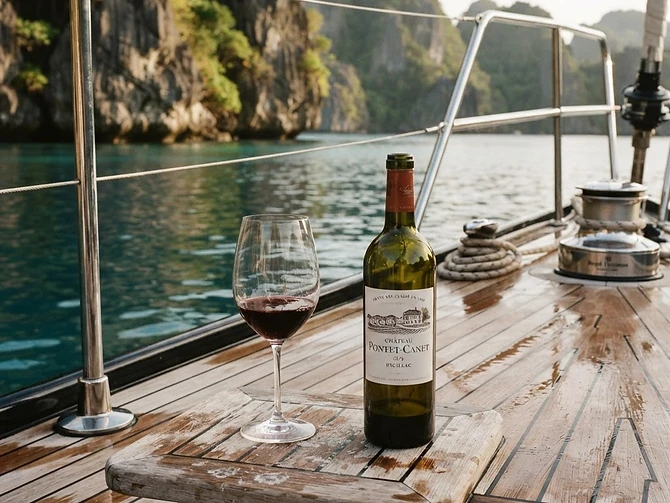
Returning to the yacht as the sun dipped behind the jagged karsts, the ritual of the galley took over. We opened a bottle of 2012 Château Pontet-Canet brought from the climate-controlled cellar—a deliberate, structural nod to the historic estates of Pauillac—and observed how the wine maintained its composure against the heavy evening air. We drank it on the aft deck as the horizon faded to a bruised, electric purple. The contrast was evocative: the refined, structured tannins of the French estate juxtaposed against the raw, untamed silhouette of the Palawan coastline.
As the final light vanished and the stars pinned themselves against the dark, the atmosphere grew perfectly still. The yacht swung with the turning tide, the anchor chain clicking rhythmically through the hawsepipe, a metallic, steady heartbeat in the profound silence. We sat in the dark, watching the phosphorescence bloom in the wake of a passing fish, the boundary between the deep ocean and the night sky dissolving, leaving us suspended in the quiet, absolute dark of the Sulu Sea.






