

The Morning Provisions
The dawn air in the Selat Melaka is never truly silent; it carries the low, steady thrum of longtail boats carving paths toward the Kuala Kedah market. By the time the sun had fully cleared the limestone ridges of Pulau Dayang Bunting, our chef had already returned from the shore, the scent of damp earth and sea salt clinging to his apron. In his crate lay a bounty that defined the day’s direction: a heap of silver-scaled ikan tenggiri, firm and smelling of the open current, and bundles of wild ginger flower, or bunga kantan, which he had sourced from a grower deep in the island’s interior. Provisioning here is not a matter of a requisition sheet, but of active engagement with the tide and the village. The galley, usually a space of industrial efficiency, became a laboratory of local aromatics, where the sharp, acidic punch of fresh calamansi competed with the deep, slow heat of toasted belacan. Watching the crew hoist the tender back into its cradles, one realizes that the vessel is not merely a platform for transit, but a vessel for transformation—where the raw potential of a coastline is refined through the alchemy of the galley.
A Latitude of Flavor
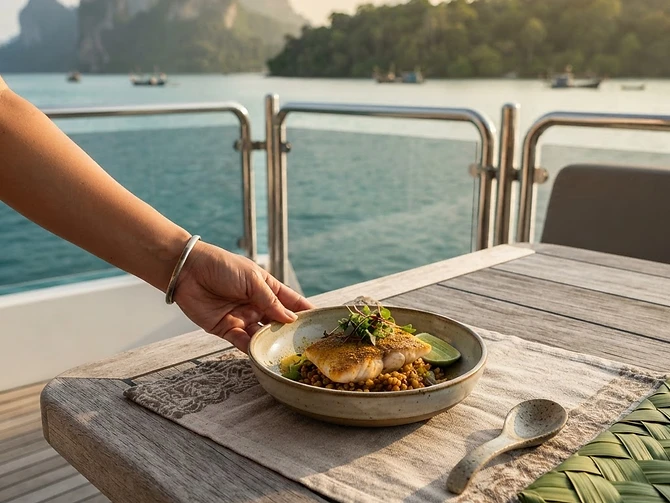
Anchoring off the western coast of Langkawi requires a certain deference to the depth sounder and the shifting silt of the Andaman basin. As our yacht swung slowly on its chain, the aft deck transformed into an expansive dining room where the boundary between vessel and sea felt porous. The evening’s tasting menu began not with an imported luxury, but with a tribute to the immediate geography. The tenggiri, cured briefly in lime juice and palm sugar, arrived on hand-thrown ceramics, the sweetness of the fish mirrored by the floral lift of the ginger flower. It was a study in restraint—each bite anchored firmly to the Malaysian coastline, yet elevated by the technical precision of the galley team. Dining at anchor, particularly here, is an exercise in situating oneself within the landscape. As we ate, the lights of distant fishermen blinked like terrestrial constellations, a reminder that we were merely temporary inhabitants of this deep, productive water. The gentle yaw of the boat, a slight oscillation as the current caught the rudder, provided the only metronome for a meal that felt as natural as the ebb and flow outside the rails.
The Resonance of the Anchorage
As the final course—a delicate coconut-infused panna cotta scented with the dark, heavy sweetness of Gula Melaka—was set down, the conversation aboard stilled. The true elegance of the evening was not found in the silver or the polished teak of the deck, but in the profound quiet that follows a meal shared in a remote reach. The water lapped against the hull, a rhythmic, cooling sound that seemed to pull the lingering heat from the deck planks. We sat long after the plates were cleared, watching the tide swirl past the transom, catching the phosphorescence that occasionally pulsed in the dark wake. In the distance, the silhouette of the mangroves merged with the encroaching shadow of the headlands, and for a moment, the ship, the sea, and the season felt perfectly, quietly aligned. There was nothing left to do but watch the tide turn, the anchor chain clicking softly in the hawsepipe, tethering us to the heart of the Andaman while the starlight caught the ripple of the departing current.






