
The Precision of the Approach
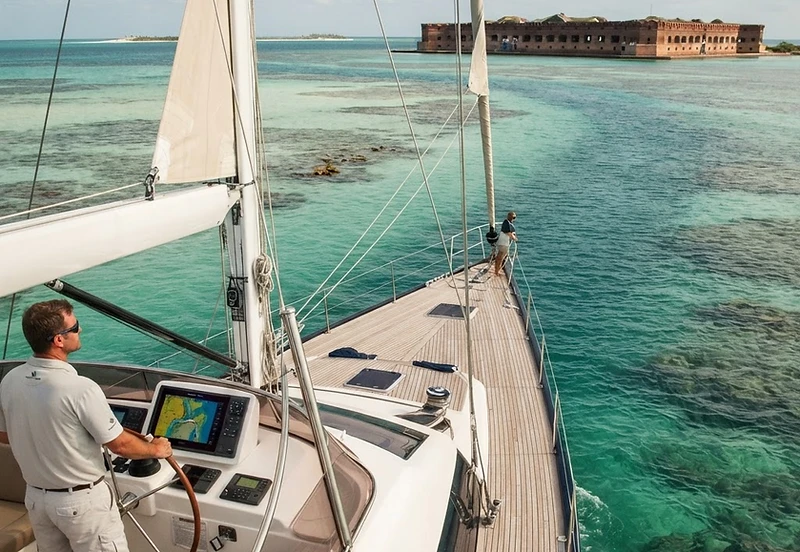
The navigation charts for the approach to Garden Key are less a set of instructions and more a cautionary tale written in fathoms. As our 45-meter Nautor’s Swan cleared the Marquesas and turned its prow toward the distant, low-slung silhouette of Fort Jefferson, the depth sounder became the only voice that mattered. There is a specific tension in the Florida Keys—a state of constant vigilance where the sea bed can rise from fifty feet to a scant five in a handful of boat lengths. We moved with the measured intent of a vessel that respects the fragility of the reef, the twin engines idling at a pulse that barely disturbed the mirror-calm surface of the Gulf.
Standing on the bridge, the air carried that particular, sharp scent of sun-warmed seagrass and drying salt. We were not merely moving between coordinates; we were negotiating a path through a living, shifting architecture. My colleague, a sommelier whose expertise in Old World estates is matched only by his ability to read the set of a jib in high winds, adjusted the stabilizer settings. He moved with the quiet grace of a man who understands that both at sea and in the cellar, timing is the only currency that retains its value. We were here to test a pairing that had traveled from the damp stone cellars of the Loire to the sweltering, luminous expanse of the Tortugas.
Vintage and Vessel at Anchor
By late afternoon, the Swan had come to rest in the lee of the fort’s massive, red-brick bastions. The anchor chain rattled out—a sound that always feels like a heavy period at the end of a long, kinetic sentence. Once the vessel swung to the tide, the rhythm of the ship changed completely. The main deck transformed into a space of quiet transition, the heat of the day beginning to dissipate into the long, golden shadows cast by the 19th-century ramparts.
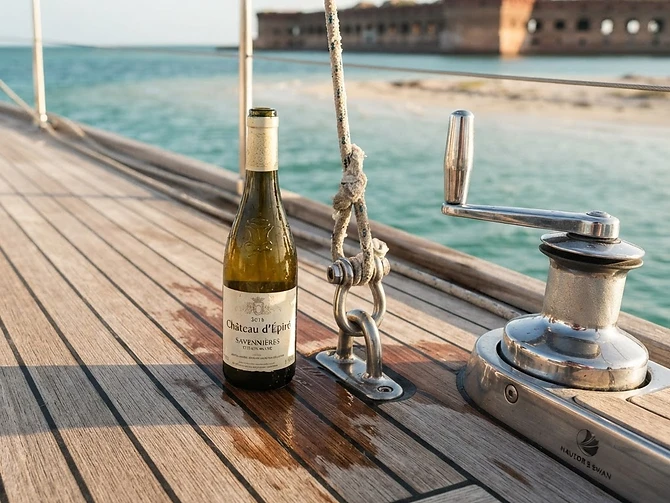
We cleared the teak aft deck, the sommelier setting out a small, chilled selection of Chenin Blanc from Savennières. It is a bold, flinty wine, one that holds its own against the humidity of the Florida sun. As we poured, the glass sweated condensation against the grain of the varnished table. We drank slowly, watching the sky shift from a brilliant, bleaching azure to a bruised, violet haze. There was no conversation for a long while; the only sounds were the soft slap of water against the hull and the distant, lonely cry of a sooty tern circling the moat. The wine, cool and searingly precise, felt like a deliberate counterpoint to the wild, unkempt beauty of the surrounding shallows. It was a moment of refined focus within an environment that demands total surrender.
The evening deepened, the water turning to black ink beneath the stern lights. We watched the last of the day boaters scramble for the mainland, their wakes leaving long, phosphorescent scars on the surface of the harbor. There is a profound honesty in this sort of seclusion—the knowledge that you have reached the edge of the map, and that for tonight, the only thing that separates you from the deep history of the Gulf is a few inches of composite and the slow, steady hum of the refrigeration system, ensuring the next bottle is ready for the morning watch.






