
The Weight of the Horizon
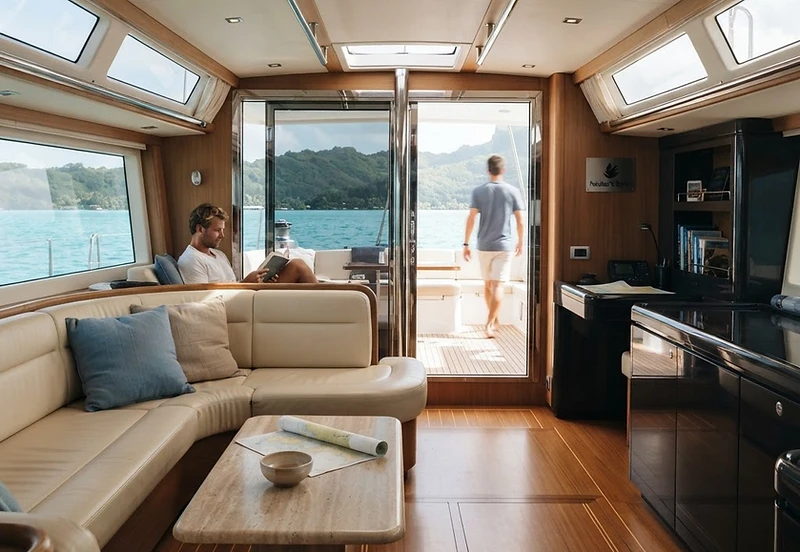
The dawn air off the coast of Raiatea is thick with the scent of crushed hibiscus and the sharp, bracing smell of cooling salt. From the cockpit of the Nautor’s Swan, the lagoon is a fractured mirror of neon turquoise, broken only by the rhythmic, percussive slap of water against the hull. Below deck, the interior is not merely a living space but a carefully calibrated response to the raw intensity of the Pacific. Here, the materials palette is curated for resilience as much as for aesthetic grace. A slab of honed white limestone serves as the countertop in the galley; its matte, cool surface provides a necessary physical anchor against the relentless rolling motion of the swells. It is a dense, grounding presence that keeps one oriented when the horizon tilts precariously beyond the porthole, reminding the voyager that stability is something one builds, not something one expects.
Tactile Navigation at Anchor
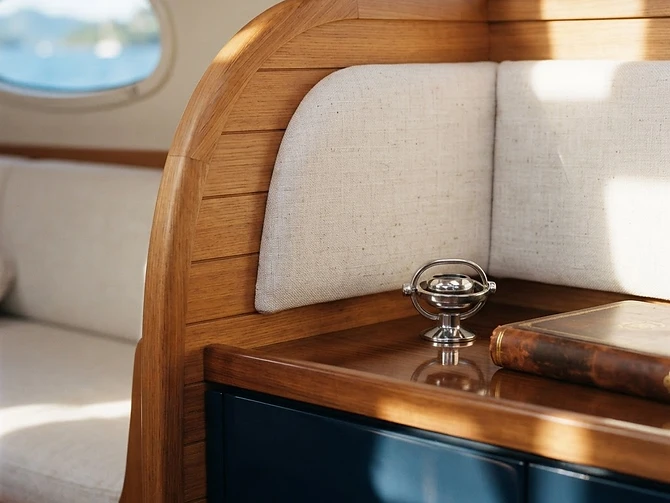
We spent the afternoon moored in the lee of Taha’a, the island’s verdant peaks rising like emerald ramparts against a bruised, rain-heavy sky. Stepping from the tender onto the sun-warmed teak deck and moving into the main saloon, the transition is softened by the presence of hand-stitched saddle leather and loose-weave linen. The leather, warm to the touch and subtly darkened by years of persistent salt-air exposure, wraps the structural bulkheads, providing a tactile endurance that mirrors the rigour of an ocean passage. Against this, the linen curtains—light, breathable, and slightly translucent—catch the trade winds, fluttering with a rhythmic, kinetic energy that brings the restlessness of the sea inside. This is the interior architecture of the voyage, where every fold of fabric and every grain of wood serves as a physical acknowledgment of our proximity to the water. It shares an ethos with the private waterfront villas scattered near Uturoa, where the boundary between interior floor and external reef is similarly dissolved by thoughtful materiality.
The Geometry of Stillness
As evening settled, the cabin lights dipped to a soft, amber glow, catching the high-gloss black lacquer of the cabinetry. The finish, a deep, piano-black reflection, acts as a dark pool, capturing the flickering bioluminescence of the lagoon outside in a way that suggests depth rather than artifice. It is a material that demands constant care; it records every touch, every shadow, and every subtle shift of the light as the boat pivots on her chain. Much like the architecture of a shore-side retreat designed to echo the movement of the tide against volcanic stone, the yacht’s interior is a study in controlled thresholds. There is no vanity here, only a quiet, rigorous commitment to the materials that allow us to live comfortably between the deep sea and the shore. When the anchor chain finally settled, its heavy, metallic rattle echoing through the hull, the cabin became a hushed, private observatory. The materials held the stillness of the night, cool and expectant, while the Southern Cross began its slow, inevitable transit over the standing rigging.






