The Anchor’s Quietude
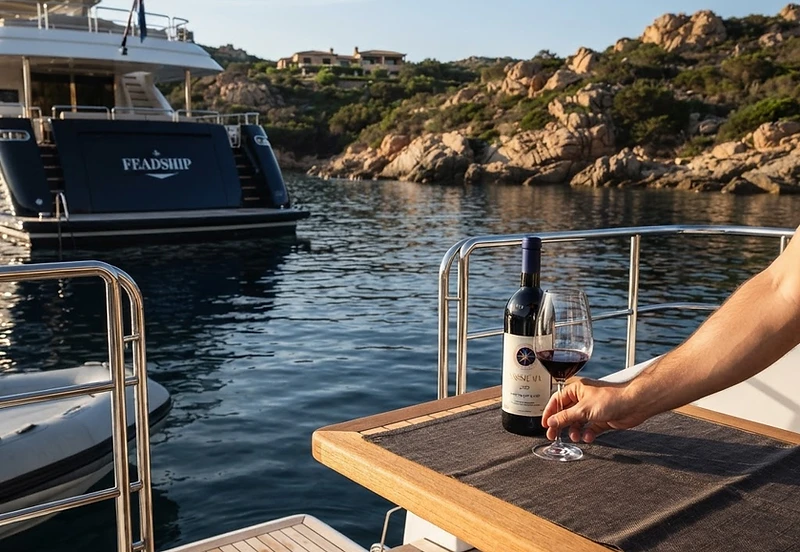
The Feadship sits motionless in the lee of Mortorio, the granite teeth of the Sardinian coast cutting a stark silhouette against the bruising purple of a dying dusk. There is a peculiar, rhythmic sound to a superyacht at anchor: the soft, insistent slap of a Mediterranean swell against the stainless steel stabilizers, the distant, low-frequency thrum of the watermaker, and the occasional, sharp creak of teak decking shifting under the weight of the evening chill. We have spent the day navigating the narrow, shallow channels between Spargi and Budelli, the water shifting from a bruised cobalt to a translucent, electric turquoise that seems to glow from the white sand of the seabed itself. As the wind finally drops, the deck crew moves with practiced, silent efficiency to secure the tender, their figures silhouettes against the darkening horizon, leaving the afterdeck to the soft, cooling hum of the evening.
The Inventory of the Deep
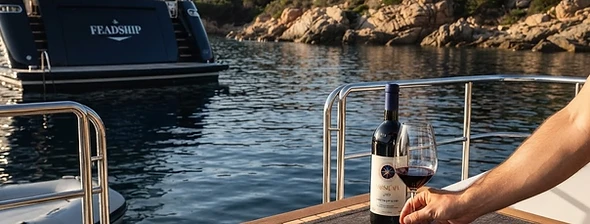
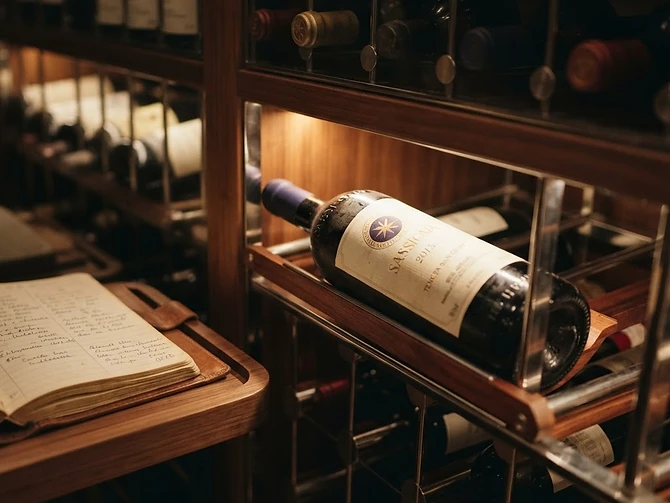
Provisioning a vessel of this scale is a feat of logistical geometry—a delicate balance of cold-chain integrity and spatial optimization—but the wine cellar, a climate-controlled vault tucked discreetly behind the engine room bulkhead, represents something far more personal. It is a floating archive of previous seasons, a collection curated not for the sake of prestige, but for the specific, shifting demands of life at sea. Tonight, the decision falls on a 2012 Tenuta San Guido Sassicaia, a Bolgheri red that has, in truth, traversed the length of the Tyrrhenian Sea more times than most of the crew. Opening a bottle that has spent months in the gentle, perpetual motion of a hull is a tactile, almost reverent experience. The cork, seasoned by the consistent humidity and the slow, rhythmic roll of the vessel, yields with a pliant softness that feels less like a service ritual and more like a private, quiet conversation with the sea itself.
A Dinner of Provenance
We dine on the aft deck, the table set with heavy, non-slip linens that catch the stray, rhythmic pulses of light from the distant port of Porto Cervo, flickering like stranded fireflies on the horizon. The menu is intentionally restrained: local red prawns from the nearby town of Palau, served simply with coarse sea salt and a sliver of Amalfi lemon, followed by a slow-roasted suckling pig sourced from an inland agriturismo near Arzachena. The wine, decanted into crystal that carries the subtle, fine-tuned vibration of the ship's generators, opens slowly, shedding its youthful austerity. In the glass, it speaks of the Tuscan coast, yet here, amidst the salt-heavy air and the scent of heated teak, it assumes a different, more grounded character—sharper, perhaps, or merely more honest in its maturity. There is no performance here, only the confluence of a decade’s worth of coastal navigation and the singular, fleeting reality of an anchorage that will be abandoned at the first hint of dawn light. We finish the evening watching the navigation lights of a passing Nautor’s Swan carve a faint, luminous wake through the dark water, the only movement left in a world that has finally, mercifully, come to a standstill.
As the moon crests the jagged ridge of the island, the empty glass sits solitary on the teak rail, a silent, dark-stained witness to a voyage defined not by the ports of call, but by the stillness captured between the tides.