The Anchor’s Geometry in the South China Sea
The Feadship sits with a deliberate, confident poise against the shadowed backdrop of the Wuzhishan coastline. We have spent the better part of the afternoon navigating the glassy, unpredictable swells of the South China Sea, moving north from the mechanical bustle of Sanya’s Phoenix Island Marina. There is a specific quality to the light here as the sun begins to slide toward the horizon—a bruised, golden haze that softens the jagged, limestone profiles of the distant islets. On board, the rhythm of the crew is near-telepathic; the low hydraulic sigh of the transom door lowering is the only signal we require to transition from the active, tactile navigation of the wheelhouse to the quiet theatre of the swim platform.
We are anchored in a sheltered cove near the Lingshui headlands, a limestone sanctuary where the dense, emerald tropical foliage of Hainan meets the absolute, glassy stillness of the water. To stand on the swim platform at this hour is to exist in a state of suspended animation. The teak planks are still warm, retaining the heat of a long, salt-crusted day spent tracing the contour of the coast. As the tenders are secured and the deck lights flicker into their low, amber cycle, the sea turns from a brilliant, sun-bleached turquoise to a deep, impenetrable violet. It is a moment that demands a precise companion, something that cuts through the heavy humidity of the Hainan evening with the sharp, mineral clarity of the chalky slopes from which it was born.
The Vintage Vigil at the Water’s Edge
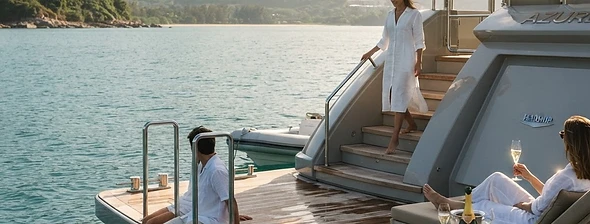
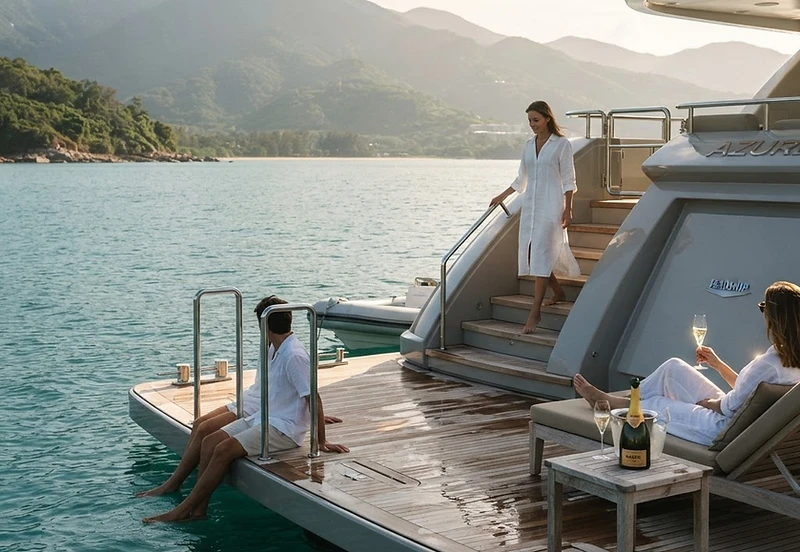
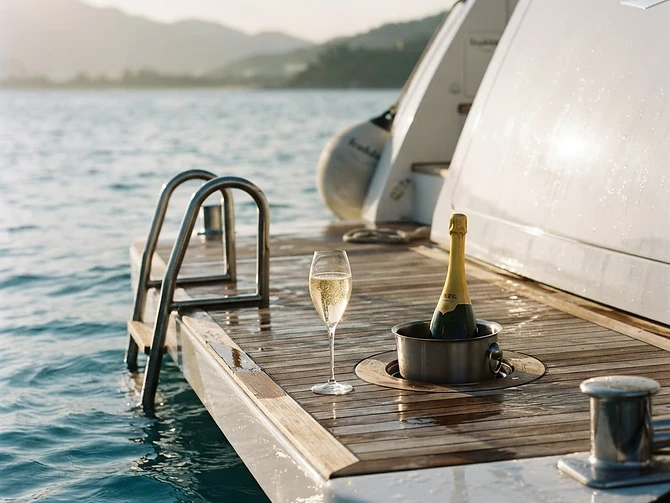
The steward places the silver cooler on the deck, a heavy vessel that catches the fading light, holding a chilled bottle of Krug Grand Cuvée. There is a profound, grounding irony in the juxtaposition: the yacht’s advanced naval engineering—the complex active stabilizers, the immense, muffled torque of the MTU engines—now rendered subservient to the simple, human act of pouring a glass of champagne while seated mere inches from the tide. We sit with our legs dangling over the edge, the occasional, rhythmic lap of a swell against the platform providing the only soundtrack to the deepening night.
The wine, cold enough to bead with thick condensation in the humid air, offers a bracing, necessary acidity—a sharp, effervescent dialogue between a remote cellar and the wide, salt-heavy expanse of the sea. We watch the last of the local fishing junks head toward the harbor at Xincun, their navigation lights flickering like distant, terrestrial stars. Conversations aboard at this hour are rarely loud; they are clipped, observational, mirroring the inherent stillness of the boat. Someone mentions the projected current for the tomorrow’s crossing toward the Xisha Islands, but the topic drifts, as it must, back to the immediate sensation: the taste of the pinot noir-heavy cuvée, the faint, clean scent of brine, and the way the darkness finally erases the horizon line between the black water and the blacker sky.
It is not an exercise in excess, but a ritual of arrival—the silent acknowledgment that, for this brief window, the passage is complete. As the first stars assert themselves above the island’s dark, serrated silhouette, the glass is set aside. We remain there, leaning back against the cool, brushed stainless steel railings, until the movement of the boat is no longer a mechanical reality, but a steady, rhythmic pulse, perfectly in sync with the slow, eternal respiration of the ocean.