
The Approach to Isabela
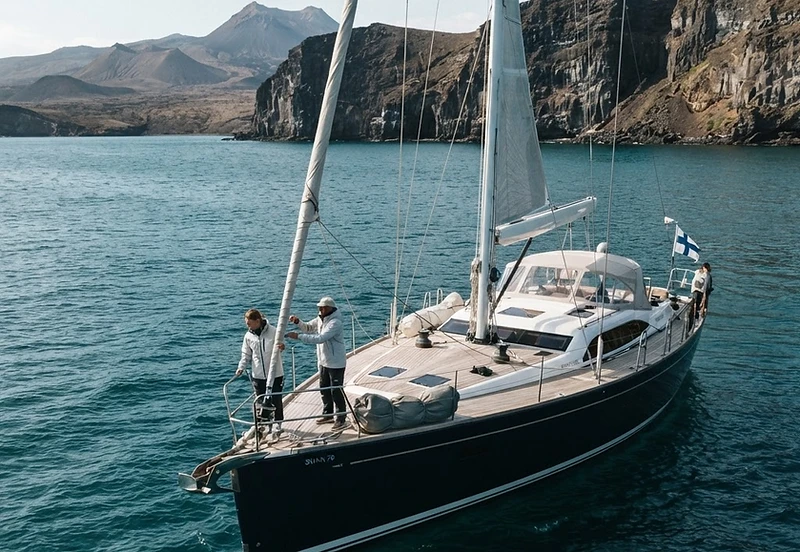
The dawn watch off Isabela Island offers a peculiar stillness, a kind of geological hush that only the Galápagos can curate. Aboard our 45-meter Nautor’s Swan, the deck teak still held the dampness of the midnight air, cool and silver-grey underfoot. There is a precise, practiced cadence to the crew as they prepare for the day: the soft click of the passerelle being secured, the low-frequency hum of the generators as we shift from night-mode to active service, and the quiet arrangement of the breakfast service on the aft deck. We sat there, watching the sun crest over the serrated silhouette of the Sierra Negra volcano, a landscape so raw it feels as if the earth were still cooling.
The plan was simple: transit the Bolivar Channel, that narrow, nutrient-rich ribbon of water between Isabela and Fernandina. It is here that the cold Cromwell Current hits the volcanic shelf, creating an upwelling that transforms the ocean into a sanctuary for the migratory giants. Sailing here is not merely navigation; it is a negotiation with an ecosystem that cares nothing for the draft of a keel or the polish of a hull.
The Rhythms of the Search
By mid-morning, the wind had clocked around to the southeast, filling the sails with a steady, reliable pressure. The Captain, a man whose hands possess the permanent salt-cracked texture of someone who has spent more time on the Pacific than on land, kept us on a cautious, zig-zag heading. Life aboard settles into a specific internal tempo during these passages. There is the scent of freshly ground Arabica beans drifting from the galley—a small, necessary indulgence against the vastness—and the tactile satisfaction of a well-poured coffee served as the bow cuts through the obsidian chop of the channel.
We found them just before noon: a small pod of Bryde’s whales, sleek and ghost-like in the deep blue. We killed the engines, letting the momentum of the Swan carry us silently toward the disturbance on the horizon. There were no shouts, only the sharp, rhythmic intake of breath from the deckhands and the distant, thunderous exhale of a blow that seemed to vibrate through the hull itself. To observe them from the rail, without the intrusion of mechanical noise, is to understand the scale of one's own existence. It was a brief, profound alignment; for ten minutes, the yacht ceased to be a vessel of transport and became merely another object floating in the great, indifferent blue.
Afternoon Drift and Shoreward Rituals
As the afternoon wore on, we retreated to the lee of a sheltered cove near Puerto Villamil. The transition from the tension of the whale-spotting to the languid routine of an anchorage is one of the finer arts of yachting. The crew deployed the tenders, the ice-boxes were readied, and the transition to a slower, terrestrial rhythm began. We spent the late afternoon in the shadow of the basalt cliffs, eating fresh ceviche prepared by the chef using lime and catch from the local co-operative, the sharp citrus cutting through the salt-heavy air.
We did not go ashore. There is a particular luxury in choosing to remain at the edge of the land, watching the town lights flicker on against the darkening flank of the volcano. We lingered over the final dregs of the day, listening to the slap of the water against the hull—a sound that, once heard in the isolation of the Galápagos, remains a permanent, quiet ache in the back of the mind. As the stars filled the sky, reflecting off the dark surface of the channel, the yacht turned gently on her anchor, a singular, luminous point of rest in an ancient and moving world.






