

The Anatomy of the Morning Tide
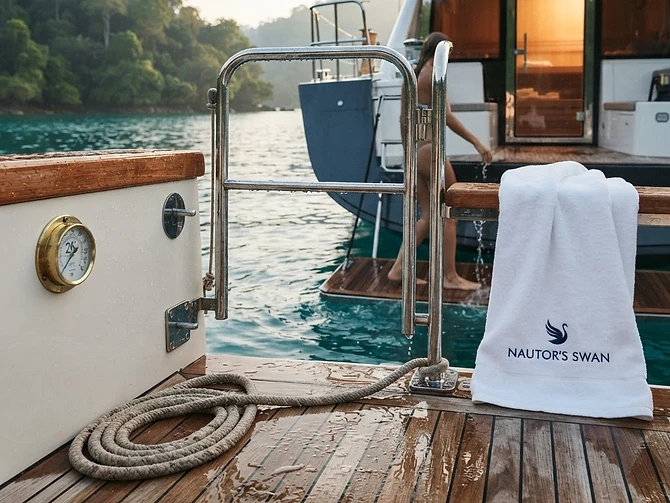
To wake aboard in the Mergui Archipelago is to understand the surrender of the compass. Here, eight hundred islands scatter like emeralds across the Andaman Sea, and the primary navigation tool becomes the intuition of the watch. When we brought our Nautor’s Swan into the sheltered, deep-water lee of Lampi Island at first light, the silence was absolute, broken only by the rhythmic, hollow slap of the current against the fiberglass hull. The morning ritual here is a necessity, not a luxury: a silent, cold plunge from the carbon-fiber transom into water so startlingly clear that the seabed—a complex, shadowed tapestry of branching staghorn corals and slow-moving hermit crabs—felt close enough to graze with a trailing hand. This is the first movement of the day, a sudden, bracing re-alignment with the maritime pulse of the region, purging the lethargy of the night’s equatorial heat with the visceral shock of the salt.
Thermal Shifts and the Galley’s Bounty
Following the immersion, the transition into the onboard sauna—discreetly integrated into the teak decking of the vessel’s aft exterior—provides a sharp, intentional contrast to the humid, pervasive embrace of the Burmese coast. Within the cedar-lined cabin, the air is heavy with the scent of pine resin and ozone. The heat acts as a counterpoint to the morning swim, resetting the nervous system while the horizon remains a flat, unyielding line of shimmering turquoise. This equilibrium is essential, for it sharpens the palate for the culinary theatre that follows. Our chef, having secured a haul of spiny lobster and fresh pla kraphong—sea bass—from the Moken fishermen who ply these intricate channels in their traditional, hand-carved kabang boats, begins the mid-morning preparation on the galley deck. The catch is seasoned with precise restraint: a squeeze of local citrus, slivers of young ginger, and a vibrant, pounding mortar-crushed paste of bird’s-eye chili. The intention is never to mask the fish, but to highlight the saline integrity of the Andaman waters, pairing the delicate, translucent flake of the sea bass with the bite of the archipelago’s native herbs.
The Anchorage and the Evening Light
By late afternoon, the tender service takes us toward the shore for a final, grounding ritual. We anchor the tender near a secluded stretch of coast where the sand is as fine and white as powdered quartz. Dining in the Mergui requires an appreciation for the elemental; we find ourselves at a modest, open-air structure where the kitchen relies entirely on what the tide deposits and the local forest yields. We are served grilled mangrove crabs, their shells cracked and dripping with a pungent garlic-chili oil, accompanied by the earthy, distinct bitterness of sautéed wild ferns and bowls of steaming, jasmine-heavy rice. There is no artifice here, only the genuine, quiet hospitality of the coast and the sudden, cooling relief of the evening trade wind. As the sun dips behind the jagged, limestone karsts, painting the water in bruised purples and brilliant, fading burnt orange, the yacht remains a steady, comforting anchor on the horizon. We return to her by torchlight, the wake of the tender leaving a brilliant, neon phosphorescent trail in the black water—a final, luminous reminder that the sea is not merely our transit, but our singular, enduring host.






