
The Geometry of Ice
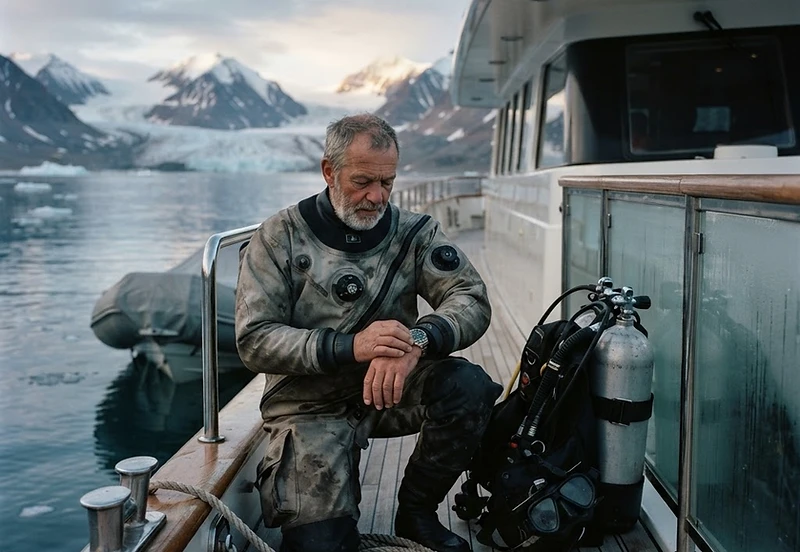
The dawn in Kongsfjorden does not break; it merely shifts from a deep, bruised indigo to a charcoal grey. We were anchored in the lee of the Blomstrandbreen glacier aboard a 45-meter Royal Huisman, her teak decks frosted with a fine layer of rime that crunched underfoot with every step toward the stern. At this latitude, the cold is not a weather event—it is a physical weight, a constant companion that turns the act of existing into a series of measured, deliberate motions. I sat on the aft deck, warming my hands around a ceramic mug of thick, black coffee, and watched the glacial meltwater streak the hull with silt-heavy ribbons of sediment.
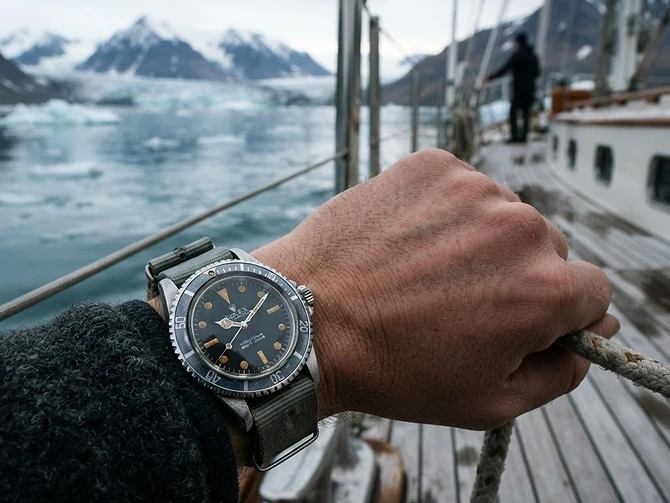
My wrist held the only piece of machinery that seemed to acknowledge the gravity of our position. It was a 1970s Rolex Submariner, an object that had spent more time under the surface of the world’s oceans than it had in the air. The bezel, once a sharp, saturated black, had faded to a ghostly, washed-out slate—a process watchmakers call 'ghosting.' It was a mirror of the landscape around us, where the harsh sun and the aggressive chemistry of the sea had leached the vibrancy from the insert. The tritium indices, aged to the colour of aged parchment, hummed with a quiet, persistent authority. Every scratch on the steel case was a chronicle: a brush against a Feadship’s stainless railing in Port Hercules, the abrasive bite of volcanic sand in the Azores, and now, the frigid, uncompromising grip of the high Arctic.
A Chronicle in Steel
Life aboard in the Svalbard archipelago requires a rhythm entirely distinct from the sun-drenched passages of the Caribbean. Here, the tender runs to the shoreline at Ny-Ålesund are punctuated by the watchful gaze of wandering polar bears and the sudden, thunderous calving of ice shelves. My watchmaker always warned me against the urge to polish. He argued that the patina—the micro-abrasions, the slight softening of the lugs, the way the dial had aged into a mottled, uneven topography—was the only honest record of the voyage. When we hauled anchor to head toward the northern reaches of Woodfjorden, I found myself checking the time not for the sake of the passage plan, but to ground myself in the continuity of the watch’s movement.
The brass internal gears of a mechanical timepiece are the antithesis of the digital noise that dominates modern navigation. In the pilothouse, the screens glowed with satellite data and depth soundings, providing a sterile map of the world. But on my wrist, the heartbeat of the watch—that soft, rhythmic tick—remained an analogue tether to the physical world. It recalled a conversation held in the small galley of a Nautor’s Swan in Newport years prior, where an old captain told me that a boat and a watch share the same soul: they are both designed to withstand the world, but they are only truly alive when they surrender their pristine veneer to the salt and the years.
The Weight of the North
As we rounded the headland, the wind picked up, sending spindrift across the bow. The watch felt heavy, a dense block of cold steel against the wool of my sweater. It had survived the pressure of a thousand atmospheres and the slow, corrosive crawl of oxidation, yet it kept time with a stubborn, mechanical precision that felt defiant against the vast, indifferent expanse of the Barents Sea. There is a particular clarity that comes when one stops treating equipment as a collection of assets and starts seeing them as companions in a shared life.
I stood on the bridge wing as the captain adjusted our heading, his eyes fixed on the horizon where the sea met the ice. I touched the crown of the watch, feeling the fine, worn grooves of the knurling under my thumb. It was no longer just an instrument; it was a map of every port, every gale, and every quiet dawn we had shared. We were sailing into a silence so profound that the only sound left was the slow, steady oscillation of the balance wheel—a tiny, metallic pulse, marking our slow transit through the ice-choked waters of the north.






