
The Geometry of the Morning Tide
The dawn in the Seto Inland Sea does not announce itself with the roar of a main engine or the clamour of a marina. It arrives as a subtle, rhythmic slap of water against the hull of our Nautor's Swan, a sound that vibrates through the teak decking like a low-frequency pulse. We are anchored in the lee of Teshima, where the islands rise like brush-stroked ink against a bruised, indigo sky. The light here is distinct—thinner, cooler, and refracted by the moisture rising from the calm, mirror-flat channels. To sit in the cockpit as the only yacht in this particular passage, watching the silhouette of a local fishing trawler from Miyanoura ghost past with nets heavy with sea-harvest, is to witness the true, unhurried heartbeat of the region. The boat, with her brightwork reflecting the burgeoning amber of the sun, feels less like a vessel and more like a floating, private observatory anchored in an ancient, maritime sanctuary.
The Galley and the Inland Harvest
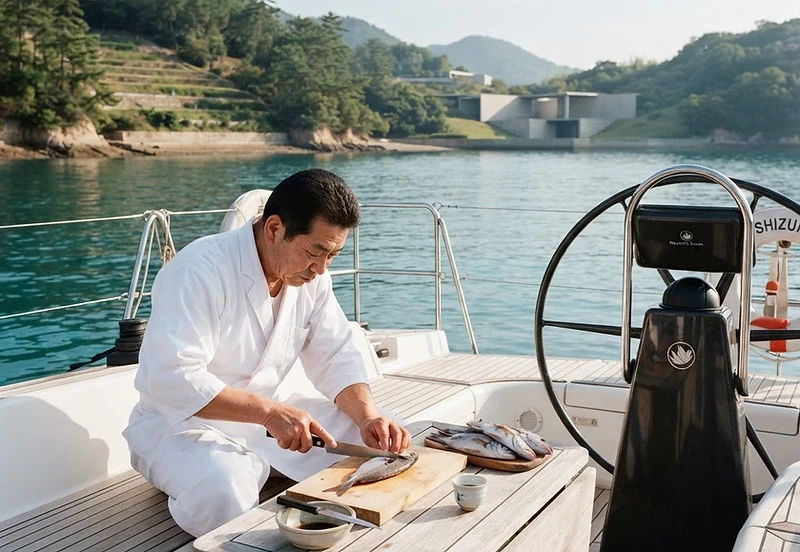
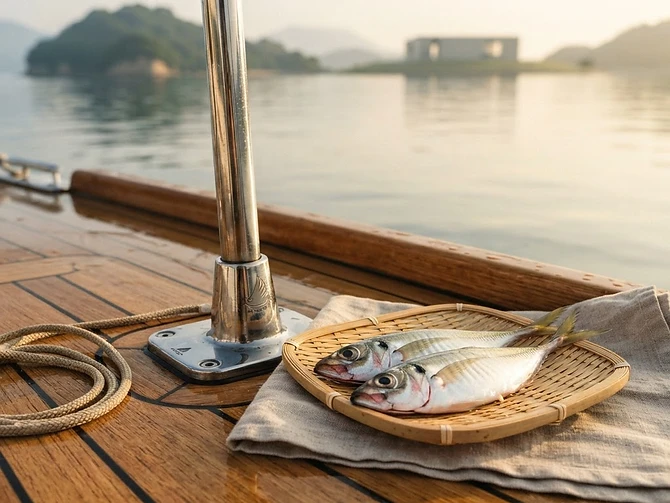
Life aboard in these waters is dictated by the small, vital exchanges between the vessel and the local fleet. By mid-morning, the wind has died completely, and our chef has secured sayori—Japanese halfbeak—from a weathered skiff operator who pulled alongside. The preparation remains surgical and precise, a philosophy that mirrors the restrained, brutalist architecture found on the nearby shores of Naoshima. We serve the fish as sashimi, the flesh translucent and firm, dressed only with a whisper of fresh wasabi root and a splash of soy sauce aged in the dark, cedar-lined vats of nearby Shodoshima. The meal is an extension of the seascape; the latent brine of the Inland Sea remains on the palate, while the sharp, aromatic zest of local sudachi limes provides a brightness that cuts through the subtle, clean richness of the fish. It is a genuine dialogue between the galley and the geography, confirming that true indulgence is found in the immediate, unadulterated proximity to the source of one’s nourishment.
The Tender Run to the Art Shore
As the afternoon heat settles, we take the tender toward the shoreline of Naoshima, tracing the calm, sheltered waters that have served as a vital artery for trade and transit for centuries. The transition from the isolation of our anchorage to the curated, subterranean galleries of the Chichu Art Museum is remarkably seamless. Walking the poured-concrete pathways, one notices the same deliberate restraint that informs the naval architecture of a well-balanced sailing yacht—every line is essential, and every shadow cast by the overhead sun is intended to guide the eye. Returning to the yacht as the light begins to fail behind the hills, we observe the crew performing the steady, evening rituals: the stainless steel fittings polished to a soft, warm luster, the heavy lines coiled with mechanical precision, and the aft deck prepared for the cooling, dusk breeze. There is no frantic movement here, only the measured, unfolding transit of the tide. As the faint, amber lights of the distant fishing villages begin to flicker like fallen stars along the coastline, we remain on the aft deck, watching the water settle into an obsidian calm, held entirely by the singular, quiet rhythm of this ancient and protected sea.






