
The Anchor’s Suspension
The dawn off the Lavezzi Islands is rarely silent, but it is always precise. As the 50-metre Royal Huisman swings on her chain, the rhythmic slap of the Tyrrhenian against her hull is the only clock that matters. We are anchored in a narrow, pale-bottomed reach where the water is so clear it renders the depth redundant, a stark contrast to the chaotic, wind-battered granite boulders that define this Corsican outpost. Inside, the world changes. The owner’s study, situated just aft of the bridge, is a space designed not for connectivity to the shore, but for a profound, deliberate disconnection from the horizon.
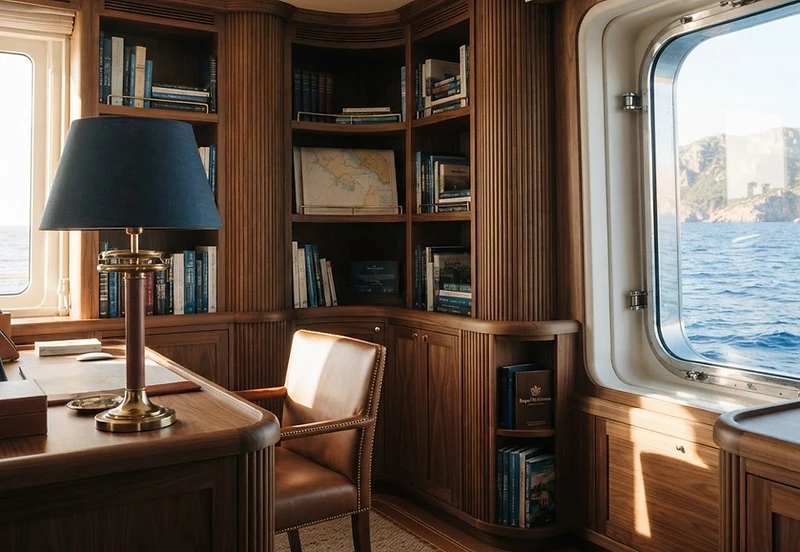
Stepping from the bright, salt-crusted teak of the main deck into the library, the light shifts from the aggressive white of the Mediterranean morning to the soft, diffused amber of walnut panelling. There is a specific scent here: aged parchment, beeswax, and the faint, lingering trace of ozone that accompanies a long-range passage. It is a room that functions as a structural anchor for the vessel, an interior architecture that mirrors the stability of the hull itself. Unlike the open-plan social spaces below, the study is a closed, intentional volume, its geometry governed by the steel bulkheads and the need for absolute acoustic isolation from the drone of the engines.
The Architecture of Reflection
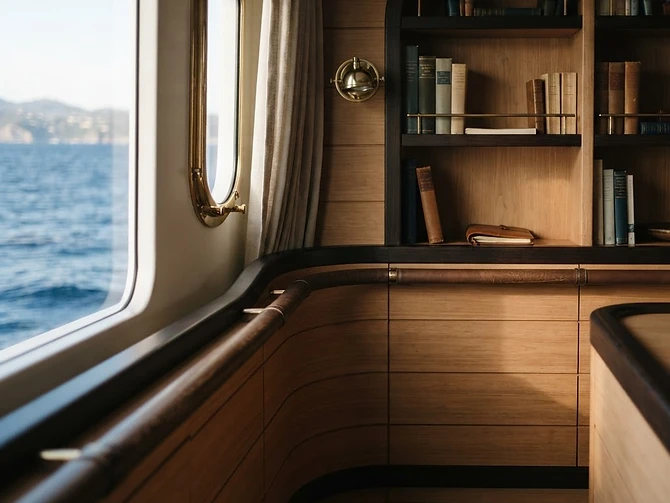
To sit at the mahogany desk, custom-milled to accommodate the subtle pitch and roll of a vessel at anchor, is to understand the house-afloat philosophy. The shelves, lined with leather-bound volumes that have made the crossing from the Caribbean to the Bonifacio Strait, are fitted with fiddles—brass-railed guards that prevent a prized first edition from becoming a projectile in a heavy following sea. The room is essentially a micro-villa, a structured, static environment grafted onto a dynamic, moving chassis. The architect, tasked with balancing the heavy joinery against the weight distribution of the yacht, has created a space where the ceiling lines follow the curvature of the superstructure, echoing the sleek, exterior lines of the yacht’s profile.
I recall the owner sitting here during a particularly restless transit between Sardinia and Corsica. We were tracking a low-pressure system off the coast, the glass of water on the side table tracing microscopic, concentric circles as the yacht hummed through the swell. He was reading, indifferent to the movement, his focus entirely contained within the four walls of his maritime sanctuary. In this environment, the library provides a necessary verticality to a life spent horizontally across the waves. It is a place of absolute stillness in a life defined by constant, restless travel.
The Final Watch
As the afternoon light begins to bleed into the deep, bruised purple of a coming squall, the study becomes a refuge. The transition from the deck—where the wind catches at your collar and the salt stings the eyes—to the silence of the library is total. You close the heavy, watertight-sealed door, and the world of the Lavezzi granite falls away, replaced by the cool, tactile reality of paper and ink. Even as the vessel begins her slow, weighted transition toward a new anchorage, the library remains, a silent, static archive held fast in the heart of the storm.






