
The sound of the Helgeland coast is not merely the slap of water against a hull; it is the percussive, crystalline ticking of glacial melt calving from the distant Svartisen ice cap, carried on a wind that holds no warmth. Aboard the M/Y Vertigo, anchored in the sheltered lee of a low-lying granite islet near Nesna, the transition from the exposed, wind-whipped flybridge to the lower-level wellness pavilion is a fundamental shift in one's equilibrium. Here, the architectural discipline of the ship merges with the primal, unforgiving geography of the North Atlantic. The steel skin of the vessel, which serves as a necessary shield against the subarctic bite, gives way to a threshold where the yacht ceases to function merely as a platform for transit, and begins to read as a grounded, living home.
The Architecture of Submerged Silence
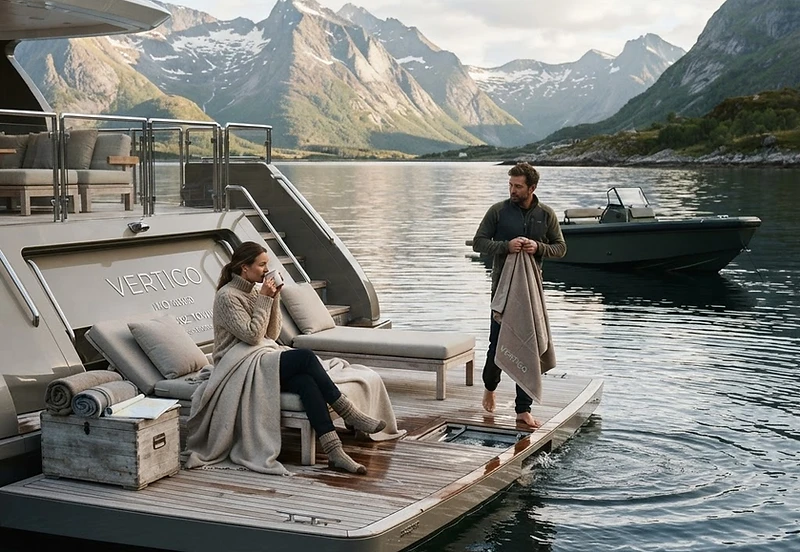
Stepping into the beach club, the first sensory impression is the sudden, complete absence of vibration. The engine room bulkhead is isolated with heavy acoustic dampening, leaving only the muffled, rhythmic pulse of the current against the transom. Designed with the intentionality of a remote Scandinavian hunting lodge, the space utilizes pale, brushed-oak joinery and basalt-toned slate to mirror the jagged, dark shoreline visible just beyond the glass. The naval architects have treated this interior volume as a floating villa, where the massive, hydraulically-actuated stern platform unfolds to act as a private, water-level jetty. Watching the sea level rise and fall against the teak planks of this terrace, one feels the immediate, physical tether between the ship’s complex engineering and the ancient, predictable rhythm of the Norwegian tides. This is architectural mimicry of the highest order; the room feels physically anchored to the seabed, even as the vessel swings gently on its chain.
Thermal Rituals at the Edge of the Fjord
The wellness pavilion is structured around the inherent tension between the near-freezing fjord water and the meticulously calibrated heat of the dry steam room. After a morning spent carefully navigating the narrow, basalt-walled channels winding south towards the port of Sandnessjøen, we find the ritual is simple, restorative, and vital. We pull the heavy, brass-fitted lever to exit the beach club directly into the ink-coloured water of the fjord. The shock is immediate—a profound, physical reset that strips away the residual fatigue of the morning’s passage. Returning to the dry heat of the cedar-clad cabin, wrapped in heavy, unbleached linens, the exterior world appears through the floor-to-ceiling glass as a rotating gallery of shifting light, granite scree, and towering, mist-shrouded peaks. It is a silent dialogue between artificial shelter and the wild environment, a place where the vessel’s design acknowledges that, in these northern latitudes, true comfort is found in the deliberate, sharp contrast of the elements.
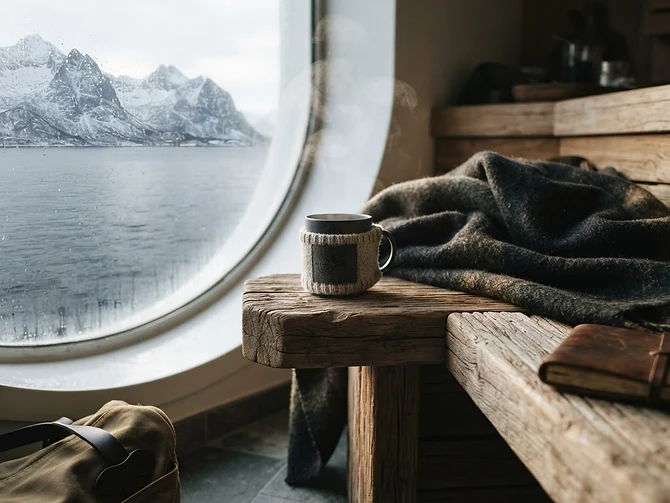
As the light fails and the northern horizon turns a bruised, electric purple, the yacht seems to dissolve into the landscape, its interior glow reflecting softly off the glassy water. I sit with a ceramic mug of dark-roast coffee, the heat radiating steadily against my palms; it is a small, tangible anchor in the immense, darkening expanse of the Norwegian Sea, a moment of profound stasis before we weigh anchor for the next passage.






