
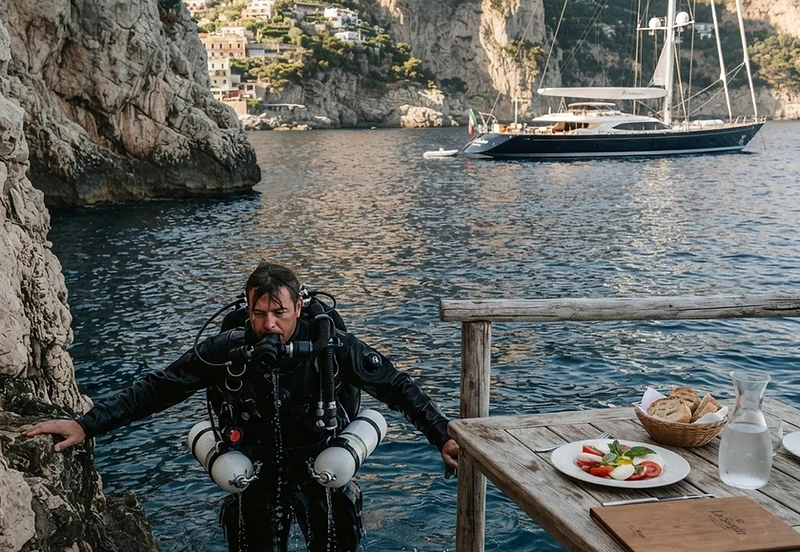
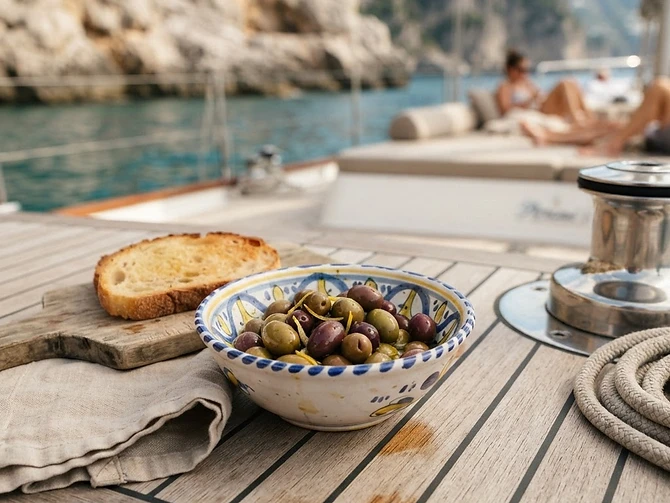
The morning light over the Tyrrhenian Sea possesses a specific, thin clarity that only reveals itself when you are anchored at dawn off the southern cliffs of Capri. From the aft deck of our vessel, a 45-metre Perini Navi, the I Faraglioni formations loomed like serrated obsidian shards against a sky turning the colour of pale apricot. There is a distinct, rhythmic hum to a yacht at rest in these waters; the gentle slap of a light swell against the hull, the distant, muffled clatter of a fisherman’s crate being moved in a nearby gozzo, and the insistent call of the gulls. We were waiting for the slack tide, the window of silence before the day’s charter traffic would churn the surface into a chaotic mosaic of wake and sun-glare.
The Weight of the Deep
Stepping off the stern platform with a rebreather is an exercise in stripping away the friction of modern life. Unlike the noisy, bubble-choked descent of open-circuit gear, the closed-circuit system allows one to move through the water column as if a ghost of the hull itself. As I descended toward the submerged limestone shelves of the Punta Carena, the world above—the teak decking, the polished brass, the quiet hum of the galley—faded into a muffled memory. Here, in the deep, the geology of the Amalfi Coast is revealed as a series of vertical corridors, carved by currents that have been shaping these cliffs for millennia. I hovered at forty metres, watching a solitary dusky grouper drift through the shadows of a cavern. The rebreather’s quiet intake, a soft, mechanical respiration, became my only tether to the surface.
The Shore’s Salted Alchemy
Returning to the yacht felt like crossing a threshold between two disparate planes. The salt on my lips was soon replaced by the sharp, metallic tang of an espresso as we watched the sun climb higher. Later, we took the tender into the narrow inlets near Nerano. We had arrived not for the spectacle of the beach clubs, but for the table at Lo Scoglio, where the rhythm of the meal is dictated entirely by what the boats brought in before noon. The chef presented a dish of spaghetti alla nerano, a study in local restraint: al dente pasta coated in the emulsified sweetness of fried zucchine, kissed with local caciocavallo cheese and a hint of fresh basil plucked from the terraced gardens above the sea. It was a meal that tasted of the soil and the salt, a perfect, grounded counterpoint to the weightlessness of the morning’s descent.
As the afternoon wore on, we moved the vessel to a sheltered anchorage tucked into the lee of a hidden cove. The crew began the process of polishing the brightwork, their movements as precise and repetitive as the tides. Sitting on the foredeck with a glass of local Falanghina, watching the shadows lengthen across the limestone cliffs of Capri, the day felt complete. There was no need for grand gestures or noise. Just the wind through the rigging, the cooling stone beneath our feet, and the knowledge that tomorrow, the sea would offer a new geometry of light and depth, waiting to be explored.






