
The Quiet Approach
The transition from the manicured docks of Serenity Marina in Sanya to the raw, unmapped shallows off the Wenchang coast is more than a change in latitude; it is a recalibration of the senses. We steered our 42-meter Nautor's Swan through the morning mist, the carbon-fiber mast cutting a sharp line against the pale, diffused light of the South China Sea. There is a distinct discipline required when navigating the eastern Hainan shelf—the charts are fickle, and the coral heads, though mapped, demand a constant, watchful eye from the flybridge. As the coastline receded into a blur of verdant hills, the engine hum faded, replaced by the rhythmic slap of water against the hull. We were alone, the vast, cobalt expanse of the channel our only companion. This is the true privilege of the cruising life: the ability to command one's own horizon, detached from the shore-bound world, sustained by the integrity of the vessel beneath our feet.
The Galley and the Coast
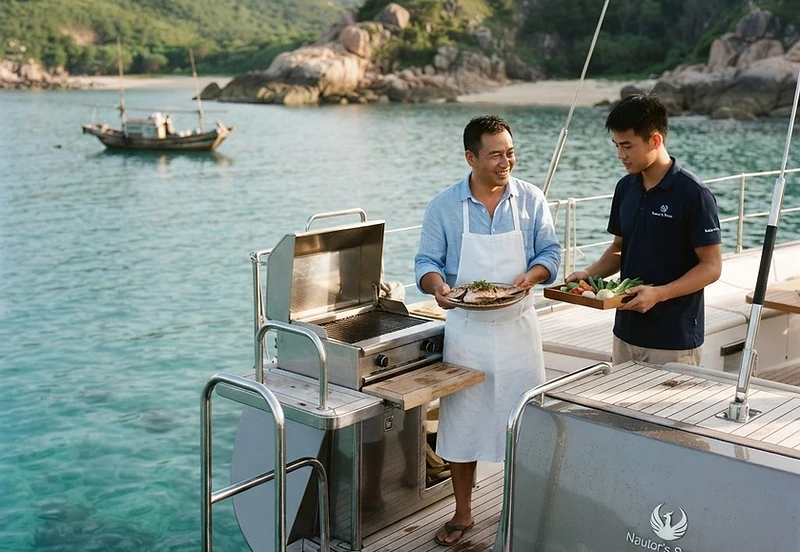
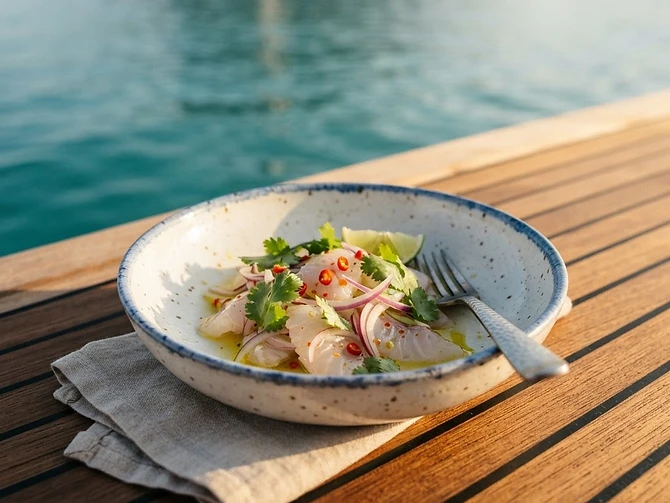
Life aboard a vessel of this caliber is defined by the quality of the stillness one can cultivate. By midday, we had dropped anchor in the lee of a protected sandbar, the water turning a translucent, impossible turquoise. This is where the maritime experience intersects with the local terroir. Our chef, having spent the previous dawn scouring the small wet markets of Longlou, returned with a basket of vibrant, local produce: ginger root, pungent bird’s eye chilies, and a haul of freshly caught hong mei yu—red snapper—landed just hours prior. The kitchen, a study in ergonomic stainless efficiency, became the heart of our solitude. The snapper was steamed gently with fermented black beans and slivers of ginger, a dish that tasted entirely of the immediate geography. There is a profound luxury in this—the ability to draw one’s sustenance directly from the surrounding waters, prepared with the exacting standards of a master of the galley, yet served on a teak aft deck with nothing but the horizon for a witness. It is a meal that bridges the gap between the nomadic nature of our journey and the soil of the Hainan peninsula.
Anchored in the Elements
As the afternoon wore on, the wind died to a whisper, and the yacht swung lazily on her chain, a solitary sentinel in an endless blue cathedral. We spent hours in the tender, exploring the fringes of the mangroves that hug the Wenchang shoreline, where the air smells of brine and crushed sea grapes. There is a specific humility in reaching such a place by water—the realization that despite our modern navigation systems, we are merely guests in this volatile, shifting environment. We returned to the mothership as the sun began its final descent, the sky bruising into shades of deep violet and burnt orange. We sat on the sundeck, the silence absolute, the only movement the slight vibration of the deck as the tide turned against the anchor. In these moments, the yacht is not just a platform for transit; she is a vessel for reflection, a bridge between the precision of the shipyard’s build and the infinite, chaotic beauty of the open sea. We did not speak; we simply watched the stars emerge, reflected in the dark, glass-still water below, the anchor chain ticking softly against the hawsepipe—the only pulse in a world of profound, salt-scented peace.






