
The Descent into Stillness
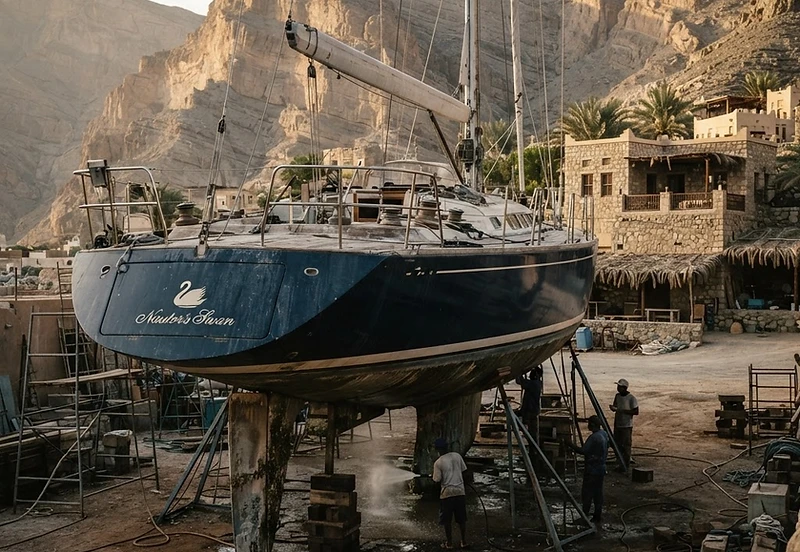
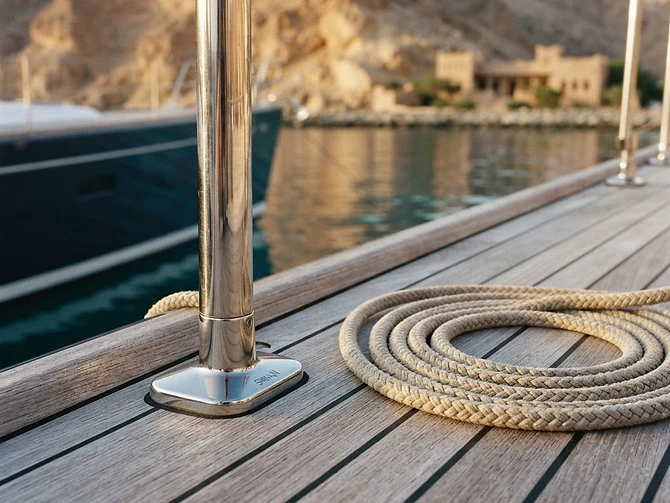
The Musandam Peninsula is a landscape of ancient geological violence, where the Hajar Mountains descend into the Arabian Gulf with unforgiving steepness. Navigating the deep-water fjords of Khor ash Sham, one feels a sudden compression of the world; the scale of the granite cliffs dwarfs even the most imposing vessel. We brought our Nautor’s Swan 80 to its final anchorage beneath the shadow of these limestone monoliths as the October heat began its slow, seasonal retreat. Laying up a boat of this pedigree is a ritual of attrition and respect. We spent the morning methodically stripping the teak decks, removing the UV-sensitive cushions, and flushing the desalination system with fresh water until the pumps hummed a clean, hollow note. There is an inherent dignity in this task—a transition from the nomadic life of the open sea to the static posture of the lay-up. Each coil of running rigging and each tensioned mooring line serves as a quiet acknowledgment that the season’s miles have been hard-won and properly earned.
Architecture at the Water’s Edge
While the crew secured the Swan, my attention was held by the shoreline. Perched on a jagged outcrop overlooking the cove sits a private residence, a striking exercise in desert modernism designed to disappear into the cliffside. The structure—a precise interplay of white-rendered masonry, weathered desert stone, and expansive, floor-to-ceiling glass—operates as a vessel of a different sort, anchored firmly to the rock. The architects have cleverly employed cantilevered concrete slabs that mirror the natural stratification of the surrounding geology. The house opens entirely to the sea; its oversized glass panels slide effortlessly into concealed voids, inviting the salt air to circulate through the cool, limestone-floored living spaces. From the terrace, a private timber jetty extends into the turquoise shallows, providing a secure berth for a sleek, carbon-fibre tender. Seeing our Swan at anchor in the basin below, framed by the villa’s sharp, clean lines, creates a conversation between two distinct philosophies of shelter: one engineered to conquer the horizon, the other designed to witness it.
The Ritual of the Closing Log
There is a singular, introspective melancholy to the closing of a logbook. On our final evening, we were hosted on the villa’s terrace. We ate simply—grilled Omani lobster caught earlier that morning by local fishermen, seasoned with nothing more than fresh lime and sea salt, served on heavy, hand-thrown ceramic plates that carried a satisfying, earthy weight. Looking down at the Swan, now enveloped in her custom protective covers, the yacht appeared as a sculptural form, a vessel in absolute repose. Our host, whose family has inhabited this specific coastal margin for generations, observed that the sea here demands a reciprocal patience; you cannot rush the water, and you certainly cannot rush the stillness. As the sun slipped behind the jagged spine of the mountains, casting long, ochre shadows across the villa’s minimalist facade and the glass-still surface of the fjord, the atmosphere tightened into a profound silence. The only sounds remaining were the rhythmic, soft slap of the tide against the jetty piles and the faint, cooling draft of air moving through the high, limestone crags—a final, steady pulse before the long, dormant winter.






