
The Hinged Horizon
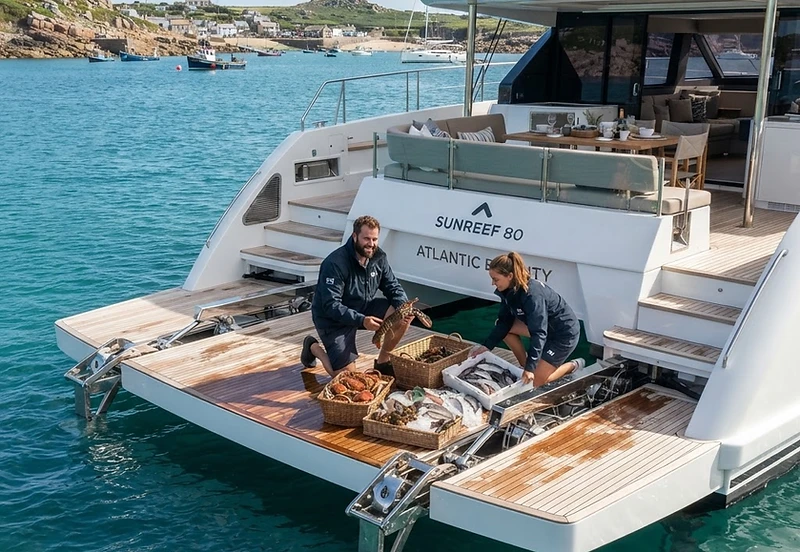
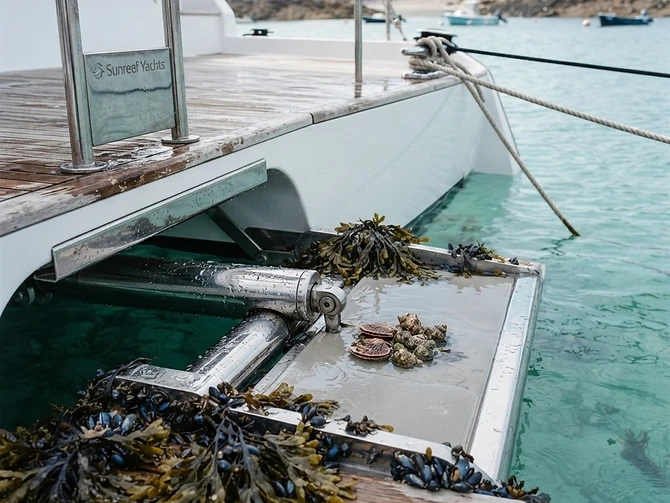
The dawn light off the Isles of Scilly is not soft; it is sharp, crystalline, and reveals a landscape where the granite of the coast seems to have been carved by the Atlantic’s own hand. Moored in the protected embrace of St. Mary’s Pool, our Sunreef 80 catamaran sits with a stillness that belies the crossing we made from Penzance. The genius of the modern power catamaran is not merely in its volume, but in the kinetic intelligence of its aft architecture. As we lower the hydraulic platform, the transom unfurls like an accordion, dipping its toes into the frigid, clear water. This is no longer a boat; it is a floating island, an interface between the mechanical precision of naval engineering and the raw, salt-stunted wildness of the archipelago. We watch the tide pull back from the rocks of St. Mary’s, revealing the slick, dark weed that marks the boundary between land and deep water, a transition our own vessel mirrors as it settles into the rhythm of the swell.
Culinary Rhythms of the Shelf
Life aboard finds its anchor not in the climate-controlled salon, but on this teak-decked stage as the tide begins to turn. Our chef, having spent the early hours at the quay in Hugh Town, returns with a haul that speaks of the cold-water bounty specific to these northern latitudes. There are spider crabs—their shells heavy and dark, covered in the minute barnacles of the deep—and a crate of hand-dived scallops, still glistening with the persistent, cold brine of the seabed. We eschew the formality of the interior dining table for the platform, the water swirling just inches below our bare feet. The ritual is ancient, yet executed with modern intent: the crabs are boiled in a seawater reduction seasoned with wild rock samphire foraged from the nearby headland of Peninnis Head, and the scallops are seared swiftly over a small, portable charcoal hearth. We finish the meal with a drizzle of dense, floral honey from a family-run farm on Tresco, the sweetness cutting through the pervasive salinity of the morning’s catch. It is a meal defined by immediate proximity; there is no distance between the source and the plate, only the few feet of water between our transom and the seafloor.
The Granite Silence
By mid-afternoon, the tender is stowed and the beach club becomes a sanctuary, a sheltered extension of the catamaran’s wide, balanced hull. The sheer scale of the craft allows us to sit comfortably in the lee of the island, observing the white-capped Atlantic rollers that break in chaotic rhythm against the outer shoals of the Western Rocks. There is a specific cadence to the day here: the gentle, percussive slap of the tide against the fiberglass, the distant, mournful cry of a fulmar, and the rhythmic, slight tension of the mooring lines. We pass the hours with books and binoculars, scanning the horizon for the next change in the heavy, Atlantic-born cloud banks, leaning into the profound silence that only deep, open water can provide. When the sun finally dips behind the jagged, brooding silhouette of Samson, the platform is raised once more, its hydraulic seals locking with a soft, final thud that echoes against the stillness. We retreat to the upper deck, watching the harbour lights of Hugh Town twinkle against the darkening water, perfectly content within our self-contained world of glass and steel, suspended between the stars and the restless, shifting granite below.






