
The Gravity of the Western Lee
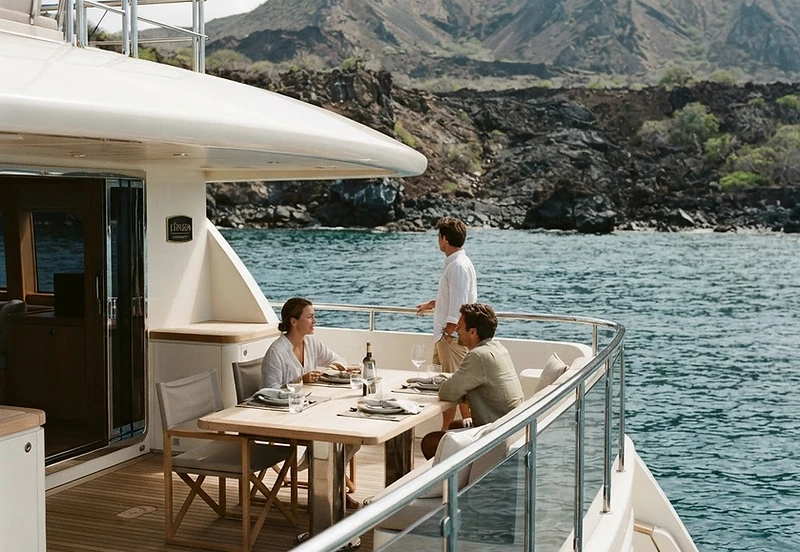
To drop anchor off the coast of Fernandina is to subject one’s vessel to the absolute, unvarnished gravity of the Galápagos. The sea here does not behave like the manicured basins of the Mediterranean or the predictable corridors of the Caribbean; it is dark, deep, and perpetually stirred by the nutrient-rich, cold surge of the Humboldt Current. As our motor yacht—a custom build with the dampened, hushed engineering that only a Lürssen can afford—swung against the weight of the iron, the silence was total, broken only by the distant, rhythmic bark of a sea lion colony marking their territory on the black, unforgiving basalt shores. This is a landscape that demands a structural humility, a quality that informs every decision aboard, from the way the bridge monitors the shifting, volcanic topography on the charts to the way the crew calibrates the deck for the afternoon’s repose. The yacht is merely a guest here, a transient guest suspended between the abyssal depths and the arid, prehistoric silence of the islands.
The Galley’s Dialogue with the Archipelago
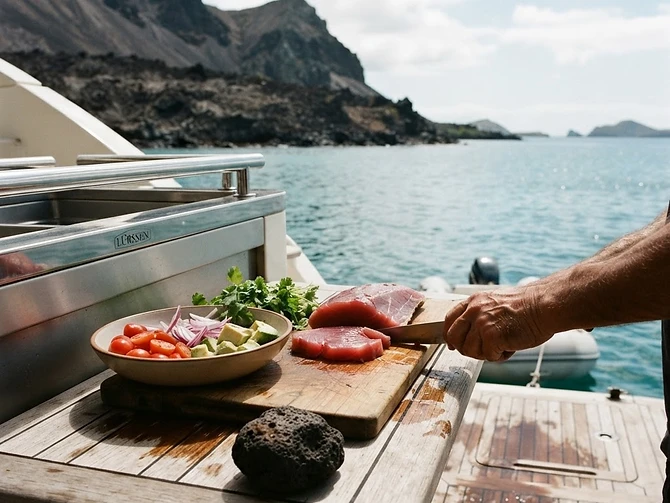
Lunch in these remote reaches is an exercise in restraint and geological provenance. Because the archipelago remains a strictly protected sanctuary, our chef works in a quiet, respectful dialogue with the local fishermen of Puerto Villamil, who navigate these waters with ancestral intuition. This morning, a small panga had sidled up to our hull at daybreak, delivering a crate of canchalagua—a local sea snail prized for its briny, firm texture—alongside a catch of vibrant red rockfish, pulled from the reef on single lines. There is no pretense in a meal prepared on the aft deck in such proximity to the Equator. We served the rockfish as a simple ceviche, cured not by the passage of time, but by the immediate, sharp acidic bite of local Galápagos lime, accompanied by slivered red onion and cilantro sourced from the high-altitude farms of Santa Cruz. The canchalagua were charred lightly over a small, portable hibachi, a technique that coaxed out a mineral sweetness that mirrors the obsidian landscape dominating the horizon. It is a meal that tastes of the very cold, swirling currents that sustain the archipelago’s singular biodiversity.
The Ritual of the Open Water
Dining on the aft deck, under an expansive, cloud-dappled sky that feels impossibly close, serves as a necessary punctuation to the voyage. The table was dressed with nothing more than heavy linen and the raw, volcanic aesthetic of the region, allowing the sight of the craggy, unyielding coastline to command the table's focus. We sat in long, comfortable stretches of silence, watching a pair of blue-footed boobies dive with mechanical, razor-sharp precision into the water just off our stern, their entries into the sea a series of percussive splashes that mirrored the clink of ice against crystal. In this corner of the world, where the modern, gleaming yachting infrastructure of marinas and super-fuel docks simply does not exist, the true luxury is the rare permission to linger. We acknowledged that the tide was not demanding our departure and that the afternoon held no higher purpose than the patient appreciation of the salt-thickened air, the intense, equatorial sun, and the elongated, indigo shadow of the Fernandina volcano as it began its slow, inevitable slide across the teak deck.






