

The Anchor’s Breath
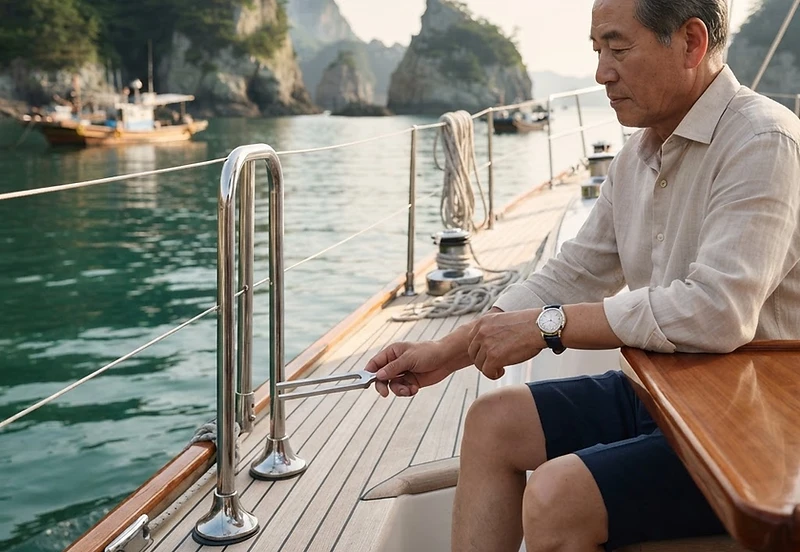
The hook is down in the lee of Hansan-do, where the Hallyeohaesang National Park holds the stillness of the Korea Strait like a guarded secret. There is a specific gravity to the air here, a composite of salt, the sharp, balsamic drift of pine resin from the craggy headlands, and the cold, damp scent of a receding tide. Aboard our Royal Huisman, the motion is near-absent—a rhythmic, subtle oscillation that confirms we are cradled by the archipelago. As the sun dips behind the serrated, violet silhouette of the mainland, the interior deck lights are extinguished, and the saloon settles into a pool of amber shadows, leaving only the soft, percussive slap of water against the aluminium hull to define our coordinates in the world.
Mechanical Precision in the Saloon
Life aboard a vessel of this pedigree is a sequence of rigorous calibrations, a persistent negotiation between the yacht’s interconnected systems and the unpredictable caprice of the sea. It is during these hours of deliberate, quiet repose—when the sails are furled and the machinery is dormant—that one feels the velocity of time most acutely. Resting on the low mahogany side table is a minute repeater, a piece of horological architecture that commands a different register of attention. In the absolute, velvet dark of the saloon, I engage the slide on the case flank. The first note—a low, resonant chime for the hour—sounds profound, vibrating with a tonal depth that would be impossible in a room of static brick or plaster. It is enriched, perhaps, by the acoustic density of the mahogany joinery and the sheer, fathomless proximity of the ocean’s depth beneath the keel. The subsequent double strikes for the quarters ripple through the cabin, crisp, crystalline, and defiant. It is a sound that feels entirely indigenous to the nautical environment; it does not contend with the wind or the current, but rather measures them, providing a crystalline structure to the vast, open-ended nature of our passage.
The Weight of the Watch
To listen to such a mechanism at sea is to acknowledge the precise intersection of human artifice and natural rhythm. While the crew moves softly in the galley to prepare a meal of locally sourced meongge—sea pineapple—served with short-grain steamed rice and a crisp perilla leaf wrap, I watch the luminous dial trace the passing minutes. There is no urgency in the chime, only a methodical articulation of our position within the night. In the context of the Hallyeohaesang waters, where the history of these islands is permanently etched by the naval tactics of Admiral Yi Sun-sin, this temporal fidelity feels like a continuation of a long, local tradition of rigorous navigation. The watch functions as a secondary compass, a tool that does not point north, but points inward, grounding the observer in the singular reality of the present moment. In the galley, the smell of toasted sesame oil begins to permeate the space, grounding the ethereal chime in the warm, domestic reality of life aboard.
As the final chime fades into the low-frequency hum of the anchorage, the silence that follows feels amplified, more substantive. The yacht sits motionless, a sturdy island of teak and steel suspended in the black expanse of the South Korean coastline. Out on deck, the anchor light casts a flickering, golden needle of illumination across the obsidian water, a solitary link between the cabin’s mechanical heartbeat and the slow, ancient, and indifferent pulse of the sea.






