
The Quiet Turn of the Chain
The dawn watch is a matter of acoustics. Before the sun has fully crested the rugged, parched hills of St-Barthélemy, the only sound on the aft deck of our 45-meter motor yacht is the rhythmic, hollow slap of trade winds against the hull and the distant, singular cry of a brown booby circling the anchorage at Anse de Colombier. We are tucked into a profound natural amphitheater, the water a translucent, cooling turquoise that holds the light long after the stars have faded. There is a specific stillness that exists only when a vessel is securely moored in these coral-fringed coves; it is a weightless suspension, a bridge between the deep, dark Atlantic and the protected, crystalline sanctuary of the bay. Under the feet, the deck vibrates slightly, not with the hum of the engine, but with the subtle, shifting physics of a vessel at rest, the anchor chain occasionally groaning against the rocky seabed as the tide pulses through the channel.
From Gustavia to the Galley
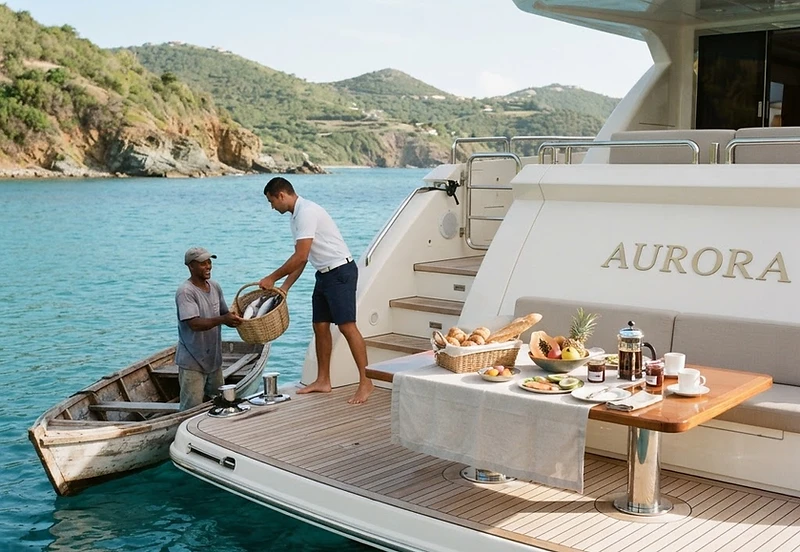
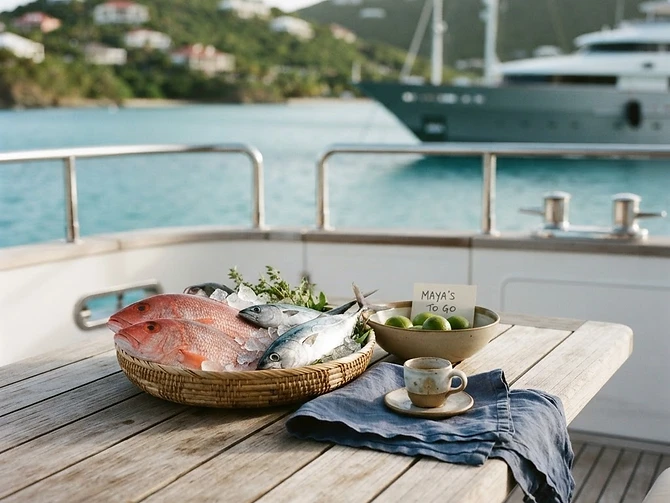
By seven, the tender is already cutting through the glassy water toward the harbor of Gustavia. For the crew, this is the essential ritual of the morning: navigating the narrow channel to greet the local fishermen who arrive with the day’s haul. Today, the catch is modest but profoundly evocative—spiny lobster, freshly pried from the submerged limestone crevices of the northern shallows, and a prime selection of wahoo, its silver skin still iridescent and taut in the pre-dawn glow. The chef’s approach is strictly elemental. Back on board, the galley begins to hum with the quiet precision of a well-oiled machine. The mission is to transform the raw, briny essence of the sea into a meal that reflects the island’s terroir. Local ingredients are the anchor here; we use the sharp, biting acidity of regional limes to cure the wahoo, pairing it with a vibrant, hand-chopped relish of Scotch bonnet peppers, sea salt, and small, sweet tomatoes gathered from a smallholder near Lorient.
The Ritual of the Table
Dining at sea is an exercise in perspective and scale. As the morning heat begins to climb, the crew sets the table on the bridge deck, an exposed, sweeping space that catches every stray breeze wandering off the Saint-Barth highlands. The table is laid with austere simplicity—coarse linen, heavy-bottomed glass, and a central bowl of tropical fruit: soursop and starfruit, their floral, heady scents grounding the saline air. We eat the wahoo ceviche, the creeping heat of the Scotch bonnets tempered by the honeyed sweetness of the local fruit, alongside a warm, crusty baguette sourced from the ovens at Maya’s To Go. The meal is not a grand display, but a genuine reflection of our geography; the flavors are sharp, bright, and immediate, echoing the jagged, sun-bleached coastline we look out upon. It is a reminder that in these waters, the most sophisticated luxury is the proximity to the source and the privilege of time. As the sun rises higher, the yacht swings slightly on its anchor, the bow adjusting to the shifting current, and the day dissolves into the infinite, shimmering blue of the Caribbean horizon, a quiet promise of miles yet to sail.
The anchor remains hold-fast, a steel testament to the patience required to inhabit such a space. Below the swim platform, the water is so clear that the shadow of the hull is cast perfectly onto the white sand below, a dark, graceful silhouette that drifts with the current. With a final sip of coffee, the silence returns, leaving us to watch the sea, simply waiting for the wind to dictate the next heading.






