
The Anatomy of an Inland Winter
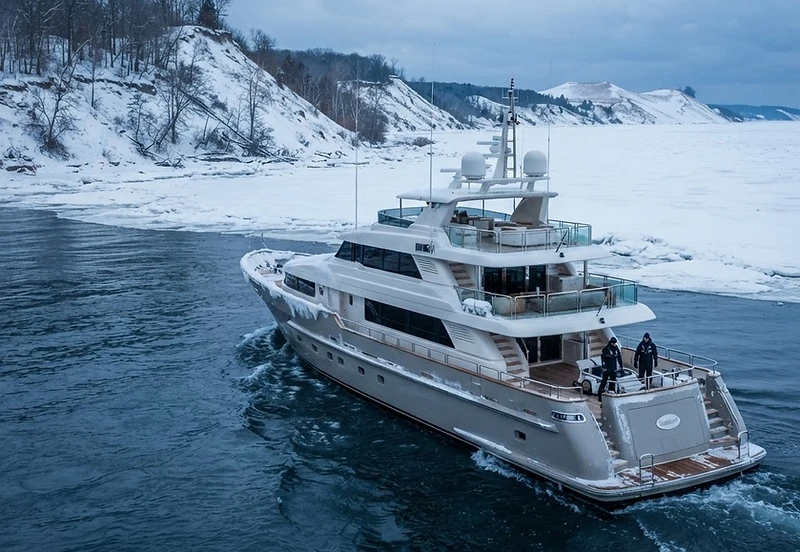
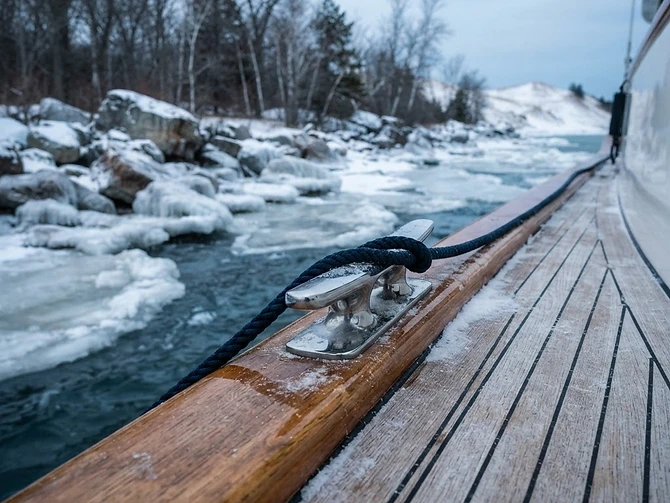
To view the Great Lakes in December is to witness an architecture of extremes. The water, a bruised, kinetic indigo, pushes against the silent, snow-dusted ramparts of the Sleeping Bear Dunes. On the deck of a 45-meter Feadship, the air is sharp enough to cut, a sensory reminder that true exploration requires more than a steady hand on the helm; it demands a deep respect for the volatile, freshwater rhythm of Lake Michigan. As we stood on the aft deck, the teak vibrating faintly under the rhythmic thrum of the stabilizers, the sheer scale of the coastline felt more like a monumental sculpture than a shoreline. The vessel, a marvel of precise naval architecture, moved through the steep, short-period chop with a stillness that defied the biting northwesterly wind, her hull geometry slicing through the gray swell as if the lake were merely a mirror of her own resolve.
Refuge in the Lee of the Shore
By dusk, the decision was made to drop anchor in the lee of South Manitou Island. There is a particular intimacy to life aboard when the world outside has retreated into a monochromatic palette of ice and dune grass. Inside, the interior design—a masterclass in restrained modernism—mirrored the stark exterior. The woodwork, warm cherry and brushed nickel, felt like an extension of the boreal forest beyond the glass. We sat in the main salon, the low light catching the grain of the cabinetry, while the chef prepared a simple, hearth-inspired meal of pan-seared lake whitefish, the faint, earthy scent of cedar smoke drifting from the galley. It is here that the concept of the superyacht as a house afloat becomes absolute; you are not merely observing the landscape, but dwelling within a mobile piece of architecture that anchors you to the very pulse of the wilderness. Through the floor-to-ceiling glass, the old lighthouse on the island blinked in a rhythmic, ancient cadence, a steady, mechanical beacon in the gathering dark.
The Geometry of a Frozen Horizon
Morning brought a silence so profound it seemed to press against the hull. The lake had smoothed into a sheet of hammered pewter, and the dunes were etched with new, fine lines of crystalline frost. We took the tender—a custom Hinckley—to the shoreline, cutting through the stillness toward a private slip tucked into a cove protected by limestone bluffs. Walking the perimeter of a nearby lakeside residence, a structure of cantilevered glass and weathered cedar that seemed to bleed into the cliffside, I was struck by the visual dialogue between the vessel and the dwelling. Both the yacht and the residence were expressions of a desire to inhabit the edge of the world without disturbing its equilibrium. As we pulled away, heading back toward the Feadship waiting in the distance, the low sunlight broke through the heavy cloud cover, casting long, geometric shadows across the ice-fringed water. It was a fleeting, perfect moment of alignment: the cold, the vessel, and the architecture of the shore holding their collective breath before the winter truly took hold.






