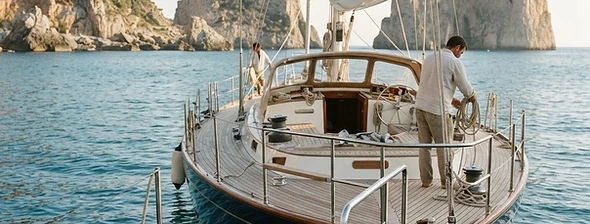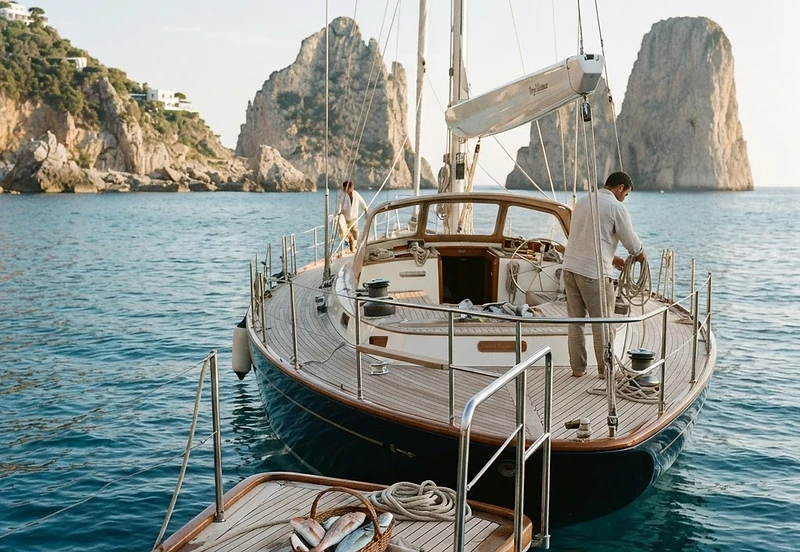
The morning off the southern coast of Capri does not break with the harsh clarity of a Mediterranean sun. Instead, it arrives in gradients of bruised violet and liquid pearl, folding around the towering crags of the Faraglioni. Aboard our 45-metre Royal Huisman, the only sensation is the gentle, hypnotic oscillation of the hull against the swell—a rhythmic reminder that we are held not by land, but by the deep, indigo cradle of the Tyrrhenian Sea. As the mist lifts, the island’s sheer limestone bastions appear like sentinels, silent and immovable, marking our separation from the frenetic pace of the mainland.
The Geometry of the Morning Watch
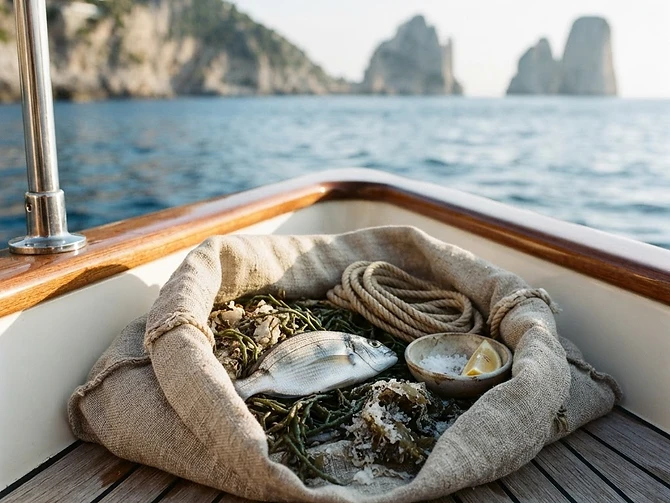
Life aboard in these sequestered hours is defined by a deliberate, almost ritualistic stillness. There is no urgency in the navigation here; the anchor is set in the soft, sandy pockets near the Scoglio del Monacone, a position that grants us an unimpeded view of the sea’s pulse. As the crew readies the tenders for the short run toward the Marina Piccola, the galley air begins to sharpen with the scent of the morning’s procurement. Our chef, returning from the early markets of Anacapri, brings with him the true character of the island: limoni di Sorrento, their skins thick and fragrant with oil, and a haul of fresh alici caught in the pre-dawn darkness by the local fishermen of the Marina Grande.
We prepare the morning repast with a reverence for these ingredients that feels inherently tied to the sea. The alici are cured simply with sea salt and the sharp, bright acid of the local citrus, served alongside crusty bread rubbed with a garlic clove and drizzled with pungent, emerald olive oil from the groves of the Sorrento Peninsula. It is a meal that tastes of the geology beneath our keel—a dialogue between the harsh, mineral-rich landscape of the coast and the brine of the Mediterranean.
The Shoreline Communion
By mid-morning, the isolation remains, but the spirit of the place invites a different kind of exploration. We steer the tender toward the hidden coves near the Grotta Bianca, where the water takes on an impossible, electric transparency. Stepping ashore to the rough stone of the coast, we make our way toward the weathered tables of Da Paolino, tucked away under a sprawling canopy of lemon trees. The environment here is an extension of the yachting experience: open-air, defined by the sun and the shade, and rooted in the seasonal bounty of the island. We dine on scialatielli ai frutti di mare, the pasta catching the briny essence of clams and mussels that mirror the depths we have been charting all week.
Returning to the anchorage as the light begins to amber, the boat seems to have transformed into a solitary, floating sanctuary. The yacht is our vessel, our home, and our only neighbour in the vast, shifting geometry of the coast. To be here, suspended between the jagged, ancient rock of Capri and the infinite horizon of the Tyrrhenian, is to understand that the true luxury of the sea is not the destination, but the quiet, sovereign space one creates amidst it.
As the stars begin to pierce the velvet dark, the lights of the distant settlements on the Amalfi Coast flicker like embers. We stand on the aft deck, the teak cooling beneath our feet, and listen to the water lapping against the rudder. The Faraglioni loom as dark, velvet shapes against the sky, their presence a grounding, eternal weight that anchors our drift, leaving us in the profound, enviable silence of the middle watch.