
The Geometry of the Denmark Strait
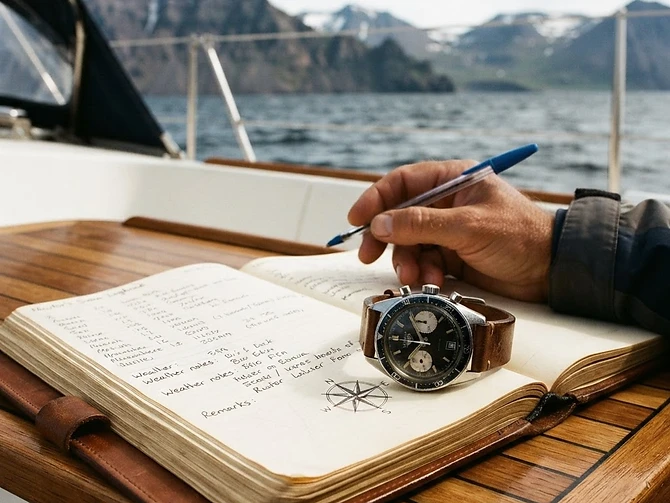
The dawn in the Westfjords is not a sudden emergence of light, but a tectonic shift in the density of the air. Aboard the 42-meter Nautor's Swan, the steel hull conducts the low-frequency thrum of the Denmark Strait’s frigid currents, a vibration that travels upward through the mahogany soles of the saloon to the marrow of the bone. On my wrist, the 1964 Heuer Carrera functions as a silent anchor, its dial the color of oxidized cream and its tachymeter scale softened by sixty years of exposure to salt-heavy maritime winds. At this latitude, where the horizon dissolves into an indecipherable blur of grey sea and slate-colored sky, the chronograph ceases to be a mere timepiece. It becomes an extension of the navigation table, a mechanical heartbeat that provides a rhythmic human scale to the vast, indifferent topography of the Icelandic north.
The Ledger of the Tides
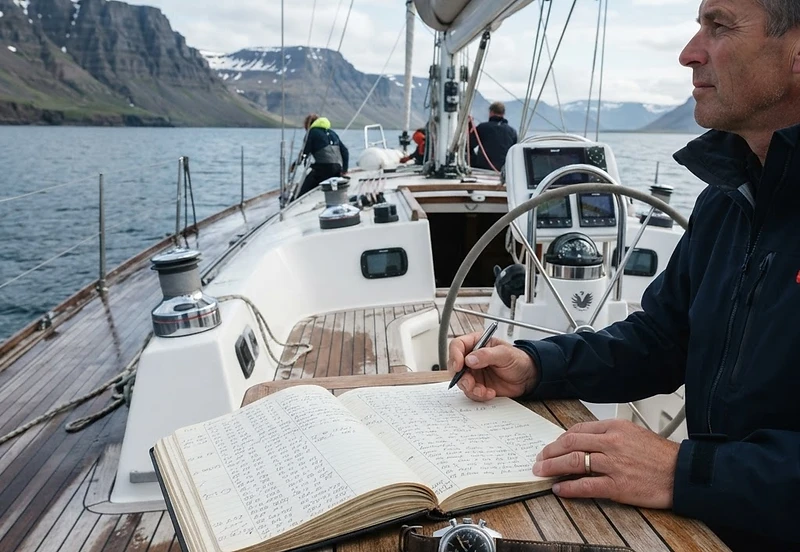
Stepping out onto the aft deck, the cold is immediate—a sharp, crystalline intrusion that strips away the lethargy of the passage. We are maneuvering toward the deep, shadowed entrance of Ísafjörður, where basalt cliffs rise like jagged, prehistoric sentinels from the dark, brooding water. I open the vessel's logbook, a heavy, leather-bound volume that carries the weight of a decade, documenting everything from the humid, turquoise shallows of the Caribbean to the severe, glaciated reaches of the Arctic Circle. The fountain pen’s nib catches on the textured paper as I write: 04:30 GMT, 66 degrees North, wind veering from the northeast. The act is a deliberate ceremony of stewardship. Beside the precise entries of latitude, longitude, and barometric pressure, I record the chronograph’s synchronicity with our transit through the fjord’s mouth. It is a dual recording of the physical world: one written in ink, the other held in the tension of a balance spring.
Anchored in the Silence of Djúpavík
By midday, the Nautor's Swan lies inert, perfectly secured in the lee of a sheltered cove near the rusted, skeletal remains of the Djúpavík herring factory. The crew has long since dispersed to the rigging, leaving the yacht in a profound, hallowed silence punctuated only by the distant, rhythmic fall of meltwater cascading down the valley walls. I sit in the cockpit with a cup of black coffee, the steam vanishing instantly into the crisp, high-latitude air. The Heuer lies on the teak table, its caseback bearing the faint, hand-etched initials of a former owner—perhaps a man who navigated the North Sea gales of a different century. The provenance of the watch is etched in these microscopic, irregular scars, mirroring the logged history of the yacht itself, which carries its own physical memory in the form of deep-sea brine, the subtle distress of the brass fittings, and the lingering, comforting scent of spruce and old varnish deep within the lockers. We are not merely passing through these waters; we are participating in an ongoing lineage of observation. As the sun begins to retreat, casting the basalt in impossible, bruising shades of violet, the watch and the logbook remain—two weathered, silent witnesses to the profound, aching stillness of the Icelandic summer. There is no grand conclusion here, only the steady, persistent rhythm of the seconds ticking away against the backdrop of an ancient, unyielding shore.






