

The Geometry of the Andaman
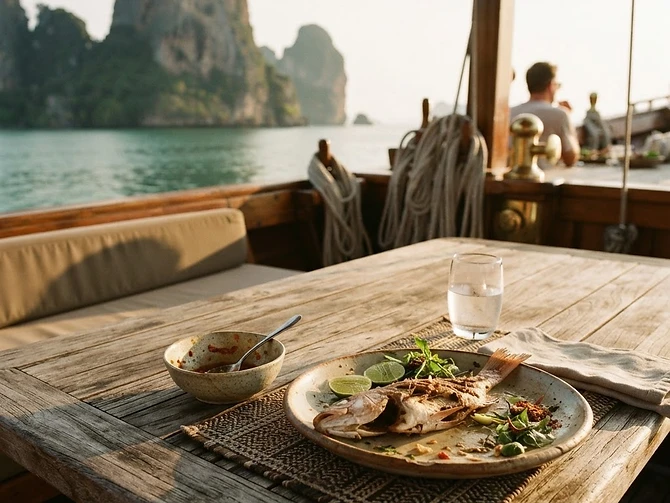
To navigate the limestone spires of Phang Nga Bay is to relinquish the clock to the cadence of the tide. We slipped our moorings at the Yacht Haven Marina, our gulet—a heavy-set, traditional build of seasoned teak and polished brass—heeling with a deliberate, slow-motion grace as we caught the morning breath of the Andaman Sea. Navigating these waters requires more than a chart plotter; it demands an intimacy with the shallows. The limestone karsts, rising like vertiginous, moss-draped sentinels above the glass-flat surface, distort one's sense of scale. Here, the depth sounder remains your most vital instrument, whispering the distance to the seabed as we weave through the labyrinthine channels toward the hidden lagoons of Koh Hong, where the anchor chain pays out with a rhythmic, metallic stutter that echoes against the cliffs.
Life aboard this vessel is governed by the architecture of the aft deck. It is a sprawling, shaded theater that functions as the lungs of the boat, drawing in the humid, salt-heavy air. As the sun traverses the meridian, we shift, the crew moving with the silent, practiced efficiency of those who have spent decades balancing life between rigging and deck. There is a distinct, physical percussion to the life here: the slap of tidal water against the hull, the tension of a mooring line adjusting to the current, and the low-frequency hum of the generator vibrating through the deck planks.
The Galley and the Morning Catch
The culinary pulse of the voyage is set at the first grey light of dawn, when our chef takes the tender to intercept the long-tail boats returning to the shallows near Ao Nang. The harvest is defined by the region: fleshy, sweet tiger prawns pulled from the deep-water channels, red snapper carrying the distinct iodine tang of the Andaman, and the piercing, sharp aromatics of wild-harvested galangal and lemongrass. We watched from the transom as the tender returned, the chef cradling a basket of blue swimmer crab, their carapaces still glistening with the cold moisture of the depths.
Dining on the aft deck is a ritual of elemental simplicity. As the sun dips behind the jagged, shadow-cast peaks, we gather at the wide, dark-stained teak table, which retains the day’s solar warmth long after the light has failed. The centerpiece this evening is a whole sea bass, steamed to opaque perfection and dressed in an infusion of bird's eye chili, bruised lime leaves, and the sharp, bright acidity of local calamansi. There is no performance here, only the raw, shared engagement of feeding—peeling crab shells, the taste of sea salt lingering on the skin, the meal unfolding in the absolute stillness of the anchorage, broken only by the distant, lonely cry of a Brahminy kite.
The Quiet Descent
As the moon rises, painting a fractured, silvered path across the bay, the conversation drifts toward the navigation of the following morning. We spread the charts across the table, discussing the merits of a push toward the outer reefs or lingering in the lee of Koh Yao Noi. The yacht, silent now save for the gentle, rhythmic groan of the lines against the bitts, feels less like a vessel and more like a sentient, solitary island. In these final, cool hours, with the scent of toasted galangal and cooling salt air hanging in the dark, the luxury of the sea becomes clear: it is the total, unadulterated ability to reside within the radius of the horizon, anchored firmly in the present, entirely untethered from the frantic velocity of the world beyond the bay.






