
The Vertical Approach
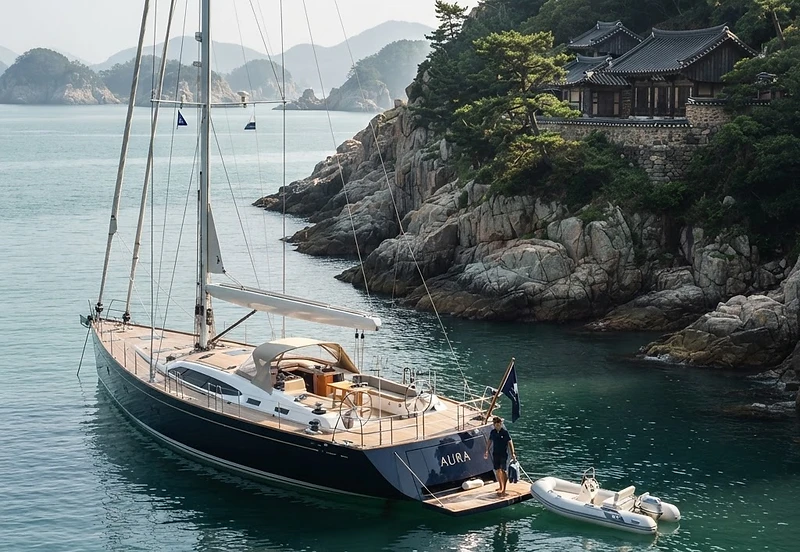
The dawn air in the Hallyeohaesang National Marine Park has a specific, thin clarity that only exists where the Korean peninsula shatters into a thousand island fragments. We were anchored in the sheltered lee of Hansan-do, our 42-meter Nautor’s Swan swinging lazily on a single anchor. The tide was ebbing, pulling a glassy, slow-moving ribbon of South Sea water past our hull, the rhythmic slap against the boot stripe providing a metronome for the quiet morning. From the aft deck, the scale of the landscape is deceptive; the mountains here rise abruptly from the brine, draped in dense, wind-bent pine that seems to defy the jagged granite substrate. Looking upward toward the treeline, a sliver of stark white concrete emerged—a mid-century villa designed with such surgical restraint it felt less like a building and more like a permanent extension of the rock face itself, waiting for the water to rise to meet it.
The Transition from Deck to Shore
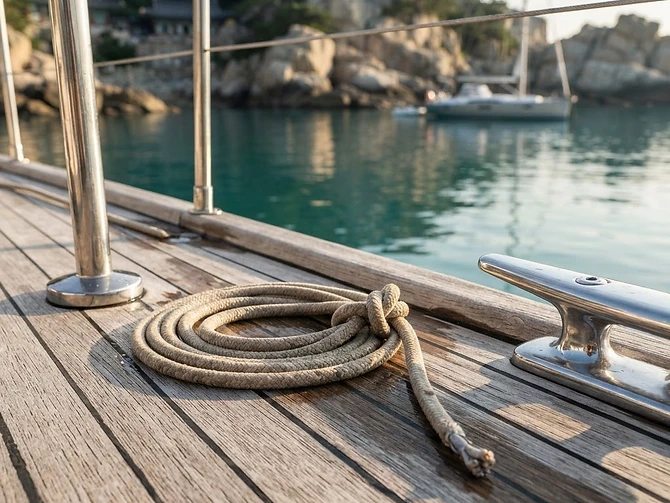
Leaving the yacht behind is always a particular exercise in sensory shedding. We descended to the tender, a rigid-hulled inflatable, the engine kicking over with a sharp, cold snap that quickly settled into a muted burble. As we pushed off, the outboard trimmed just so, we left a clean, silent wake that traced a line back to the Swan. The transition from the broad, hand-laid teak-planked sanctuary of the yacht to the open sea is a visceral reminder of one’s own insignificance, yet the destination promised an architectural grounding. As we approached the private jetty, carved with patient labor directly into the dark, porous basalt shelf, the air shifted from the bracing, saline bite of the open channel to the damp, mossy scent of ancient stone and deep-forest needle-fall. The villa’s architect had mirrored the island’s own violent geometry: long, uncompromising horizontal planes of glass and raw concrete that allowed the seascape to puncture the living spaces, effectively making the house a prism for the shifting, silver-and-blue maritime light.
The Interior Meridian
Stepping onto the terrace, the silence of the island was punctuated only by the distant, rhythmic chime of a navigation buoy back at the anchorage. Inside, the villa—a masterpiece of structural minimalism—used seamless floor-to-ceiling glass to dissolve the boundary between the internal corridor and the vertical drop to the water. We sat on a low-slung, canvas-backed chair, looking out through the transparency toward our vessel, which appeared as a perfect, white-hulled model resting on the deep, indigo-ink mirror of the bay. The owner of the house, a woman who understands that true luxury in this rugged corner of the world is found in the fleeting interval between the sea and the stone, poured green tea from a weathered, iron-heavy ceramic pot. There was no conversation for several minutes; we simply watched the tidal currents pivot with mathematical precision around the headland, observing how the water reclaimed its territory beneath the villa's shadow.
As the afternoon light began to lean against the cliffside, turning the granite a bruised, deep purple and highlighting the crystalline texture of the rock, we retreated back to the tender. The descent to the water was quick, a brief, sharp return to the liquid element that defines our constant movement. Reboarding the Swan, the engines hummed with a familiar, deep vibration, a mechanical heart preparing for the evening’s run toward the lights of Tongyeong. We left the villa to its quiet, solitary watch over the strait, a structure as immutable, weathered, and composed as the sea churning beneath it.






