
The Transition into the Granite Corridor
The passage from the turbulent, steel-grey chop of the Salish Sea into the deep, glass-still corridors of Desolation Sound is a sensory shift that demands an immediate, tactile recalibration of pace. As we brought our 50-foot sailing catamaran—a vessel defined by a generous, open-plan aft cockpit that blurs the boundary between the teak-decked interior and the surrounding wilderness—under the immense shadow of the coastal mountains, the mechanical hum of the diesels faded. In its place, the rhythmic, hollow slap of water against the fiberglass hulls became our only metronome. Dropping the hook in the lee of a granite headland near the crystalline waters of Prideaux Haven, we found ourselves suspended in a stillness so profound it felt heavy, almost liquid. The air, crisp and cooling, carried the resinous scent of ancient Western Red Cedar, a sharp, bracing contrast to the salt-heavy gusts we had navigated while rounding the Malaspina Peninsula earlier that morning.
The Galley and the Cold Water Harvest
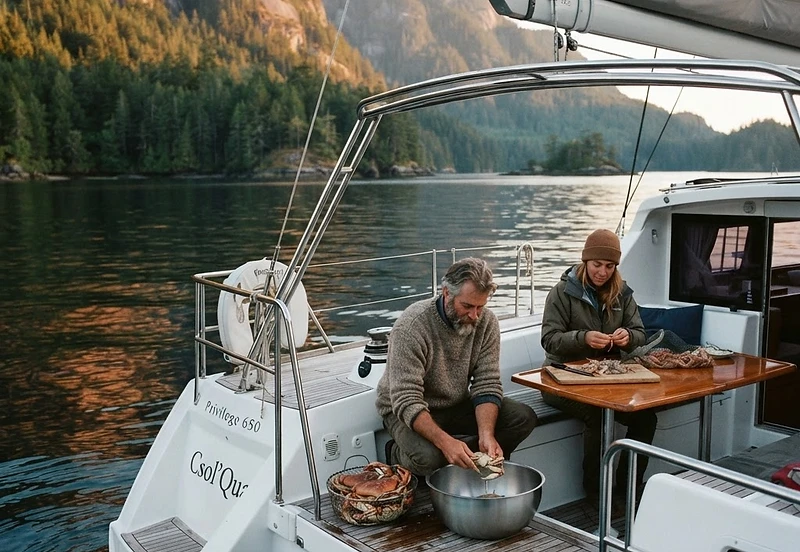
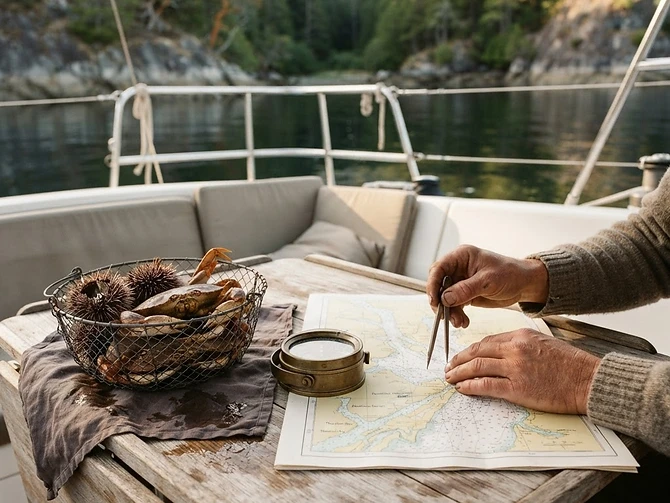
Life aboard in these northern latitudes is governed by the resilience of the local ecosystem, and by mid-afternoon, the focal point of the vessel inevitably migrates to the cockpit table. Our chef had spent the dawn hours securing a haul from a local fisherman operating out of the small port of Lund; the prize was a generous basket of British Columbia spot prawns, the true jewels of these waters, known for their sweet, firm meat and vibrant, translucent shells. Preparing such a catch on board requires a restrained, precise hand; there is no utility in masking an ingredient that possesses such innate character. By the time the sun began to dip behind the jagged, mist-wreathed ridges that define the horizon, our aft cockpit had been transformed into a place of purposeful, simple assembly. The prawns were flash-poached in a light court-bouillon infused with hand-foraged sea asparagus—salty and crisp—and a handful of wild chives gathered from the rocky shoreline. The ritual of peeling these crustaceans by hand, with the cooling breeze drifting off the dark, pine-covered cliffs, underscores the singular pleasure of eating precisely where one travels. It is a process that strips away the unnecessary, revealing a fundamental, unadorned connection between the sea’s bounty and the vessel that facilitates our passage.
The Lingering Silver of the Twilight
As the daylight began to deepen into the bruised violets of evening, the cockpit transitioned from a space of culinary preparation to one of quiet, observational reflection. There is a specific, haunting quality to the light in the Pacific Northwest—a silver, diffused glow that seems to linger stubbornly long after the sun has vanished behind the towering peaks. We sat in the cockpit, the remaining warmth of the day still retained in the teak decking, watching the tide begin its slow, inevitable retreat from the surrounding kelp forests. A distant, lonely call of a loon echoed off the sheer rock face, a sound that serves as the true, untamed heartbeat of this wilderness. These moments—the lingering taste of the sea, the gentle, almost imperceptible movement of the yacht on her rode, and the sight of the first stars piercing the encroaching canopy—are the essential, earned rewards of the voyage. We are merely temporary guests in this vast, granite-bound sanctuary, held in the cradle of the Sound, watching the water turn to a sheet of polished obsidian as the night watch begins in earnest.






