
The Morning Descent at Pollara
The dawn air off the coast of Salina carries a distinct, mineral sharpness—the smell of volcanic rock dampened by a restless Tyrrhenian swell. Aboard a 45-meter Nautor’s Swan, the transition from sleep to the sea is instantaneous; the gentle list of the hull reminds one that we are held not by land, but by the weight of the anchor chain. By 06:00, the tender is already lowered, cutting a quiet wake toward the small fishing boats clustered near the submerged calderas of Pollara. There is no urgency here, only the necessity of being present before the thermal winds begin to stir the surface.
We meet a local fisherman, Salvatore, whose wooden gozzo is laden with the dawn’s yield: taut, silver-skinned alletterato and clusters of bright, briny capers harvested from the island’s sun-baked terraces. These are the ingredients that define the geography of the table here, a culinary landscape where the ferocity of the volcanic soil meets the cold, deep currents of the Mediterranean. Back on deck, the galley becomes a workspace of focused precision. The chef fillets the tuna with a steady hand, the fish served crudo with nothing more than a drizzle of green, peppery olive oil pressed from the nearby slopes of Malfa and a scattering of crushed, salt-cured capers.
Refining the Passage Through the Lipari Straits
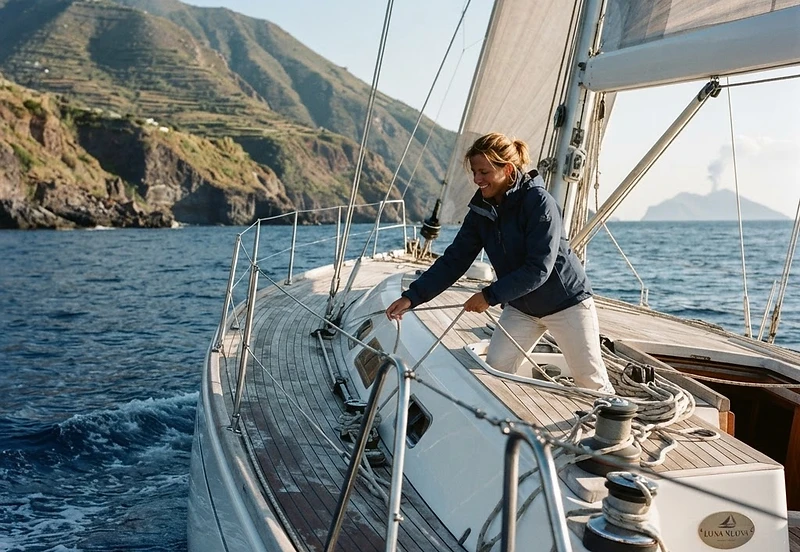
To sail the Aeolian chain is to navigate a series of tectonic surprises. Leaving the anchorage at Salina, we steer toward the channel between Lipari and Vulcano. The yacht handles the swirling currents with the grace of a vessel designed for the deep, her rig perfectly trimmed to manage the gusts that spill off the dramatic, basalt cliffs. It is in these moments—when the autopilot is off and the helm is held firmly—that one understands the true economy of life aboard: a constant recalibration of balance, both for the ship and for the crew.
Lunch is served on the aft deck, a simple affair that mirrors the journey. We eat thin ribbons of hand-rolled pasta tossed with shavings of local ricotta salata and a garnish of wild fennel gathered from the hillsides of Panarea. The dining experience is stripped of artifice; it is an extension of the morning’s harvest, a tactile connection to the rugged slopes we passed hours earlier. Conversation is sparse, limited to the shifting light on the water and the observation of a distant trawler tracing the horizon. There is a profound luxury in this simplicity, an adherence to the rhythm of the sea rather than the demands of the shore.
A Quiet Vigil at Stromboli
As the afternoon light deepens into a bruised purple, we skirt the northern edge of Stromboli. The yacht maintains a respectful distance from the active vent, the dark water reflecting the intermittent glow from the crater above. The atmosphere is one of profound stillness. We watch the plume of ash drift lazily against the stars, the ship’s engines idling at a near-whisper. The day concludes not with a grand gesture, but with the quiet sound of the hull settling into the evening tide, the taste of sea salt still clinging to our skin, and the enduring, dark silhouette of the mountain watching over the deck.






