
The Geometry of Absolute North
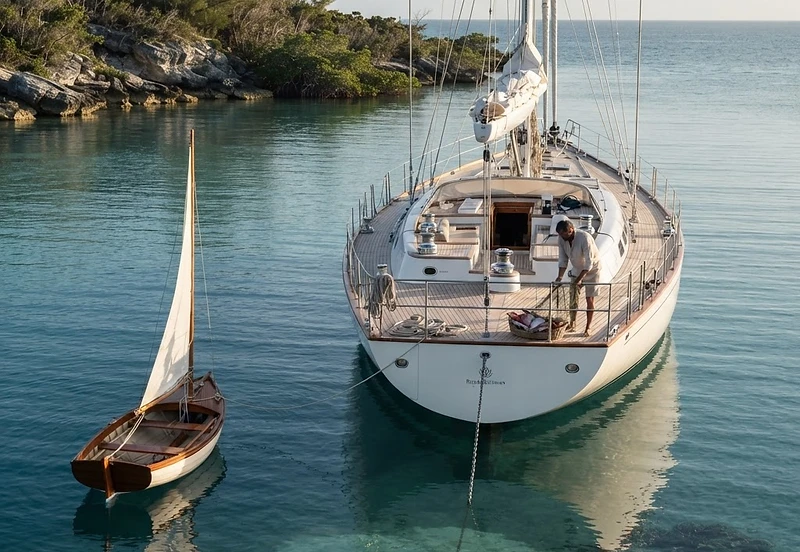
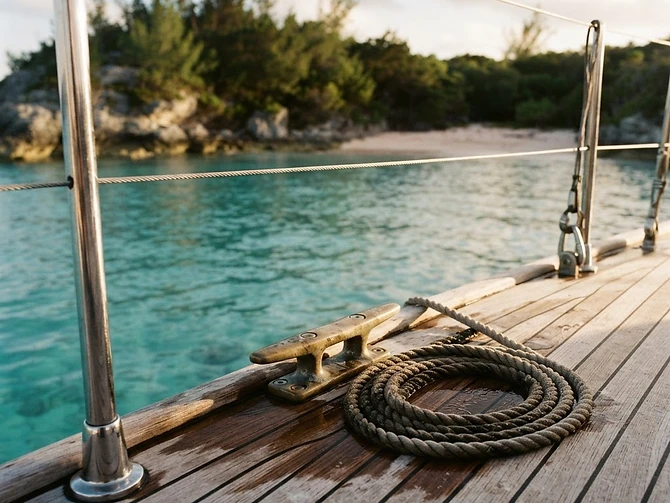
To drop the hook in the lee of a remote Bermuda cay, miles removed from the polished bustle of Hamilton Harbour and the Royal Bermuda Yacht Club, is to encounter a rare, crystalline stillness. Our vessel, a meticulously maintained 45-meter Royal Huisman ketch, holds her station with a deliberate, haunting grace. In the Sargasso Sea, the water possesses a distinct, viscous quality—a saturated, abyssal indigo that seems to compress the horizon into an iron-tight line. Standing on the warm teak of the foredeck at first light, the faint, metallic rattle of the chain against the bow roller is the only rupture in a dawn that feels entirely untethered from the modern meridian. The masts trace slow, pendulous arcs against a sky shifting from bruised violet to the blinding, high-altitude gold peculiar to these mid-Atlantic latitudes.
The Culinary Currency of the Reef
Life aboard, when the coastline is reduced to a jagged silhouette of limestone and stubborn scrub-cedar, relies on the symbiotic dialogue between the galley and the surrounding shelf. By mid-morning, the tender is lowered, not for the vanity of exploration, but to rendezvous with a local fisherman working the shallow, turquoise margins in a traditional flat-bottomed skiff. He brings the morning’s yield: firm, translucent wahoo and the prized, meaty spiny Bermuda lobster, still displaying the iridescent blues of the reef. There is an inherent, solemn ritual to this transfer—the transition of the wild, unscripted catch into the structured, controlled theatre of the galley. Back on the aft deck, our chef prepares the catch with a spareness that borders on reverence; the wahoo is flash-seared and seasoned only with a crush of hand-harvested sea salt and the sharp, bright juice of locally grown Meyer lemons, served alongside a salad of sea beans foraged from the intertidal rock pools. In this isolation, dining becomes a mapping of the island's geology; the food carries a sharp, mineral edge, a direct distillation of the coral foundations that support these isolated outposts.
The Equilibrium of the Watch
As the sun finally slips below the Western Ledge, the yacht transforms into a sanctuary of diffused warmth and deepening mahogany shadows. The interior, defined by the kind of meticulous joinery that feels like a physical manifestation of silence, glows under low-voltage recessed lighting. Conversation on the deck is sparse, punctuated only by the rhythmic, percussive slap of small swells against the hull’s counter—a sound that anchors the soul in the present. We find a profound sense of equilibrium in these twilight hours, where the technical necessity of navigation gives way to the simple, profound pleasure of being moored in the lee of the world. One might take a glass of crisp, chilled Albariño on the flybridge, tracking the bioluminescence that stirs like liquid electricity in the wake of a school of passing jacks, feeling the vessel’s massive displacement translate into a strange, weightless grace. We do not scan the horizon for the running lights of other vessels, for there are none; we look instead at the way the star-heavy night sky mirrors the vast, dark expanse of the Sargasso, leaving us held in a suspended, luminous blue void.
By the time the anchor watch is set, the wind has dropped to a whisper, carrying the faint, sweet scent of night-blooming jasmine from the hidden coves of the island. The world is nothing but the swing of the boat and the patient, endless respiration of the Atlantic.






