
The Passage Through the Straits
The dawn air in the Andaman Sea is heavy, tasting of salt and cooling rainforest earth. We rounded the southern tip of Pulau Langkawi under a charcoal sky, the stabilizers on our 42-meter Feadship humming a rhythmic, almost imperceptible counterpoint to the distant, guttural call of a hornbill. Transiting these waters demands a particular deference to the chart; the depths here shift with the tides, and the underwater topography is as jagged and dramatic as the limestone towers that pierce the clouds above. We kept a sharp eye on the sonar, the electronic pulses tracking the sudden shoaling near the karst pillars of the Dayang Bunting archipelago. There is a singular thrill in navigating this coast, where the boundary between the deep, navy blue of the open passage and the jade shallows of the hidden bays feels like a deliberate, geographical choice.
The Villa at the Water’s Edge
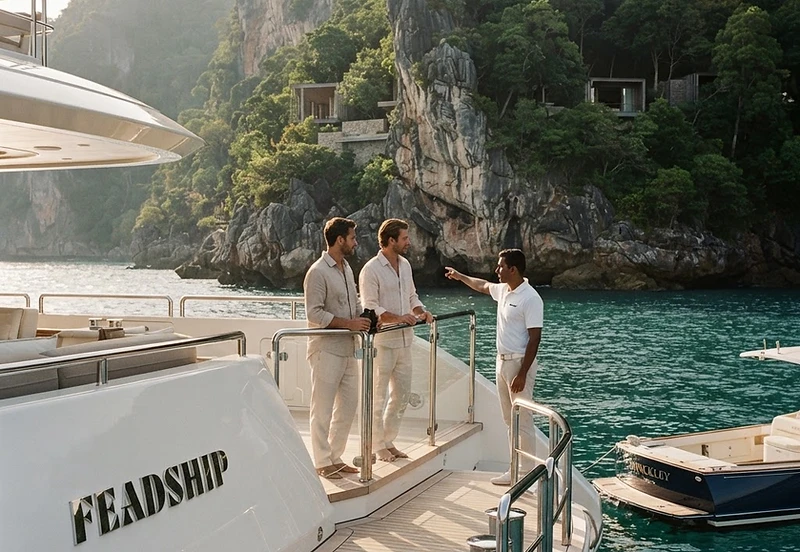
By mid-morning, the haze had burned off to reveal the true intensity of the Malaysian sun. We dropped the hook in a sheltered bight near Teluk Datai, the holding firm in the sandy silt that characterizes the sea floor here. The vessel swung gently to the current, presenting a clean, white-painted profile against the dense, emerald curtain of the shoreline. From the aft deck, I caught sight of the villa—a structure by Kerry Hill, cantilevered over the precipice. It appeared as an extension of the geology itself, its timber-slatted facades mimicking the verticality of the surrounding dipterocarp trees. We lowered the Hinckley tender, its fiberglass hull cutting a clean, silent wake toward the private pier that seemed to grow directly out of the coral reef. Stepping from the tender onto the worn teak boards of the dock, one feels an immediate shift in scale; the yacht, which felt vast and expansive while we were underway, now looked like a delicate, graceful companion moored in a private, liquid courtyard.
The Quiet Equilibrium of the Shore
Lunch was served on the villa’s lower terrace, a space designed with the same nautical rigor as a yacht’s main deck. The breeze carried the sharp scent of crushed lime and galangal, drifting up from the kitchen below. We spoke little, our attention anchored by the vista: the yacht riding perfectly to its cable, a singular, precise testament to human engineering against the prehistoric majesty of the coast. The architecture here does not compete with the sea; it observes it. Wide glass spans vanish into hidden wall pockets, allowing the humid, salt-laden air to circulate through the living spaces just as it moves through the companionways of a ship. As the afternoon light softened, casting long, bruised shadows across the water, the distinction between life aboard and life ashore became entirely academic. We took our coffee on the terrace, watching the tide begin its slow withdrawal from the black volcanic rocks, marking time not by the clock, but by the newly exposed, barnacled base of the cliff and the slight, corrective swing of our vessel out in the bay. We lingered until the sun dipped behind the western ridge, leaving the sea a flat, polished surface of bruised plum and charcoal, before returning to the tender for the short, dark crossing to the mothership.
Back on the swim platform, the familiar routine of the evening commenced—the gentle, rhythmic click of the tide against the hull, the dimming of the navigation lights, and the final, sweeping look at the darkening horizon. We were simply another element in the landscape, a temporary, floating architecture anchored at the edge of a world that existed long before our arrival and will remain long after we weigh anchor.






