
The Geometry of the Morning Watch
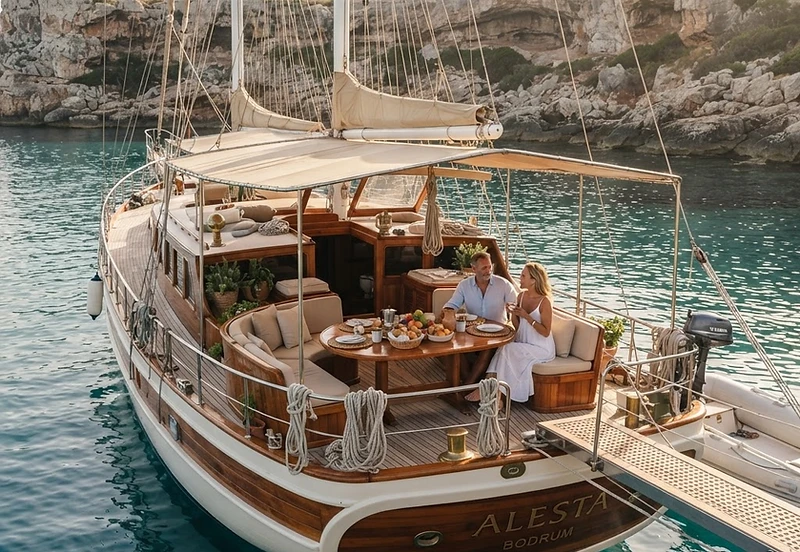
The dawn off the coast of Formentera is not a transition, but a state of being. We lay at anchor in the turquoise silence of Cala Saona, the custom-built 30-metre gulet swinging rhythmically on a short scope. There is a specific, guttural tension in the rigging—a humming resonance of stainless steel wire and seasoned iroko timber—that signals the day’s potential. From the deck, the limestone cliffs of the island rise like pale ramparts, their crevices harbouring the endemic rosemary and wild thyme that will eventually find their way into our midday galley prep. The air here holds a distinct, razor-sharp salinity, a bracing clarity that separates the salt-dusted teak of our transom from the hazy, golden shoreline of the Balearics.
By 07:00, the tender is lowered, a calculated, heavy splash followed by the steady, low-frequency pulse of the Yamaha outboard as we make for the small, weathered quay at La Savina. We aren’t looking for artifice; we are looking for the morning’s harvest, the fundamental currency of a life at sea. At the local market, the exchange is brief and entirely tactile: firm, silver-skinned gerret caught in the night’s haul, and small, sun-drenched lemons that smell of iron-rich earth and sea spray. The chef, moving with an ease born of years in confined galleys, selects a handful of local capers and a single, darkened glass bottle of unfiltered olive oil sourced from an orchard in the island’s interior. These ingredients are not merely provisions; they are the building blocks of a life spent suspended between the galley and the indigo deep.
The Aft Deck Rituals
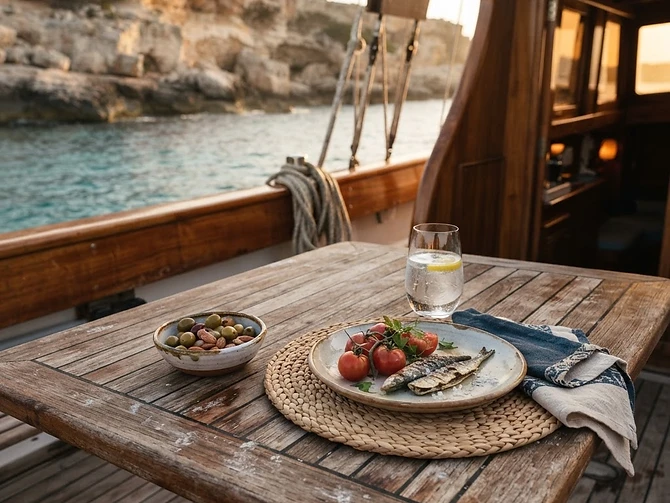
As the sun dips behind the pine-covered ridgeline of the island, the aft deck undergoes a metamorphosis. On a vessel of this pedigree, the dining table is the true nerve centre, an extension of the deck’s natural geometry where the boundary between boat and horizon vanishes. The transition from active navigation to evening repose is marked not by a clock, but by the hollow, metallic clink of crystal and the final, settling drag of the anchor chain deep in the sand. Tonight, the focus is the morning’s catch: gerret, quick-seared over high heat in the galley and served with a vibrant, acidic emulsion of island lemon and the crushed herbs foraged at dawn. It is a meal defined entirely by its proximity to the water; when the cool, salt-heavy night air meets the warmth of the plate, the flavour profile is indelibly anchored to the geography of the seabed below us.
There is an essential, unhurried grace in the logistics of chartering these waters. The crew moves with a practiced, near-silent efficiency, clearing the lines and polishing the brass while we remain focused on the shifting palette of the horizon. A conversation drifts toward the notorious wind patterns near Ibiza’s Es Vedrà, the talk weaving in and out of the low, steady slap of water against the mahogany hull. We aren't simply dining; we are observing the slow, liquid passage of the Mediterranean night, watching the masthead light flicker against the vast, star-strewn darkness of the open sea. It is a dialogue between the architecture of the vessel and the indifference of the tide.
As the conversation wanes into the small hours, the deck settles into a profound, heavy quiet. The only sound is the rhythmic, reassuring groan of a fender against the polished topsides, a reminder that even when stationary, the ship is always in conversation with the swell. We sit in the warm, amber glow of the low-voltage deck lights, watching the reflection of the constellation Cygnus ripple slowly across the dark, glass-still surface of the anchorage, held fast in the heart of the Balearic night.






