
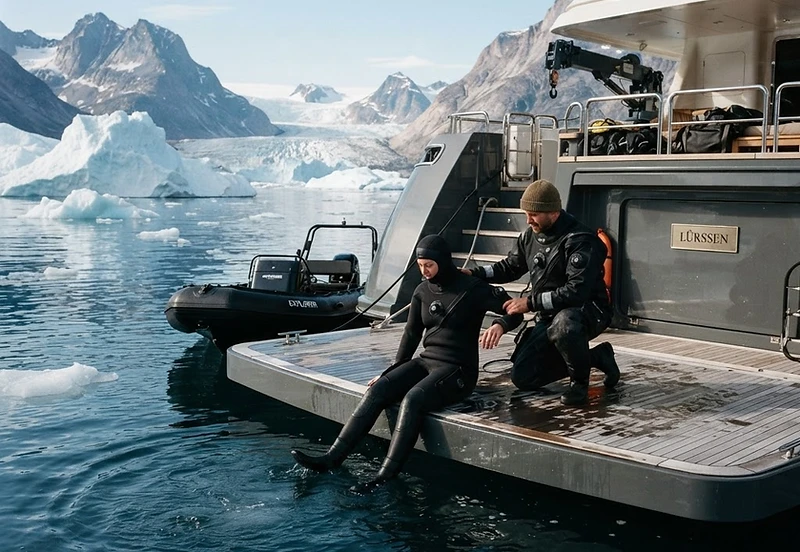
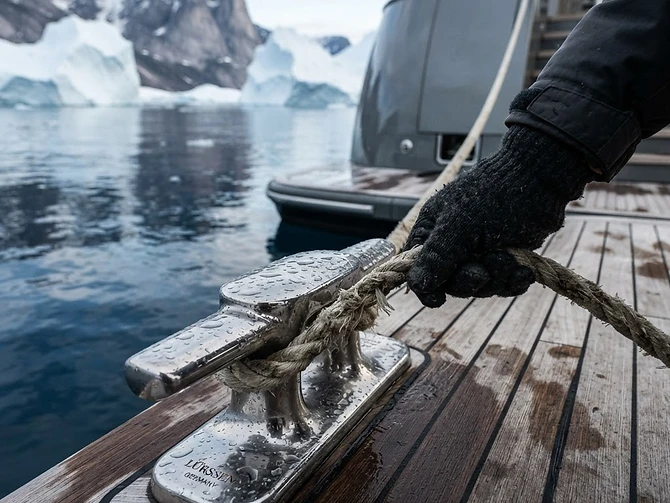
The sound of a Greenlandic morning is not silence; it is the rhythmic groan of pack ice shifting against the hull of our vessel, an ice-classed explorer that held its station with the steady, pulsing confidence of a Lürssen pedigree. We sat at anchor in the cold, indigo reach of Disko Bay, the towering basalt columns of the shoreline catching the first, fragile light of a sub-arctic dawn. For a yacht of this displacement, these fjords are not merely a route, but a cathedral of shifting light, where the water is so dense with glacial minerals that the depth sounder seems to hold its own steady dialogue with the ancient, silted floor beneath us.
Beneath the Glacial Surface
Stepping from the dive platform into a dry suit is a ritual of deliberate preparation, a stark, tactical contrast to the effortless, climate-controlled drift of the yacht above. Down here, the water carries the faint, sharp scent of ancient, crushed stone and oceanic clarity. We descended along the flank of a submerged iceberg, its walls translucent and veined with impossibly blue pockets of compressed, prehistoric air. The visibility was startling, turning the descent into a slow-motion flight through a suspended, freezing wilderness. My dive partner, a maritime geologist accustomed to the currents of the North Atlantic, gestured toward a cluster of deep-water anemones clinging to the jagged rock face, their movement a hypnotic, slow-dance in the glacial surge. To be this far north, suspended in such a fragile, immense environment while knowing the warmth of a teak deck and the immediate comfort of a heated cabin awaited, is the fundamental tension that defines the modern Arctic yachting experience.
The Galley’s Arctic Ritual
Returning to the deck, the transition from the numbing cold of the fjord to the protected, sheltered environment of the yacht’s aft lounge felt like a return to civilization’s most refined core. Our chef had spent the morning trading with local hunters near Ilulissat, securing a pristine brace of Arctic char caught in the cold, inland melt-streams. Back in the galley, he avoided the unnecessary complexity of heavy sauces, opting instead to sear the fillets in a pan with nothing but a knob of local butter and a scatter of wild crowberries foraged from the tundra slopes above the harbor. We ate on the sundeck, the plate vibrant with the char's deep, translucent pink flesh. The fish, firm and tasting faintly of the mountain minerals it had lived among, was served simply, accompanied by a slice of rye bread toasted over an open flame until the edges were blackened. It was a meal that tasted of the landscape—honest, bracing, and deeply grounded in the geography we were currently exploring.
As the sun began its long, horizontal slide toward the horizon, casting the drifting icebergs in a bruised, incandescent violet, we hauled the anchor. The yacht turned her prow back toward the open, unforgiving reach of the Davis Strait. We moved with the current, leaving the ancient silence of the fjord behind, our wake a momentary, dissolving ribbon of white water across the obsidian sea. There was nothing left to do but watch the light fail, the yacht’s steady, mechanical hum providing a comforting, rhythmic pulse against the vast, indifferent geometry of the North.






