
The Atlantic Shelter
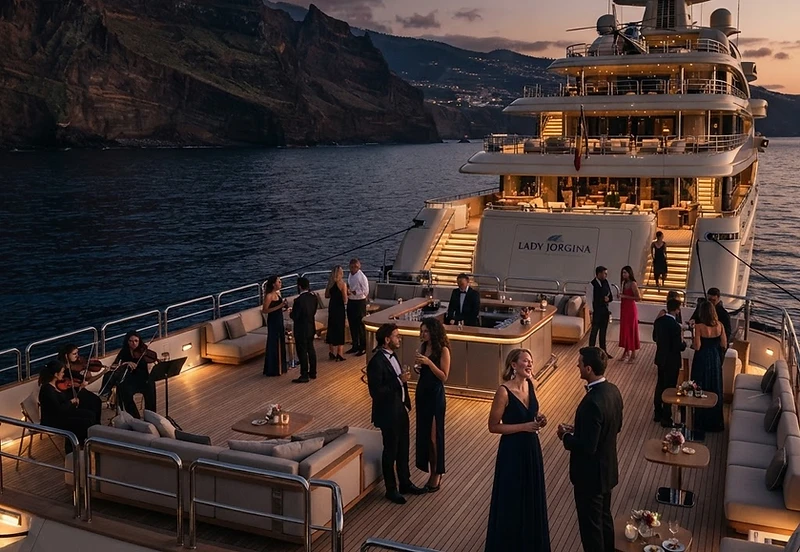
The swell off the eastern coast of Madeira possesses a rhythmic, muscular quality that serves as a perpetual reminder of the ocean's reach. As we brought the 50-meter Lürssen around the rugged, red-earth headlands of the Ponta de São Lourenço, the wind died to a whisper, leaving us in the deep-indigo lee of the basalt cliffs. It is a place of dramatic stillness, where the sheer scale of the volcanic geology makes the yacht feel both secure and remarkably small. Anchoring here requires a precise hand on the throttle; the bottom rises sharply from the abyssal depths, and the holding is dictated by the basalt shelves that have been hammered by the mid-Atlantic for millennia.
The Saloon as a Vessel
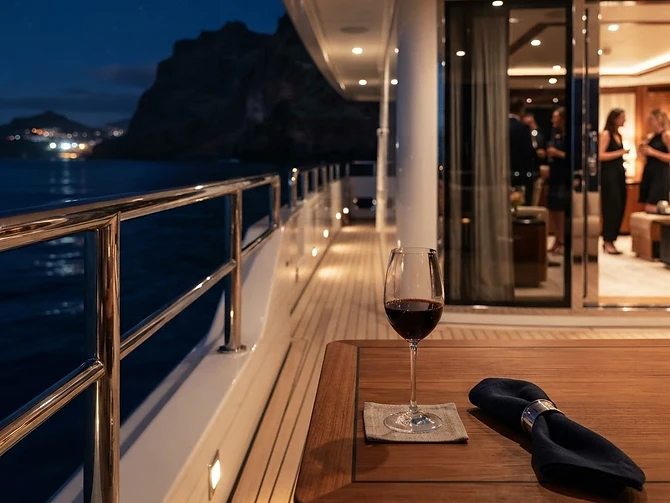
Life aboard during such an approach is governed by the shifting light. As the sun dipped behind the island, the interior of the formal dining saloon—designed with a restrained palette of brushed sycamore and matte-finished nickel—became the focal point of the evening. For a party of ten, the space is intimate yet expansive, a sanctuary of stillness despite the restless energy of the sea just feet away. The transition from the aft deck to the saloon is a ritual of cooling air and dimming light; we watched the last of the coastal mist cling to the crags while the crew adjusted the low-voltage lighting to match the velvet texture of the twilight horizon.
The Galley and the Volcanic Harvest
The menu for the evening was not a product of global sourcing, but a direct dialogue with the Funchal markets at dawn. Earlier that morning, our chef had returned from the Mercado dos Lavradores with deep-sea espada—black scabbard fish—caught in the profound trenches surrounding the archipelago. Served with a delicate emulsion of papas semilha, the small, firm potatoes native to the island's volcanic soil, and garnished with the wild fennel that clings to the cliffs above Caniçal, the meal felt entirely tethered to the coordinates beneath our keel. We spoke of the passage from the Azores, the way the trade winds had buffeted the hull, and the peculiar, metallic tang of the spray that lingers on the air for hours after the breeze drops. There is a specific cadence to a dinner at sea, a shared acknowledgement that our presence here is transient, allowed only by the grace of the current and the integrity of the steel beneath us.
The Quiet Wake
By the time the final course was cleared—a simple preparation of local passion fruit and sugar cane honey from the high-altitude plantations of Calheta—the conversation had drifted to the logistics of our departure at first light. Through the wide, sweeping windows of the saloon, the lights of a small fishing boat flickered, a solitary pinprick of humanity against the vast, dark amphitheatre of the Atlantic. The formality of the table setting, with its polished silver and heavy linens, stood in stark relief to the wild, churning blackness just beyond the glass. It is this dissonance that defines the yachting life; a commitment to order, craft, and human connection, held in place against the beautiful, uncaring indifference of the open sea.






