
The Anatomy of the Anchorage
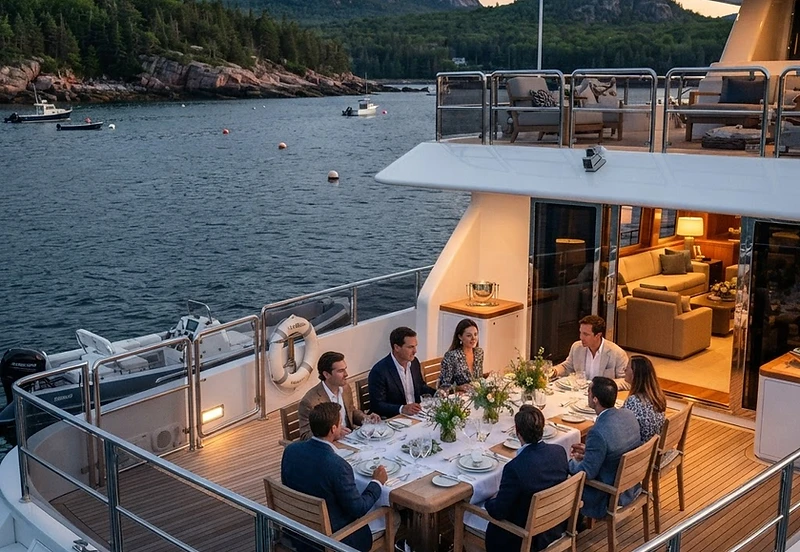
There is a specific, bracing stillness that descends upon the Maine coast when the heavy coastal fog lifts, leaving the spruce-lined granite of Mount Desert Island etched with startling clarity against a cooling, violet sky. We were anchored in the sheltered lee of Sutton Island, our Feadship held firm by the rhythmic drag of the tide against a deep-set anchor. The day had been defined by the erratic, beautiful challenges of the Down East coastline—the sudden shifts in current, the navigation of granite teeth, and the sharp bite of the Atlantic wind. From the aft deck, the air carried a visceral cocktail of cold brine, dampened balsam, and the metallic tang of an impending autumn evening, a sensory tether to the wild environment surrounding our vessel.
The Saloon as a Maritime Stage
Inside the formal dining saloon, the mahogany bulkheads caught the amber glow of low-voltage recessed lighting, casting a warmth that defied the encroaching chill outside. The space is an exercise in nautical restraint; every fixture is weighted to account for the subtle, constant pitch of the sea, ensuring the dinner for ten remains an act of grace rather than a struggle against the elements. As the crew attended to the table—placing heavy, crisp linens and silver polished to a mirror finish—there was no sense of static formality. Instead, the room functioned as a living theatre of sea-going hospitality. A guest might glance through the expansive, near-panoramic glass to see the dark, rugged silhouette of the shore, a constant, humbling reminder that while we dined in a controlled, refined atmosphere, we remained entirely subject to the temperament of the Gulf of Maine.
The Galley’s Dialogue with the Land
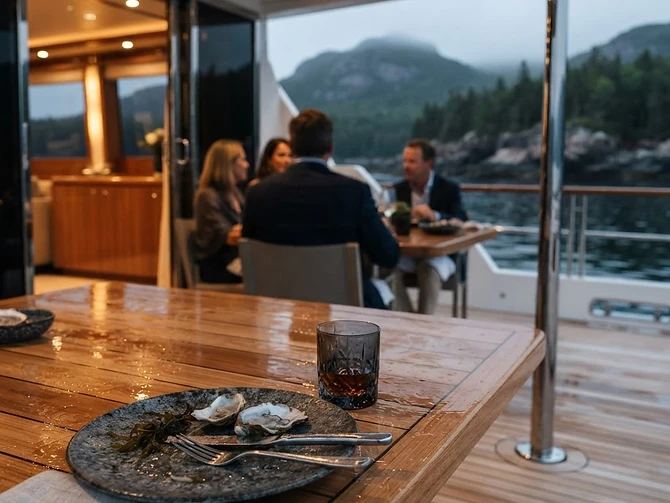
The menu for the evening was an intentional translation of the local geography. Our chef had spent the dawn hours at a small wharf in Northeast Harbor, sourcing the day’s haul directly from a lobsterman whose vessel bore the salt-etched scars of a long season. The centerpiece was a pan-seared Atlantic halibut, its flesh firm and flaking with the distinctive, mineral clarity of these deep, near-freezing waters. It was served with a succotash of sweet corn foraged from fields near Ellsworth, sautéed with wild Maine chanterelles gathered from the dense inland woods. Every component spoke to the local foodways—the brightness of the sea salt, the earthy, damp musk of the mushrooms, and the bracing sweetness of the halibut itself. The dinner was not merely a meal; it was the logical culmination of the day’s navigation, a tether between the yacht’s polished interior and the unyielding, ancient nature of the coastline just a few hundred yards off the beam.
As conversation drifted across the table, punctuated by the soft, steady ring of stemware, the yacht shifted almost imperceptibly on her chain. The dining saloon felt like an isolated island of light, a private observatory from which we watched the distant, rhythmic pulses of lobster boat markers blinking in the darkness as they traced their solitary paths toward home. It was a moment of profound, quiet equilibrium: the fine-tuned machinery of the yacht holding us precisely in place, the sea providing the harvest, and the night air humming with the untamed, ancient rhythm of the North Atlantic.






