
The Transom Descent
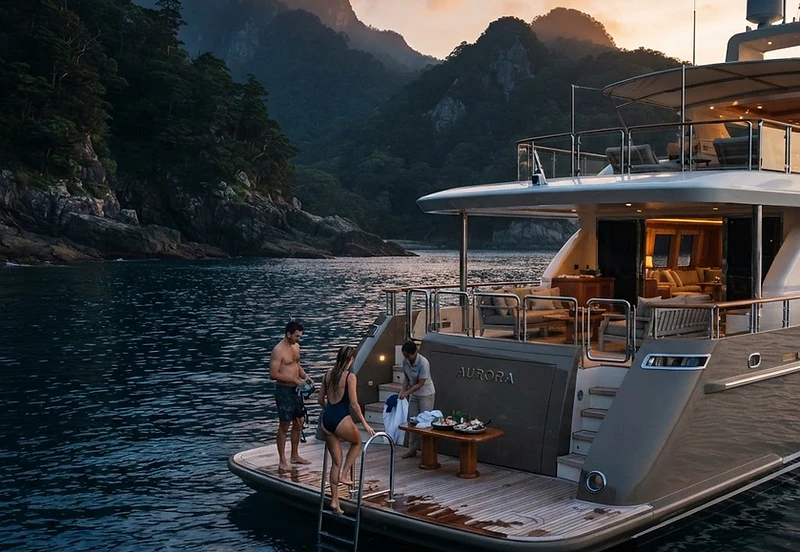
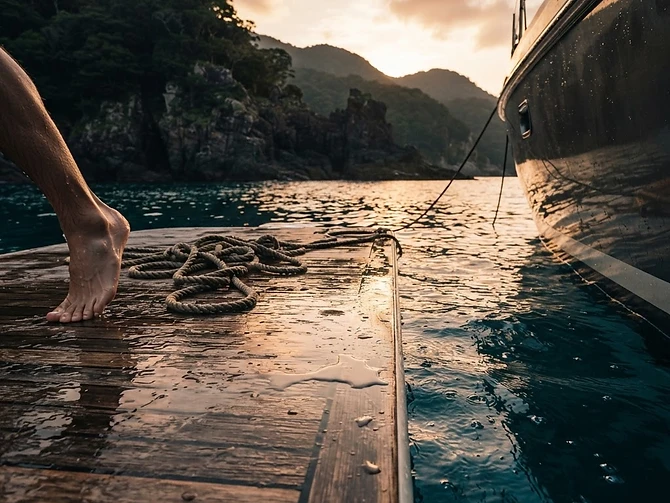
There is a specific cadence to the day’s end when the vessel is moored in the lee of Yakushima’s western headlands. The humidity of the southern Kyushu current clings to the teak, tempered only by the persistent, cooling breeze flowing down from the island’s mountainous, forested interior. As the sun begins to collapse behind the dense canopy of ancient Yakusugi cedars, the boat shifts slightly on her anchor chain—a soft, metallic rattle that serves as the only clock we acknowledge. The ritual is unspoken: the tender is stowed, the transom folds down like a beckoning palm, and the water, a deep, bruised indigo at this hour, waits to wash away the salt of an afternoon’s navigation.
We slip into the East China Sea, the water surprisingly dense, humming with the invisible life of the Kuroshio current. There is no urgency in the water. To swim here, in the shadow of volcanic cliffs that plunge directly into the deep, is to feel the sheer, intimidating scale of the landscape. Beside the yacht, the hull reflects the shifting spectrum of the sunset—copper, violet, and finally, a charcoal grey that mirrors the raw stone of the shoreline. It is a moment of total equilibrium, a necessary pause between the technical navigation of the day and the sensory rituals of the galley.
The Harvest and the Hearth
Returning to the deck, the transition from the wild sea to the refined quiet of the evening is marked by the scent of shiso and charred ginger. Our chef, having spent the morning navigating the stalls at the Anbo fish market, has returned with kibinago—delicate, silver-striped herring—and a haul of rockfish landed by local fishermen on the southern coast. In the galley, the day’s labor is being transcribed into a menu that respects the elemental simplicity of the region. There is no heavy-handed ornamentation here; the focus remains entirely on the inherent character of the ingredients, a philosophy that mirrors the vessel’s own clean, purposeful design.
Dinner is served on the aft deck as the last of the light fails. We eat thin, sashimi-grade slices of kanpachi seasoned with a touch of hand-harvested sea salt and the sharp, bright zest of tankan, the citrus fruit that defines the flavor profile of the Yakushima foothills. The conversation is low, punctuated by the rhythmic lapping of the tide against the hull. There is a profound comfort in this: the knowledge that the vessel is perfectly secured, the crew has executed their watch with silent, invisible precision, and the island remains, vast and ancient, just a few hundred yards off our beam.
The Night Watch
As the stars begin to assert themselves over the Pacific, the yacht feels less like a complex piece of engineering and more like a sanctuary. The deck lights are dimmed to preserve the absolute clarity of the night sky, and the silence is punctured only by the occasional, haunting call of a nocturnal seabird. It is in these hours that the reality of the voyage settles in. We are not merely visiting this coast; we are momentarily part of its geology, anchored in a stillness that few ever witness from the shore. Above the silent deck, the anchor light blinks steadily—a singular, defiant spark against the immense, dark velvet of the sea.






