
The Architecture of the Morning Tide
The dawn air in the Seychelles does not so much break as it seeps into the interior, a soft, humid luminescence that turns the teak decking of our tender into a mirror of polished honey. We are approaching a 60-meter Feadship anchored in the sheltered cradle of St. Mary’s Pool, off the coast of La Digue. From the water, the vessel does not sit as an intrusion, but as a floating extension of the coastal architecture—a piece of mobile, high-precision geometry that echoes the smooth, wind-sculpted granite boulders strewn across the white sands of the Anse Source d'Argent. To board is to transition from the raw, chaotic beauty of the Indian Ocean into a space engineered for silence.
The Suite as a Spatial Masterclass
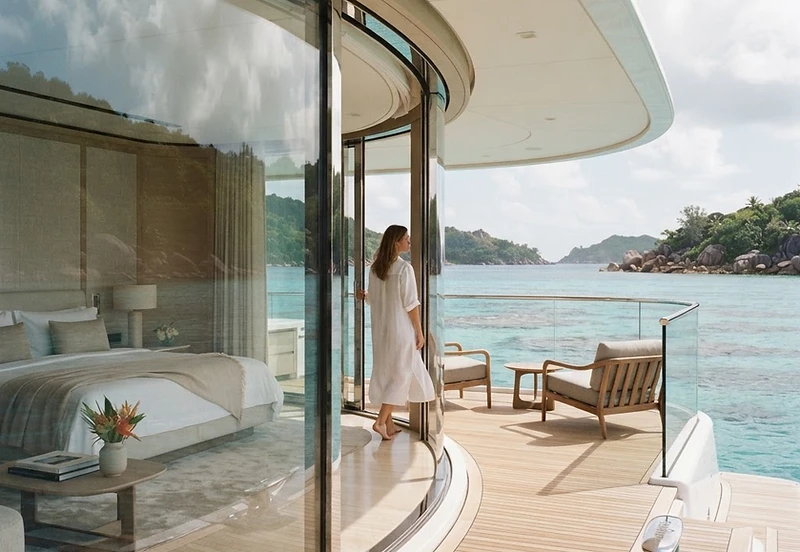
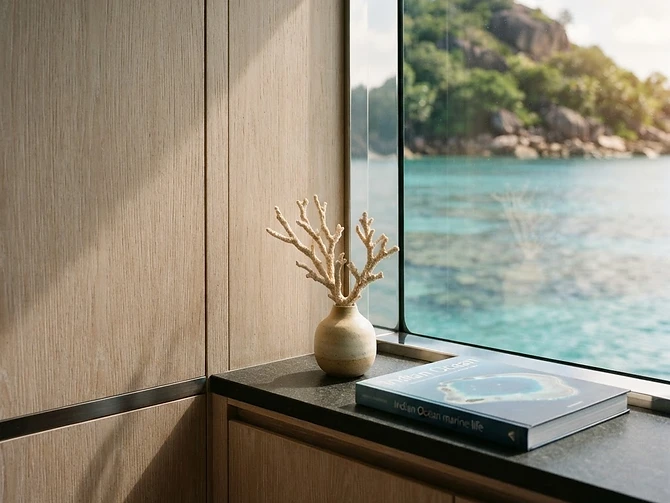
Stepping into the owner’s suite on the main deck, the sensation is one of profound volume. The interior designer, having spent months mapping the specific refraction of equatorial light, has eschewed the cluttered excesses of traditional superyacht styling. Instead, the room functions with the clarity of a modernist villa. The bulkhead-to-bulkhead glazing offers a 180-degree vista, turning the maritime horizon into a living, shifting mural of indigo and cyan. The joinery—bleached white oak with a grain so tight it feels like silk beneath the palm—serves as the structural skeleton, anchoring the floating bed to the center of the space just as a stone hearth anchors a home built into the cliffs of the Côte d'Or.
There is a specific rhythm to life in this suite. It is the sound of the hull sighing against the swell, a deep, structural resonance that reminds you that you are suspended between the sky and the reef. The layout is intentionally permeable; the master bath, clad in honed limestone that mirrors the geology of the inner islands, flows seamlessly from the dressing area. It feels less like a cabin and more like a private sanctuary where the outdoors is invited in through deep, recessed apertures. We sat for coffee, listening to the steward discuss the morning’s delivery of fresh mangoes and passionfruit from a local farmer near Victoria, the smell of roasted beans cutting through the sharp, saline tang of the breeze.
The Horizon Reclaimed
By late afternoon, the sun begins its steep descent, casting long, bruised shadows across the water. The suite changes character entirely, the white oak absorbing the orange glow until the room feels heavy with warmth. Looking out from the writing desk, I notice how the deck lines align perfectly with the distant horizon, a deliberate choice by the naval architects to ensure that the interior feels fixed, stable, and permanent even while the anchor chain hums and shifts in the coral below. It is a masterclass in domesticating the infinite; a space that provides the security of a shorebound residence without ever losing the necessary, unsettling magic of the deep sea. As the last light catches the white froth of a wave breaking on a distant pinnacle, the cabin feels as solid as the granite of the coast, and as ephemeral as the turning tide.






