
The Rhythm of the Minch
The dawn air off the Sound of Mull carries a distinct sharpness—a mixture of cold salt spray and the damp, earthy scent of peat smoke drifting from the highland hills. Standing on the aft deck of our Nautor's Swan, the teak underfoot is beaded with dew, and the silence of the anchorage is punctuated only by the rhythmic slap of water against the hull. There is a particular clarity to the light here; it does not bathe the landscape so much as it carves it, defining the grey granite of the cliffs against the moody, shifting blues of the Atlantic. We have spent three days tracing this coastline, avoiding the charted bustle of Oban in favour of the deeper, quieter inlets where the wind dictates the itinerary and the chart plotter serves only as a humble suggestion. To be here is to accept that the sea, not the schedule, sets the tempo.
The Galley and the Coast
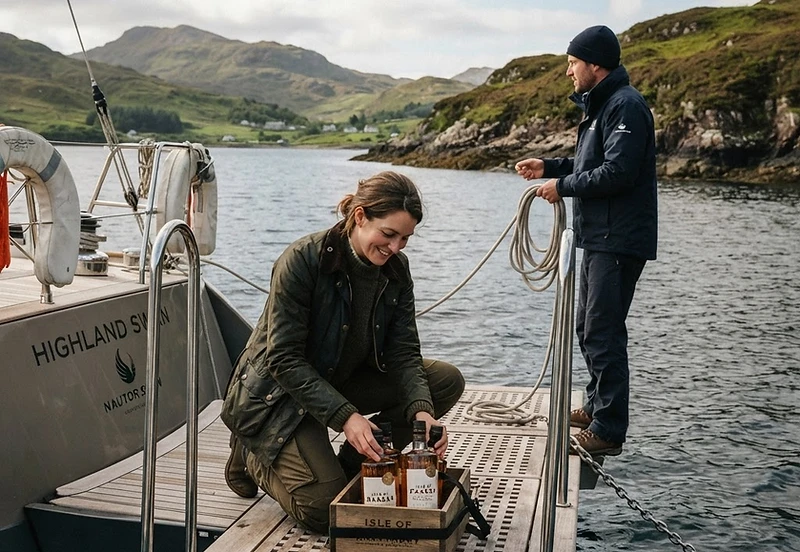
By mid-morning, the mood shifts from the solitude of the anchorage to the pursuit of the day’s provisions. We drop the tender and make for the small, wind-battered pier at Ardtornish, where the local connection to the land is absolute. Yachting in these waters is a collaborative exercise with the environment. Our chef, having coordinated with local crofters, secures a crate of hand-dived scallops and a bundle of wild sea kale foraged from the nearby shingle banks. Back in the galley, the preparation is deliberate and restrained. The scallops, translucent and sweet, require little more than a quick sear in local butter, their natural brininess echoing the deep, cold currents we traversed at first light. This is not the elaborate cuisine of the city; it is the raw, unadorned expression of the coast, served on deck as the boat swings gently on her mooring.
The Quiet Harbor of Eigg
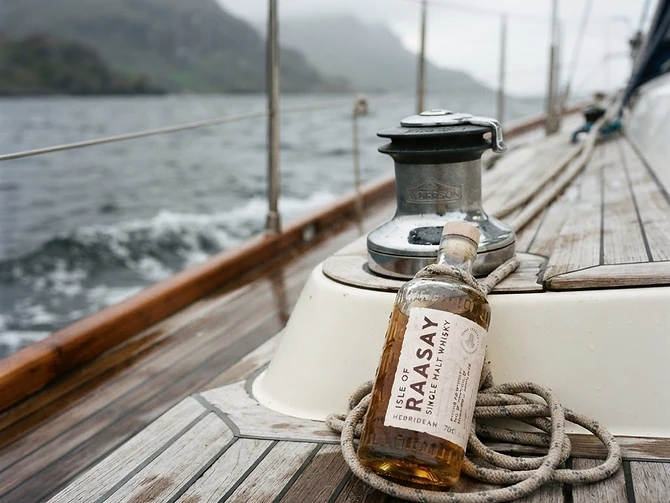
As the afternoon light begins to bruise into shades of violet, we make the run across to the Isle of Eigg. Approaching by sea, the island reveals its dramatic Sgùrr—a towering pitchstone ridge that acts as a sentinel over our approach. We anchor in the shelter of the bay, the holding ground firm, and go ashore to the Galmisdale Harbour. There is a profound sense of temporal suspension here; in the small village, time is measured in the arrival of the ferry and the shifting of the tides. We sit at a weathered table near the water, enjoying a dram of whisky from the nearby Isle of Raasay Distillery, watching the masts of local fishing boats bob in the harbour. There is no urgency to return to the vessel, nor is there a desire to reach further ground. The yacht, a dark, elegant silhouette against the deepening dusk, waits patiently, her masthead light flickering to life as the stars begin to assert themselves over the Hebridean expanse.
Returning to the stillness of the main cabin, the gentle vibration of the tide against the rudder acts as a low, steady hum. We have spent the day in a state of constant, quiet movement, yet the feeling is one of perfect, anchored repose. Outside, the dark water of the Atlantic stretches toward the horizon, a vast and indifferent mirror to the quiet life we have found within these granite walls.






