
The Geometry of the Morning Tide
The dawn in the Bay of Islands does not break so much as it dissolves, a slow bruising of violet light that reveals the jagged silhouettes of the kauri-crowned headlands. Aboard our chartered Nautor's Swan, the transition from sleep to sea is marked by the singular, rhythmic slap of water against the hull—a sound that anchors the world. We are anchored in the quiet embrace of Urupukapuka Island, the mast shivering slightly under the morning breeze, a gentle reminder that even at rest, a sailing vessel is never truly still.
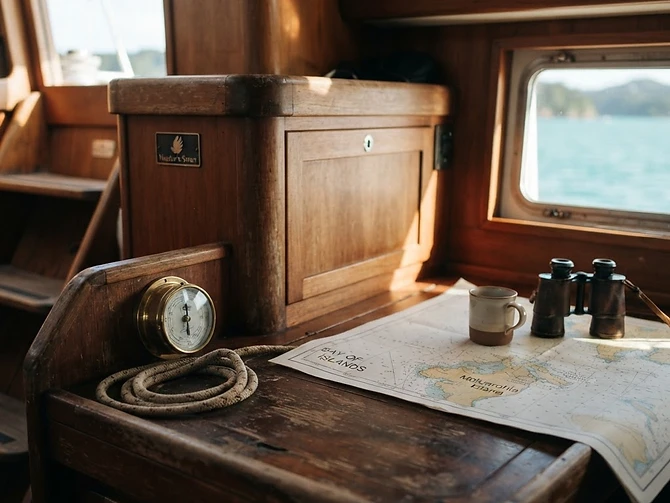
Life aboard follows the arc of the sun. The first ritual is not coffee, but the checking of the lines and the scan of the horizon for the telltale change in the ripple that signals the incoming tide. Our skipper, a man whose hands possess the rough-hewn wisdom of a lifetime spent navigating these fickle coastal passages, notes the barometric pressure with a glance at the bridge electronics. We raise the anchor with a measured, deliberate winching, the chain rattling a metallic cadence against the quietude of the bay as we pivot toward the open channel, the bow cutting a clean, purposeful path through the cooling morning haze.
Culinary Currents and the Coastal Hearth
By midday, the sea has provided its own invitation. We drop anchor off the shore of a sheltered inlet where the scent of native manuka smoke hangs low over the water. Here, the local culinary character is forged from the interaction between the land and the Pacific's cold, nutrient-rich bounty. We take the tender ashore, steering past craggy, mussel-encrusted outcrops to reach the modest, weather-beaten jetty that serves as the gateway to a long-held regional secret.
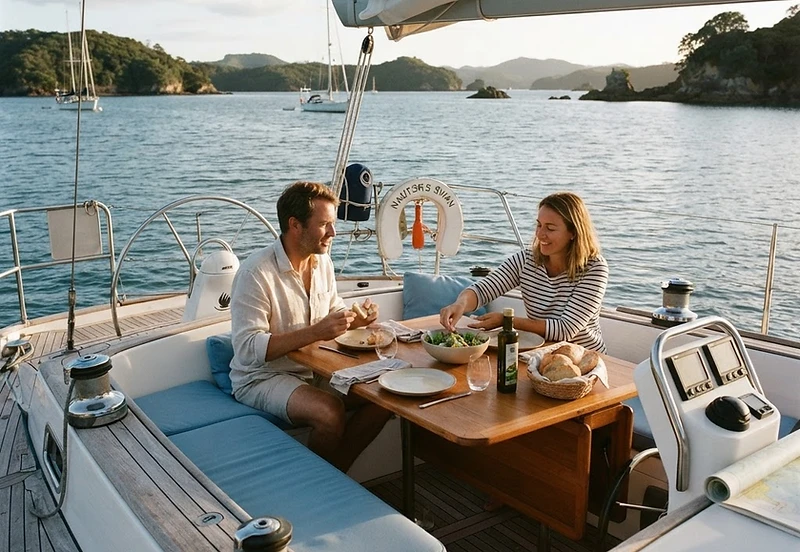
We find our way to a kitchen where the afternoon’s rhythm is governed by the morning’s catch. The menu is a direct conversation with the coast: green-lipped mussels steamed in aromatics, the shells opening to reveal a sweetness that speaks of the deep, pristine channels between the islands. There is no pretense here; the table is set with rough-hewn timber, and the side dishes are simple—a salad of freshly foraged sea greens and local citrus, the sharp, bright acidity cutting through the richness of the catch. We dine on snapper landed just hours prior at the Otehei Bay docks, its flesh firm and pearlescent, seared over an open flame until the skin crackles like parchment.
The Quiet Vigil at Twilight
Returning to the yacht as the sky deepens into a bruised indigo, the cabin feels like a sanctuary of polished teak and soft, ambient light. There is a specific, profound intimacy to life aboard at dusk—the way the galley’s warm glow spills out onto the cockpit, the muffled cry of a distant diving gannet, and the encroaching coolness that necessitates a heavy wool sweater. We spend the final hours of the day watching the lights of Russell twinkle across the water, a constellation of human presence mirrored against the vast, dark expanse of the bay.
The wind has died down to a whisper, and the yacht swings slowly at its mooring, a pendulum governed by the invisible shift of the currents. There is no desire to measure the passage of time. Instead, the focus is entirely on the sensation of the vessel underfoot—the way the deck flexes, the soft groan of the rigging, and the knowledge that tomorrow will begin, as today has, with the rising of the tide and the salt-air promise of the next headland.






