
The Volcanic Horizon
The morning light over Jeju does not break; it rises, cauterizing the mist that clings to the Halla-san peak before descending toward the coast. Aboard our charter catamaran, a stable, wide-beamed platform designed for the shallow, shifting depths of the Korea Strait, the sensation of moving is less like sailing and more like gliding over liquid obsidian. The anchor watch at dawn is a ritual of silence, broken only by the rhythmic slap of water against the hulls. As the crew furls the mainsail, the air carries the scent of sea salt and damp basalt—a sharp, mineral tang that characterizes these southern waters, far removed from the manicured marinas of the mainland.
We are navigating the stretch between the island’s northern ports and the quieter, rock-strewn coves to the south. The catamaran’s shallow draft allows us to tuck into bays where a deep-keeled monohull would never dare, granting us proximity to the rugged, craggy coastline that feels, at times, entirely personal. By mid-morning, the wind picks up, a steady northeasterly that turns the water into a field of brilliant, fractured diamonds, and we make our way toward the sheltering arms of Seogwipo.
The Galley and the Coast
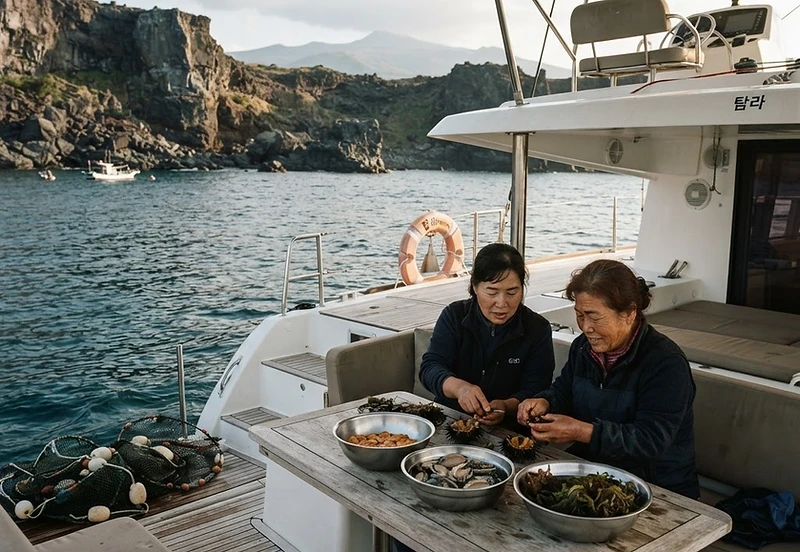
There is an unspoken pact between the yacht’s galley and the local fishermen who ply these waters. In the early hours, before the sun has fully crested the cliffs, we met a small wooden boat near the harbor entrance. Our chef, an expert in the local jeonbok (abalone) and sora (turban shell), exchanged a silent, respectful nod with the local skipper. A basket of freshly landed abalone, their shells still damp with the cold, pressurized depths of the channel, was hauled over the gunwale. The culinary soul of Jeju is not found in complex artifice, but in the immediacy of its bounty, a direct connection to the seabed.
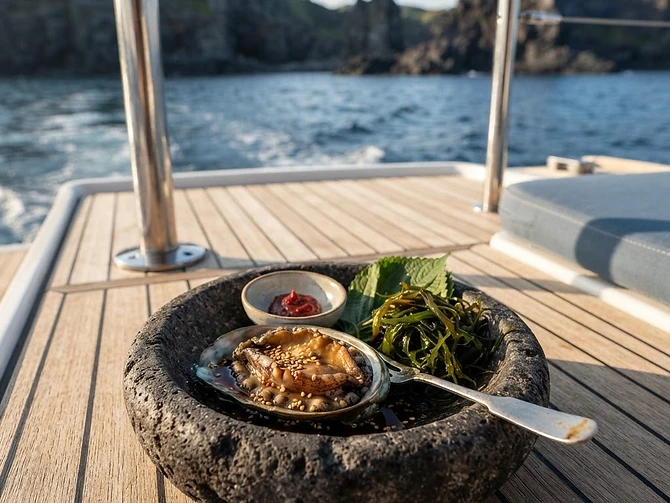
By noon, we were anchored off a hidden cove near Beop Hwan. The chef prepared a simple, vibrant mulhoe, a chilled raw fish soup that acts as the ultimate restorative for a life spent under the sun. Using the morning’s harvest, he sliced the abalone into translucent ribbons, folding them into a base of sharp gochujang, shredded cucumbers, and crisp Korean pears. The crunch of the pear against the firm, sweet resistance of the abalone was a sensory map of the island’s terroir. We ate on the trampoline, the salt spray still dry on our skin, feeling the steady, gentle movement of the vessel as the tide began to turn, swaying in the rhythmic, oceanic hum of the strait.
The Shoreward Descent
As the afternoon waned, we took the tender toward the shoreline, where the craggy basalt forms natural jetties. Our destination was a modest, family-run eatery nestled against the cliffside, where the menu is dictated solely by what the sea gives up each day. The welcome was quiet, marked by the setting of heavy ceramic bowls filled with gijeok—a local sea mustard soup that sustains the haenyeo, or free-diving women of Jeju, after their long, demanding shifts in the surf. Sitting at a weathered wooden table, watching the local fishing boats flicker back toward the harbor, the distinction between life aboard and life on the island blurred entirely.
Returning to the catamaran under a sky bruised with purple and indigo, the silence of the anchorage reclaimed us. The vessel felt like a living creature, settling into the evening swell. We watched the lights of the harbor blink to life, tiny sparks against the vast, dark shoulder of the mountain. In the final hours of the day, there was no need for conversation; the sound of a line creaking against a cleat and the distant, rhythmic surge of the tide against the volcanic shelf served as the only necessary chorus, grounding us in a world where the sea, the boat, and the shore are finally and perfectly aligned.






