
The Granite Barrier
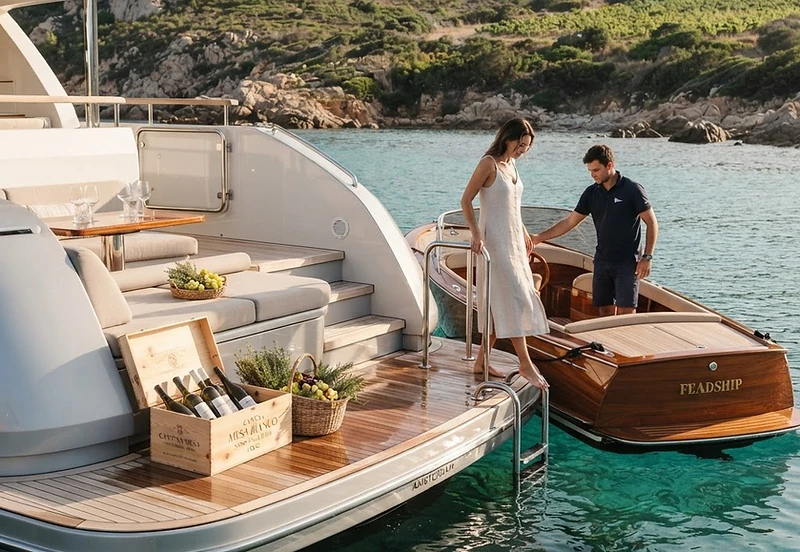
The dawn air in the Gulf of Olbia possesses a razor-sharp, crystalline quality, the kind that exists only where windswept granite shelves meet the deep cobalt of the Tyrrhenian. We were riding at anchor on a 45-metre Feadship, her bow pointed toward the jagged, limestone-dusted silhouette of the island of Tavolara. The ritual of the morning remains sacred: the soft, rhythmic hum of the crew preparing the tenders, the rich scent of dark-roast espresso drifting from the galley, and the subtle, insistent tension of a light maestrale tugging at the fenders. Our objective was not a beach club or the crowded, gleaming piers of Porto Cervo, but the hushed, interior silence of a vineyard estate tucked deep into the hills of Gallura, a landscape forged by the same geological forces that carve the treacherous Sardinian coastline.
The Ascent from the Water
Boarding the rigid inflatable tender, we punched through the light, sparkling chop, watching the yacht’s sleek, white profile shrink against the expanse until she was merely a detail in the vastness. Navigating toward the small, weathered quay at Cannigione, we experienced that visceral shift in rhythm that occurs when leaving the sea-level perspective of a deck for the winding, ancient tracks of the interior. The air here was heavy with the scent of macchia—the wild, resinous scrub of juniper, rosemary, and myrtle—that defines the Mediterranean heat. We arrived at the gates of a historic estate, a place where the maritime influence is not merely an aesthetic, but the very lifeblood of the terroir. These vines drink the salt-heavy air, a salinity that reveals itself in the finished wine with a bracing, mineral tension. Walking the rows with the winemaker, one cannot help but notice the structural parallels to our life aboard; the vines are trained with the geometric precision of a rigging plan, disciplined yet thriving in the harsh, sun-drenched granite soil that characterizes this northern edge of Sardinia.
A Midday Pairing
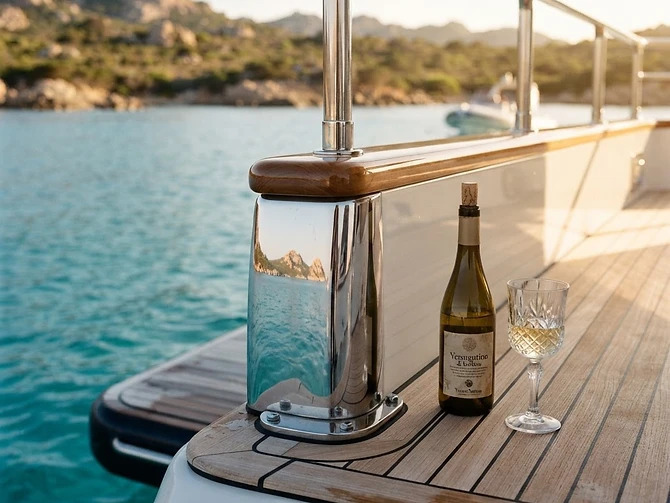
By noon, we were back on the aft deck, the tender secured and the hull rocking with a hypnotic, liquid grace in the heat-shimmer of the anchorage. We opened a bottle carefully pulled from the yacht’s chilled, climate-controlled lockers—a crisp, straw-colored Vermentino di Gallura that echoed the exact, flinty minerality of the soil we had walked only hours earlier. There is a singular, quiet satisfaction in consuming the product of the earth while suspended directly over the water that fostered its character. The wine, cold and precise against the humid, salt-kissed breeze, tasted of the sea, the rock, and the patient, unhurried passage of a summer day. As the sun began to dip toward the horizon, casting long, bruised shadows of indigo across the water, the yacht swung slowly on her anchor chain, a rhythmic, metallic creak marking the transition from the golden hour to the soft violet of evening.
We watched the shoreline fade into a blurred silhouette, the lights of the distant coast blinking like low-frequency navigation beacons. There was no urgency to weigh anchor; the estate and the sea had reached a silent, profound accord, one held within the glass and the other in the steady, reassuring roll of the hull against the incoming tide. In that stillness, the distance between the vine and the vessel simply dissolved.






