
The Passage Through the Coral Labyrinth
The Guna Yala archipelago is not a destination for the hurried or the navigationally complacent. To approach these waters—where the San Blas islands scatter across the Caribbean like emeralds cast upon a silk sheet—is to acknowledge the absolute authority of the reef. We arrived at the edge of the Cayos Holandeses just as the sun began to bleed into the horizon, our draft demanding we track the deeper, cobalt-hued channels with absolute focus. The yacht, a custom 32-metre sloop, moved with a surgical grace born of years of diligent maintenance; her standing rigging sang a low, humming note in the evening trade winds. Navigating these waters is a constant, tactile dialogue between the sonar display and the unblinking eye, a negotiation with the shifting shallows that define this remote, unforgiving reach of the Panamanian coast.
The Galley and the Daily Bounty
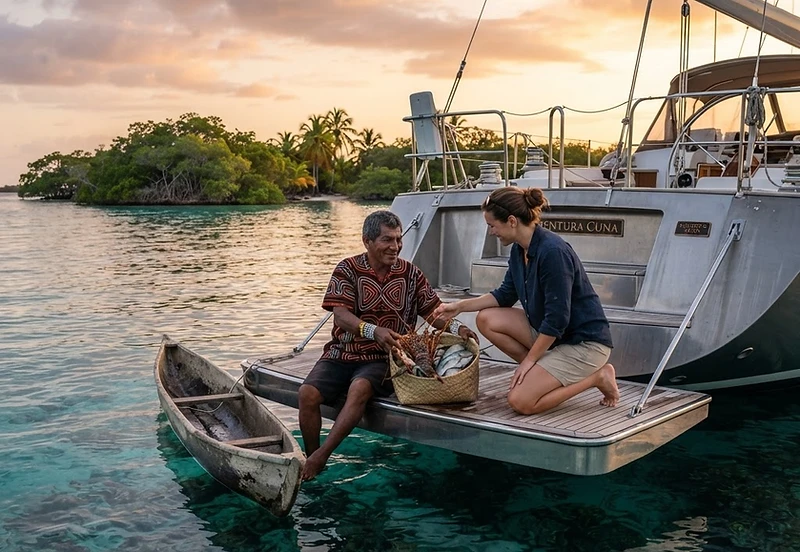
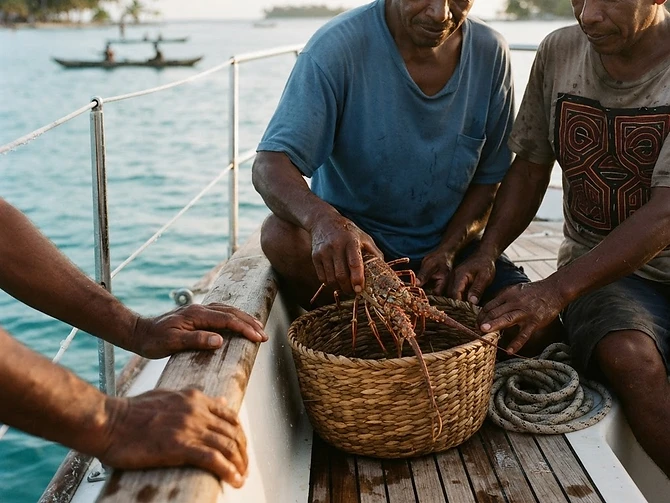
Life aboard in the San Blas is measured by the haul brought alongside by the Guna fishermen who approach our hull in their carved wooden cayucos. By late afternoon, we had secured a bounty of spiny lobster—langosta—and a cluster of silver-scaled red snapper, their eyes still bright with the morning’s clarity. There is a profound, stripped-back elegance in a meal prepared here; our chef, working within the compact, climate-controlled confines of the galley, leans entirely on the local larder rather than imported artifice. We eschew the heavy reductions of the city for the stark purity of the region: limes harvested from the nearby coastal forests, hand-pressed coconut milk, and the vibrant, stinging heat of ají chombo chilies. Dinner tonight is an exercise in restraint: the snapper, butterflied and grilled over a controlled flame, finished with coarse sea salt and a squeeze of acidic citrus that cuts through the tropical humidity. It is a meal that tastes of the very reef we are anchored above.
The Ritual of the Quiet Anchorage
As the stars begin to assert their dominance over the dark expanse of the Caribbean, the anchorage becomes a theatre of singular silence. In the Bocas del Toro region to the west, the rhythm of the port is more insistent, defined by the wood-stilted cantinas and the hum of panga engines, but here, among the cays, the night ritual is internal. It is the gentle, hypnotic rotation of the yacht around her anchor chain, the soft, rhythmic lapping of the tide against the teak planking, and the distant, percussive pulse of the surf breaking on the outer barrier reefs. We gather on the aft deck, the heavy day-time heat finally surrendering to a cool, salt-laden nocturnal breeze. There is no urgency to return to the shore, no desire for the electric hum of a manicured marina. We are anchored in the living history of the sea, where the flicker of a single kerosene lamp on a distant island is the only evidence that humanity exists beyond our own floating perimeter. We watch the horizon, content to let the turning tide determine our morning departure, knowing that when the sun eventually climbs, the cycle of the sea and the harvest will begin again, unchanged, sufficient, and entirely our own.
The anchor light burns steady against the velvet black of the sea, a solitary beacon watching the slow drift of the Milky Way as it mirrors itself in the dark water below.






