
The Teavapiti Transition
Entering the Teavapiti Pass requires more than simple navigation; it demands an intimate dialogue with the water. As our gulet—a robust, hand-built vessel with the unmistakable aroma of oiled teak and salt-hardened timber—slipped through the reef, the Pacific’s brooding, deep-ocean indigo gave way to a blinding, translucent turquoise. Our captain, a man who navigates the Society Islands not by chart plotter but by the shifting clarity of the lagoon floor, held the helm with a light, intuitive touch. Below us, the coral heads rose like submerged cathedrals, shifting from sharp jade to pale, sandy violet as the depth betrayed us. There is a specific, guttural resonance that ripples through a hull when moving from the heave of the open swell into the hushed, protected embrace of the shallows; it is the sound of a ship finding its composure. Here, the ocean does not push against the vessel so much as it suspends it, holding us in the silence of the leeward lagoons.
The Galley and the Silver Catch
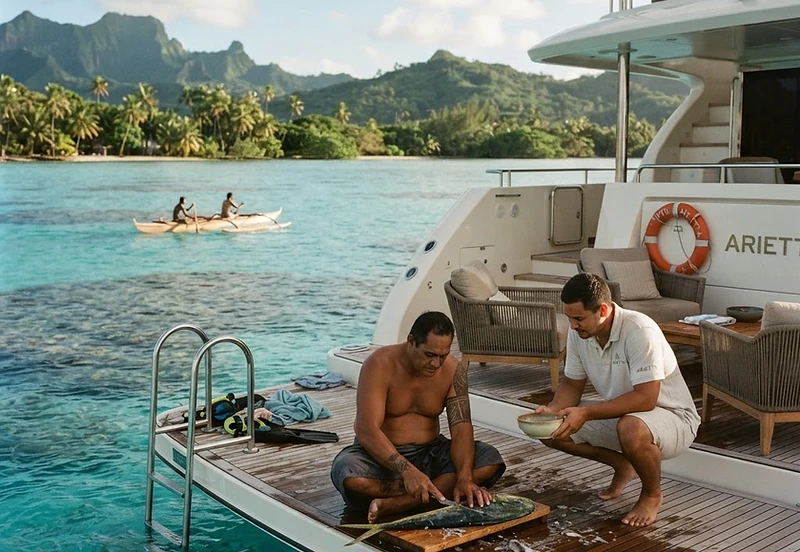
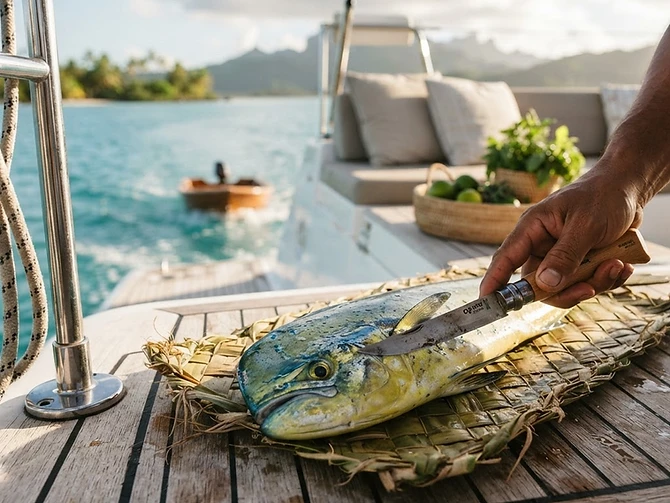
The rhythm of life aboard the gulet is dictated by the sun’s arc and the availability of the day’s bounty. Upon our arrival in a quiet bight off the Taha’a coastline, the transition from movement to stillness was punctuated by the arrival of a local fisherman. We hailed his skiff, a weathered outrigger, and settled a fair trade for a fresh, muscular mahi-mahi, its skin shimmering with the metallic iridescence of the reef. In the galley, the chef approached the fish with a practiced, almost clinical reverence. Using a thin, flexible filleting knife, he carved the translucent, firm flesh with minimal waste, the silver skin discarded to reveal the purity of the catch. Dinner would be a study in restraint: a delicate crudo accented only by the vibrant, piercing acidity of citrons verts sourced from a small garden in Uturoa and a crystalline dusting of hand-harvested sea salt. This is the authentic, unadorned luxury of the charter experience—the realization that the distance between the reef’s edge and the dinner plate is measured in mere heartbeats, unburdened by the complexities of long-range transport or industrial supply.
The Aft Deck at Twilight
As the sun finally retreated behind the jagged, volcanic silhouette of Mount Otemanu, the air turned cool and sweet, carrying the faint, intoxicating scent of wild vanilla drifting from the Taha’a plantations on the shore. We gathered on the expansive aft deck, where the table was dressed in simple, crisp linen that pulsed gently in the dying breeze. To the west, the dim, flickering lanterns of small outrigger canoes emerged, moving with a ghost-like grace against the darkening water—a reminder of the ancestral rhythms that endure long after we have secured our lines. The mahi-mahi was served on heavy ceramic, the fish retaining the cool, clean minerality of the currents that swirl between the Society Islands. Conversation became secondary to the environment; the gentle, rhythmic slap of water against the transom served as a natural metronome, grounding us in the geography of the moment. We were not merely observers of this coast; we were transient parts of its ecosystem, sustained by its harvest and cradled by its shelter.
As night claimed the lagoon, the anchor rode pulled taut, a singular, sturdy tether connecting us to the volcanic sediment miles beneath our keel. The engine’s final shudder faded into the dark, leaving only the breathing of the tide and the emergence of the Southern Cross, brilliant and razor-sharp against the velvet expanse of the Pacific sky.






