
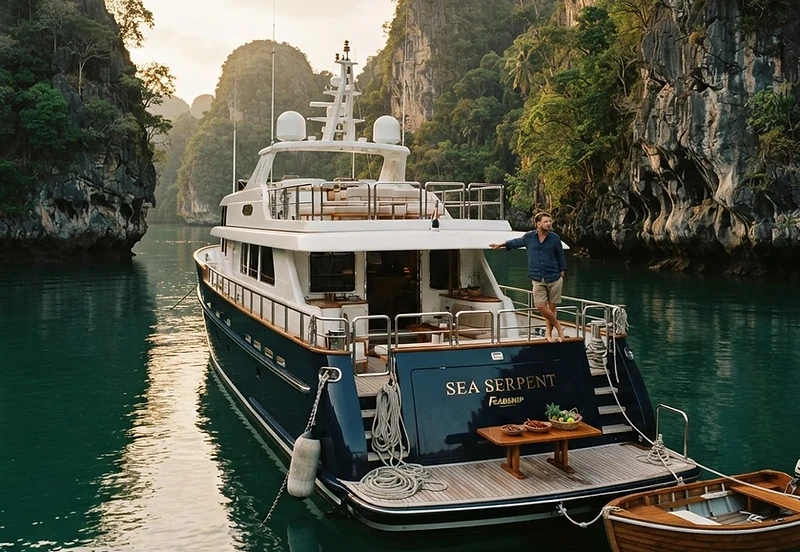
The wind had died to a breathless hush, leaving the Andaman Sea as smooth as polished obsidian, save for the rhythmic rise and fall of the Sea Serpent against her chain. A day spent navigating the labyrinthine limestone corridors of the Mergui Archipelago—tacking through narrow, emerald-shrouded passages in our fifty-meter Feadship—had demanded everything of our focus. Now, as the sun retreated behind the jagged teeth of the distant islands, the ship shifted into the quiet, rhythmic composure of a night at anchor. The salt that had crusted the teak decks during our passage had been rinsed away, replaced by the humid, heavy scent of tropical earth and blooming jasmine drifting from the shore.
The Morning Run and the Alchemy of the Galley
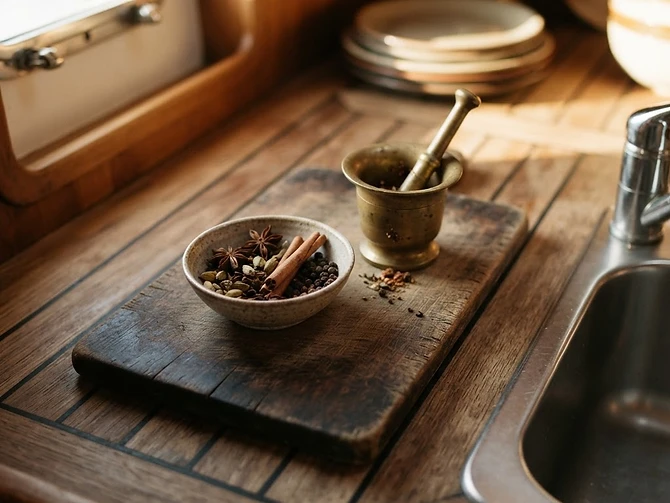
Our culinary narrative had begun at dawn, long before the light hit the water. We had shadowed a local wooden long-tail boat into a nameless anchorage near the Mawlamyine coast, where the air tasted of brine and cooling embers. Our chef, whose devotion to local sourcing borders on the ascetic, had secured a haul of Mackerel and giant river prawns brought in by the local fleet. He returned to the galley with his satchel heavy with bundles of wild lemongrass, vibrant bird’s eye chilies, and the distinct, earthy funk of belacan, a fermented shrimp paste that provides the backbone of the region’s spice profile. By afternoon, the galley was less a service space and more a workshop; the sharp, rhythmic snap of ginger against steel and the infusion of pandan leaves into the rice steamer created an aroma that permeated the aft deck, promising a meal defined by the terrain rather than the menu. To watch the chef dismantle the mackerel with surgical precision was to see the day’s navigation translated into sustenance.
Dining at the Edge of the Tide
As the stars pierced the velvet dark, we gathered on the aft deck. The usual frantic energy of a marina was replaced by the profound, slightly unsettling silence of the deep archipelago. We ate simply: the mackerel, seared to a precise, translucent finish, rested in a reduction of tamarind and palm sugar that balanced the salinity of the sea with the sweetness of the islands. The prawns were tossed with a sambal of crushed chilies and shallots, a preparation that demanded time and deliberate attention, much like the navigation that had brought us to this coordinate. There is a specific, quiet gravity to dining on the water in such a remote reach; the clink of stainless against ceramic was muffled by the sheer scale of the limestone cliffs looming in the dark, and the conversation drifted, mirroring the slow, circular swing of the yacht at anchor.
Anchored in the Currents of Time
The transition from the thrill of the passage to the stillness of the night is a delicate art. Between the courses, one becomes acutely aware of the vessel's connection to the seabed; the faint shudder of the chain as the current shifts reminds us that we are merely guests in this vast hydraulic theatre. We sipped cold tea infused with lime leaf, watching the lights of a distant fishing trawler flicker like a dying star near the horizon. This was not a night for grand gestures or the frantic pace of a modern port, but a slow immersion into the silence that only comes when one reaches the edge of a chart. Every movement aboard, from the way a glass is set down to the soft slide of a sliding hatch, felt amplified by the absence of the engine’s hum.
The moon emerged as a sliver of bone, tracing a path across the water that reached toward the hull. The cooling air finally suppressed the scent of the evening’s spices, leaving only the crisp, clean draft of the open ocean. We settled into the deep, upholstered silence of the night, cradled by the current as the vessel waited for the turn of the tide, drifting toward the horizon as if anchored to the stars themselves.






