
The Quiet Approach to the Southern Shelf
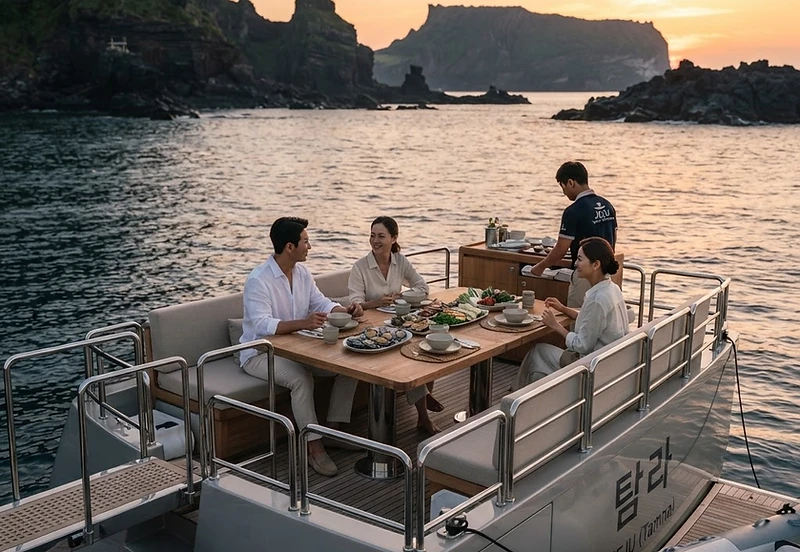
The transition from the open, unpredictable swells of the East China Sea into the lee of Jeju’s southern coastline is marked by a sudden, profound shift in the quality of the light. Navigating our draft toward the sheltered anchorages near Seogwipo, the basalt cliffs rise from the water like obsidian teeth, ancient and immovable. There is a specific rhythm to anchoring here; the sound of the chain running out is punctuated only by the distant, rhythmic cry of the haenyeo—the island's legendary female divers—surfacing from their morning work. They are the true masters of these waters, and their presence defines the local foodways far more than any coastal infrastructure. Watching the crew of the tender prepare for a morning run to the local markets, one feels the hum of a yacht that is not merely passing through, but actively participating in the day's maritime pulse.
The Saloon as a Coastal Mirror
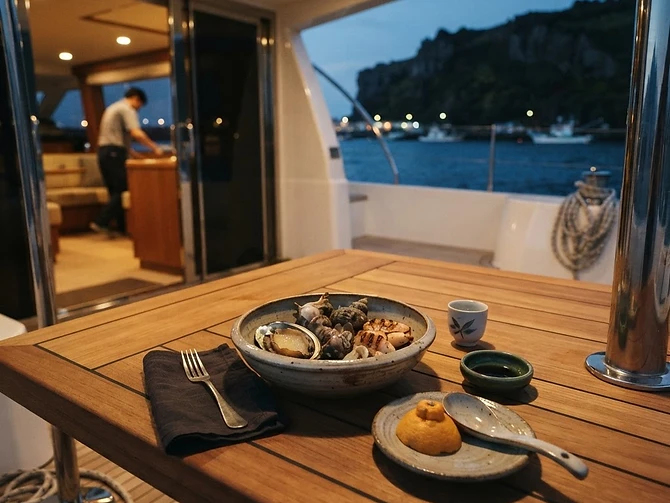
As the afternoon sun retreats behind the dormant peak of Hallasan, the mood aboard moves naturally from the bridge to the formal dining saloon. For an owner, the saloon is not just a room for service; it is a glass-enclosed theater that must hold its own against the sweeping, volcanic drama of the Jeju landscape. The interior design here—a subtle blend of matte-finished cedar and soft, off-white linens—is intended to draw the eye outward, to the darkening horizon where the lights of local fishing boats begin to flicker like stars against the black of the water. When we set the table for ten, the intention is to create a seamless extension of the sea, where the boundaries between the yacht’s refined interior and the rugged, salt-sprayed coast dissolve entirely.
From the Tide to the Table
The dinner itself is a dialogue between our galley and the morning’s haul. Our chef, having spent the early hours at the bustling Seogwipo Maeil Olle Market, returned with crates of omoksa, or the local rockfish, and deep-sea abalone harvested from the very reefs we currently overlook. There is a purity to this food that rejects complexity in favor of precision. We served the abalone thinly sliced, lightly kissed with a touch of local rapeseed oil and a pinch of hand-harvested sea salt from the nearby tidal flats. The conversation at the table drifts from the afternoon’s passage around the jagged islets to the sensory specifics of the meal: the sweetness of the shellfish, the crispness of the accompanying local greens, and the faint, briny scent that drifts through the slightly opened aft doors. It is a ritual that feels at once highly formal and deeply rooted in the primal necessity of the coast.
As the plates are cleared and the conversation slows into the easy, low-frequency hum of a satisfied crew and company, the yacht settles into its mooring. The engine room is silent, the water-maker is off, and the only movement is the gentle, almost imperceptible lift of the hull on the tide. Looking out from the saloon, the silhouettes of the basalt headlands remain, a dark reminder of the enduring land. One doesn't need to be in port to feel the weight of a place; sometimes, it is enough to simply be anchored in its wake, watching the moon rise over the volcanic dark, waiting for the first light to bring the divers back to the surface.






