
The Geometry of the Approach
The dawn in the Gulf of Göková does not break so much as it dissolves, turning the deep indigo of the Aegean into a translucent, shimmering turquoise that feels impossibly thin. Aboard the 45-meter Nautor’s Swan, the morning air was sharp with the scent of sun-warmed pine and the faint, briny tang of a receding tide. We had anchored in a secluded cove sheltered by the Karaca headlands, the water beneath our hull so clear that the shadow of the keel was etched perfectly onto the white sandy seabed twenty feet below. Getting from the deck to the shore was not a matter of a marina walk, but a deliberate, salt-sprayed transit via the Williams Dieseljet tender, the spray catching the low sun as we cut across the bay.
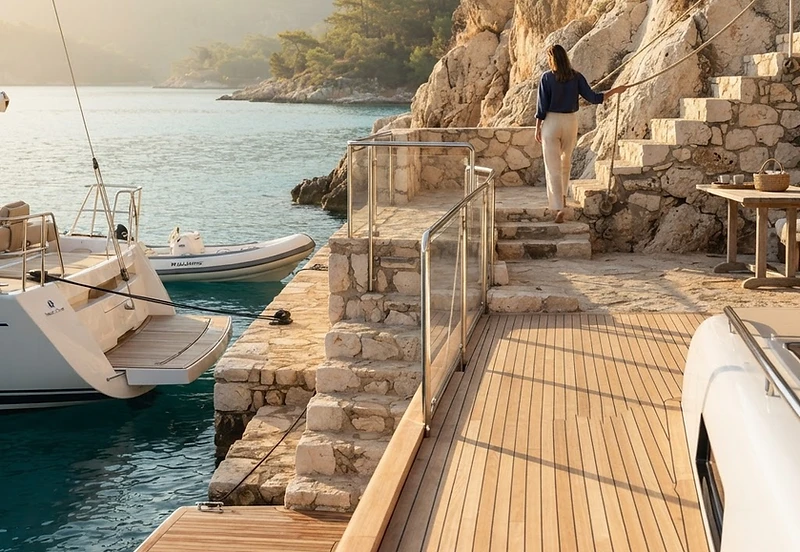
As we moved toward the northern escarpment, the scale of the coastline shifted. The land here does not gently roll into the sea; it erupts. Embedded into the vertical limestone face, almost invisible from the open water, stood a residence of profound architectural restraint. Designed to mirror the stratigraphy of the cliff itself, the villa appeared less constructed and more revealed, a series of cantilevered stone terraces that defied the gravity of the terrain. Navigating the tender toward a small, private stone jetty, one could see the precise design intent: a seamless transition between the nautical life aboard and the stationary, quiet permanence of the villa.
Tactile Thresholds and the Open Horizon
Stepping off the tender onto the wet stone of the landing, the transition was physical. My boots shifted from the textured non-slip teak deck of the tender to the cool, honed limestone of the villa’s lower terrace. This is the art of the tender run; it is the moment the explorer becomes the guest. The architect had utilized floor-to-ceiling glass that retracted entirely into the cliff, meaning the boundary between the living space—furnished in muted, earthy linens—and the open expanse of the Gulf simply evaporated. Over a breakfast of local olives, warm simit, and honey sourced from the nearby village of Akyaka, we watched the masts of a few distant gulets tracing the horizon line, their white sails cutting slow, rhythmic arcs against the deep blue.
There is a specific, quiet audacity in a house that asks the sea for permission to exist. Every beam of reclaimed cedar, every glass pane aligned to catch the midday Aegean glare, felt like an extension of the yachting experience. We spoke little, mostly watching the light shift across the water. The primary sound was the rhythmic lapping of the wake from a passing fishing boat, hitting the base of the cliff and echoing faintly upward into the terraces. It was a reminder that even when one is anchored in a permanent structure, the sea remains the ultimate host, dictating the mood, the light, and the very pace of the day.
The Pull of the Blue
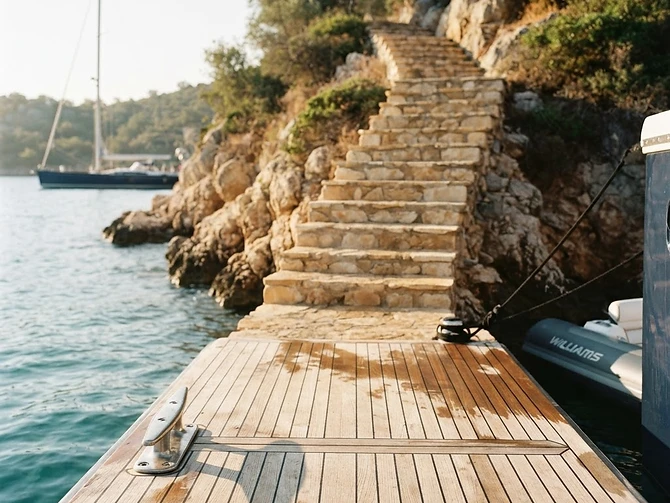
By mid-afternoon, the wind began to clock around, bringing the characteristic, cooling breath of the meltemi. It is the universal signal for a departure. Packing our things, we descended the winding stone staircase back to the jetty where the tender waited, bobbing gently against the black fenders. As the engines fired, the villa receded into the limestone bluff, losing its definition until it was nothing more than a shadow in the rock once more, indistinguishable from the natural crags that define this rugged coast.
Returning to the Swan, we hauled the anchor—a heavy, mechanical, and deeply satisfying sound that resonated through the steel hull. As the yacht gained way and the bow began to slice into the building swell, the villa became a mere fragment of the coast. Standing on the aft deck, watching the house vanish behind a jagged limestone ridge, I realized that the true luxury wasn’t the architecture of the villa itself, but the freedom to leave it behind, to untie the lines, and to let the Gulf of Göková reclaim the horizon once again.






