
The Geometry of the Arrival
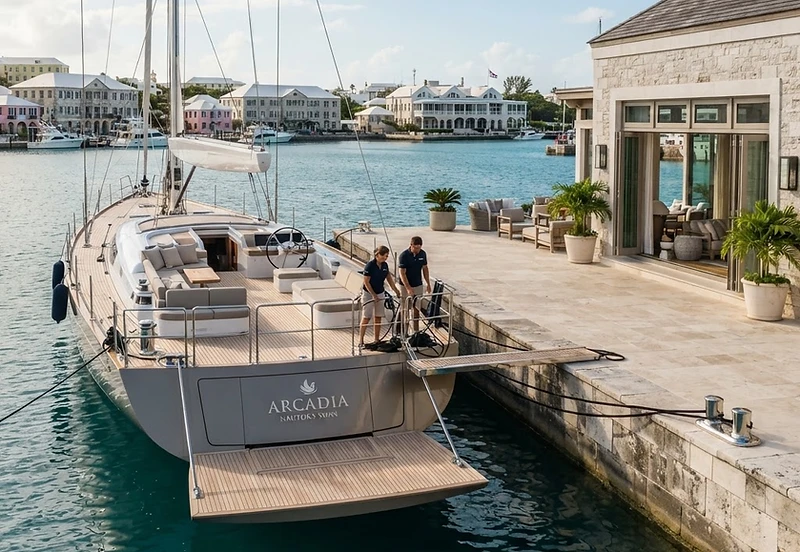
The morning light in Hamilton Harbour does not merely fall; it refracts through the dense, saline air of the Sargasso Sea, washing the limestone facade of the residence in a chalky, pale glow that feels as ancient as the reefs themselves. From the main saloon, the floor-to-ceiling glass doors are drawn back into their pockets, completely erasing the threshold between the polished white marble interior and the weathered, salt-bleached cedar of the quay. It is a structure conceived with the singular intent of welcoming the ocean, not merely observing it from behind reinforced panes. Just thirty feet from the sofa, a 60-foot Nautor’s Swan sits tethered to its mooring, its carbon mast swaying in a measured, rhythmic arc against the halyards, providing a percussive, metallic song that serves as the room’s ambient heartbeat. The scent is immediate and unmistakable: a sharp, clean marriage of Atlantic salt spray, warmed wood, and the faint, sweet trace of oleander blooming in the humid gardens of the North Shore.
The Tender’s Wake and the Quiet Porch
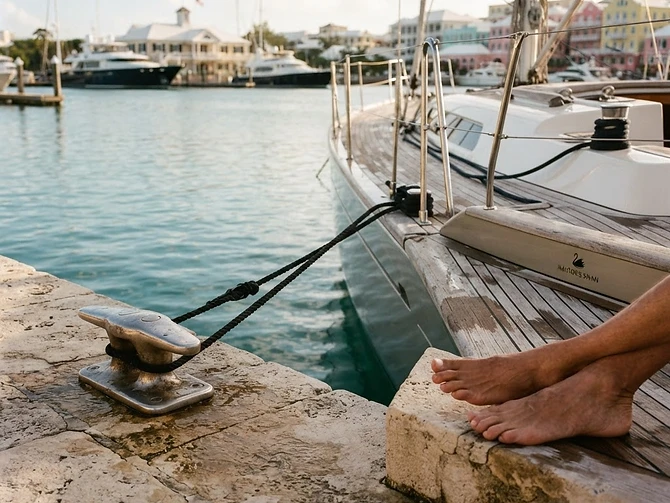
Life in this latitude is dictated entirely by the lunar cycle and the shifting, powerful currents that pull through the Great Sound. One does not simply reside here; one waits for the window of the weather, reading the sky as closely as any skipper. By mid-morning, the trade winds had freshened, the deep cobalt of the Atlantic beyond the barrier reef shifting to a nervous, ruffled indigo. We took the tender—a nimble, custom-built rigid inflatable with teak decking—past the historic clubhouse of the Royal Bermuda Yacht Club, watching the bow spray arc into fleeting rainbows against the backdrop of limestone-walled cottages. There is an exquisite, calibrated tension in moving from the refined, still interior of the house directly onto the heaving surface of the water. Returning hours later, the graceful, sweeping lines of the Swan seemed to mirror the intentional architecture of the shore, both designed with a focus on hydrodynamic efficiency and aesthetic restraint. We sat on the edge of the quay, legs dangling over the clear, deep water, sharing a plate of fresh wahoo ceviche, the sharp acidity of the lime and local peppers cutting through the heavy, pressing humidity of the afternoon.
The Evening Vigil
As the sun begins its long, gold-spun slide toward the horizon, the house settles into the deep, bruised blues of the Bermuda twilight. The quay becomes a transitional space—a stage for the evening’s final nautical passage. Watching the distant, running lights of a 100-metre Lürssen catch the swell as it navigates the narrow channel, one recognizes the shared language between the marina-side residence and the vessel moored before it. Both are machines for living, refined by the uncompromising necessity of the elements. There is no separation here, only a long, continuous tether of salt, current, and shadow. We left the doors open as the stars began to pinprick the darkening sky, the rhythmic slap of the water lapping against the stone piles the only lullaby required. When the anchor watch is kept from the comfort of a low-slung leather armchair, the sea ceases to be a distant destination or a hobby; it becomes, quite literally, the very floor beneath your feet, pulling at the foundations of the house with every incoming tide.






