
The Meridian of the Mid-Atlantic
The dawn air in Madalena harbour on the island of Pico carried the sharp, iodine-heavy tang of the Atlantic, underscored by the faint, earthy roast of café da ilha brewing in the galley. We stood on the foredeck of our 65-foot Nautor’s Swan, the teak planks still holding the cool damp of the night, watching the charcoal-coloured mist peel away from the flanks of the massive volcano that dominates the island. To set a course for the blue sharks of the Azores is to acknowledge that the yacht is not merely a residence, but a fragile, temporary outpost in an kingdom governed by cold-water physics and the migration of the deep. As we cast off the lines, the twin engines hummed with a low, mechanical restraint, pushing us past the breakwater and out into the vast, indigo uncertainty where the continental shelf falls away into the Atlantic abyss.
The Silent Geometry of the Descent
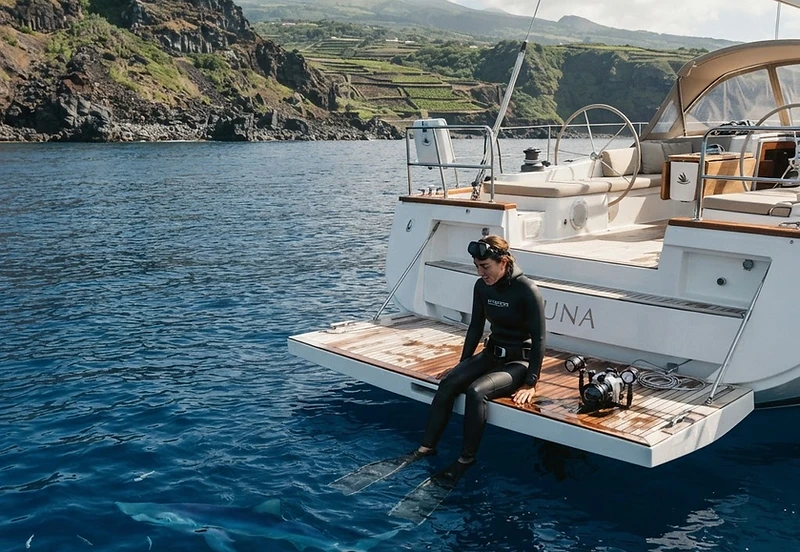
Once we reached the designated drift point some miles offshore, the Swan became a sentinel, rising and falling with the long, rhythmic, oily swells characteristic of these mid-Atlantic reaches. Entering the water from the swim platform felt less like a leap and more like a total surrender of territory. Within twenty minutes, the blue sharks materialized—iridescent, razor-edged phantoms that moved with a fluid, lethal economy of motion. They circled us with a grace that rendered our own presence remarkably clumsy. These are creatures of the open ocean, their eyes reflecting the vast, empty sky above as they navigated the current. There was no adrenaline-fueled panic, only a steady, cold-blooded curiosity; we were merely observers in their domain. Beside the hull, trailing a strictly monitored drift, our captain kept his focus locked on the horizon, his hand never far from the radio, ensuring our tether to the world of the surface remained absolute while we drifted in the wake of the yacht.
The Volcanic Larder of Horta
Returning to port as the sun dipped toward the horizon, painting the basalt sea walls of Horta in shades of bruised plum, the focus shifted from the wild to the hearth. We brought the tender into the quay, leaving the Swan swaying gently at her moorings, and walked to Genuíno, a restaurant perched at the water’s edge with a view of the anchorage. Here, the maritime soul of the Azores is rendered with a minimalist, unpretentious clarity. We sat at a corner table, the salt of the dive still stiffening our skin, and ordered a platter of cracas—the gnarled, prehistoric-looking barnacles that are prised from the local volcanic rock—and a perfectly grilled boca negra, a deep-sea rockfish landed by the very trawlers moored a stone’s throw from our table. The flavour was an education: a saline, firm distillation of the reefs and the cold, nutrient-rich currents that swirl between Pico and Faial. We paired it with a sharp, mineral-forward Verdelho from the terraced vineyards of Pico, the acidity slicing cleanly through the rich, flaky texture of the fish. As the evening light faded, leaving the illuminated silhouette of the Swan against the darkening, restless Atlantic, we realized the day had been defined by a singular trajectory: the hunt beneath the keel and the ritual of the table. We finished with a small bowl of local pineapple compote, the fruit’s bright, piercing sweetness a final reminder of the land’s volcanic fertility, before returning to the yacht to sleep, lulled by the eternal, heaving pulse of the sea.






