
The Geometry of the Morning Tide
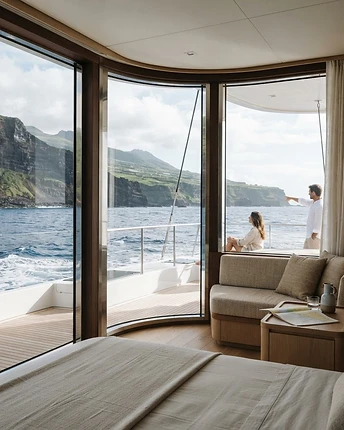
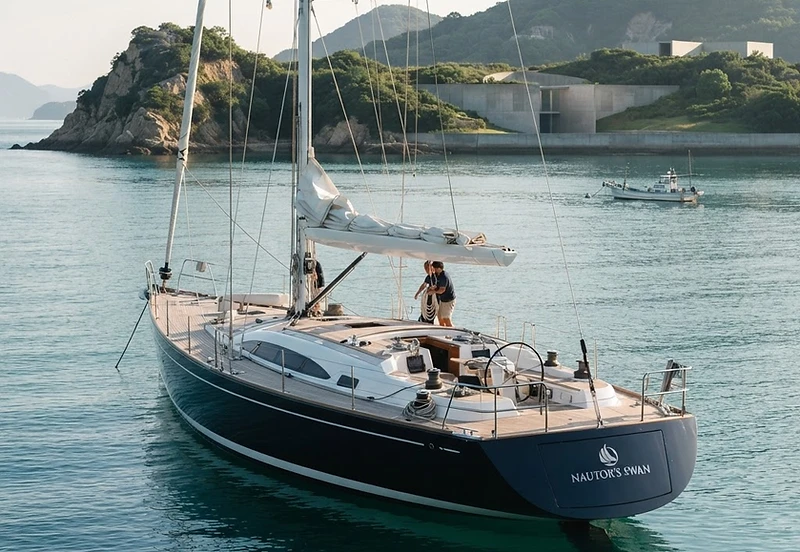
The dawn off the coast of Naoshima arrives without fanfare, a gradual cooling of the air that precedes the true light. Aboard our Nautor's Swan, anchored in the sheltered lee of the Teshima headland, the morning is filtered through the pale, matte-finished oak joinery of the main saloon. Unlike the dark, high-gloss mahogany or oppressive varnished teak common to traditional maritime craft, this interior is composed in bleached, quartersawn oak—a deliberate choice that mirrors the minimalist precision of the Tadao Ando structures scattered across the nearby hills. As the sun clears the craggy granite peaks of the mainland, the light catches the tight, vertical grain of the cabinetry, turning the cabin into a living room of soft, diffused textures. There is no sharp, blinding glare here; the timber absorbs the sea-light, refracting it until the entire space feels like a quiet, structural extension of the archipelago itself.
The Architecture of a Passage
Stepping from the companionway onto the teak deck, one is struck by the sharp contrast between the rigid, structural geometry of the cabin below and the liquid, mercurial uncertainty of the Seto Inland Sea. To sail these waters is to negotiate a series of narrow channels and sudden, complex shifts in the current, where the islands rise from the water like sculpted architectural plinths. We weighed anchor just after seven, the wind a light, consistent breath from the east, carrying the faint, briny scent of kelp forests. It is a passage of quiet, focused movement. Beneath our feet, the hull—a structure as refined and intentionally ordered as any villa on the adjacent shore—cuts through the water with the deliberate grace of a vessel engineered for precision. The boat, in its stillness, functions as a private home; in its motion, it is an instrument of navigation. As we tacked toward the harbour at Miyanoura, the pale oak interior remained visible through the hatches, a steady, calm heart beating within the shifting, sapphire blue of the passage.
The Shore and the Hull
By midday, the short tender run to the island revealed the singular, meditative ambition of the region: to integrate human presence into the rugged, granite landscape without ego. Looking back from the shoreline, the yacht seemed a natural extension of the archipelago's landscape, its lines low and honest against the horizon. We dined at a small, austere counter near the ferry terminal, the taste of local tai sashimi sharp with citrus and sea salt, a visceral reminder of the water we had just crossed. There is a specific, profound luxury in the transition between these two spaces—the white oak sanctuary aboard and the weathered, industrial stone of the port. As the evening tides began to turn, we returned to the mooring, the boat waiting for us like a quiet, well-crafted room waiting to reclaim its inhabitant. In the fading light, the interior softened further, the pale wood grain catching the final violet hues of the day, proving that at its best, a yacht is not merely a vessel, but a dwelling that moves with the rhythm of the world.