
The Passage and the Geometry of the Reef
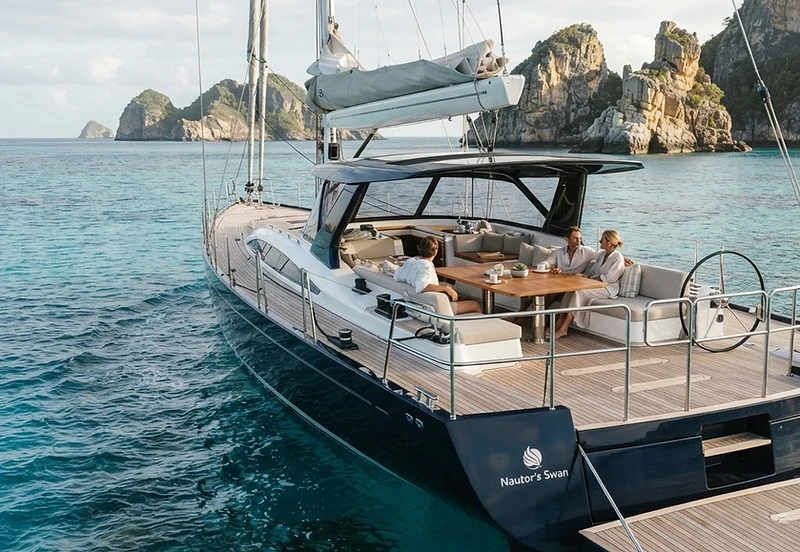
The dawn air in the Whitsunday Passage does not just signal the start of a day; it carries the weight of a rising barometer and the distinct, briny scent of pulverized coral. Aboard the 40-metre Nautor's Swan, the transition from the deep-blue abyss of the Coral Sea into the sheltered, turquoise shallows of the archipelago is a study in precise navigation. The captain holds a steady heading toward the jagged silhouette of Hook Island, the teak deck beneath our feet vibrating with the rhythmic, low-frequency hum of twin engines working in perfect harmony with the changing tides.
As we clear the passage, the scale of the landscape shifts. These islands are not merely geological features; they are massive, verdant plinths rising from a seafloor that changes texture by the hour. Here, the yacht is less a vessel and more a mobile aperture through which we observe the coast—a floating architecture that requires us to understand the land's structural bones as much as the seabed’s contours. We watch a shoal of fusiliers break the surface, a sudden, shimmering ripple that mirrors the clean, high-modulus lines of the yacht’s deck house.
Living at the Edge of the Canopy
By mid-morning, the tender is lowered, and we make the short transit to a private cove near Langford Island. The architectural narrative here is dictated by the environment: a series of contemporary beach villas designed by local firm Cox Architecture, their timber louvres and cantilevered rooflines mimicking the fractured, layered geology of the island’s cliffside. Stepping from the tender onto the sand, one immediately feels the dialogue between the vessel we arrived on and the fixed structure waiting on the shoreline. The villa is an extension of the yacht’s ethos—an exercise in indoor-outdoor fluidity where glass walls disappear, inviting the salt air to circulate through spaces that feel as transient and airy as a well-appointed aft deck.
The structure sits so low to the limestone shelf that it seems to breathe with the tide, a feat of engineering that respects the verticality of the surrounding Norfolk pines.
We take a light lunch on the villa’s terrace, the menu focused on the immediate environment: local Moreton Bay bugs grilled over charcoal and a crisp salad of foraged sea parsley. It is a quiet, anchored moment, punctuated only by the clinking of linen napkins against porcelain and the distant, muffled report of a halyard tapping a mast in the bay. The contrast is palpable: the yacht, with its sophisticated systems and carbon-fibre rigging, tethered to the raw, unyielding ancient stone of the island, linked by a brief, exhilarating run across the sapphire water.
The Evening Drift
As the sun begins to dip below the horizon, painting the sky in violent shades of violet and ochre, we return to the ship. The anchor winch engages, a heavy, mechanical sound that signals our transition back to the nomadic rhythm of the passage. The islands begin to merge into singular, dark monoliths against the fading light. From the flybridge, the view is absolute; the yacht’s navigation lights cast a soft, rhythmic glow on the water, mapping our path as we prepare for the next morning’s reach toward the outer reef.
The ocean is finally still, the surface tension holding the stars like spilled salt on a blackened lacquer table, leaving us to navigate by the steady, pulsing beam of the Hook Island light.






