
The Anatomy of Rebirth on the Hard
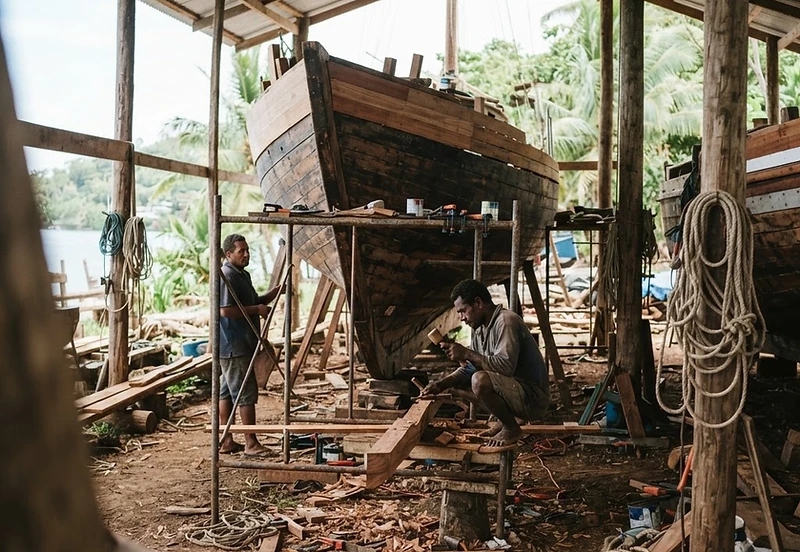
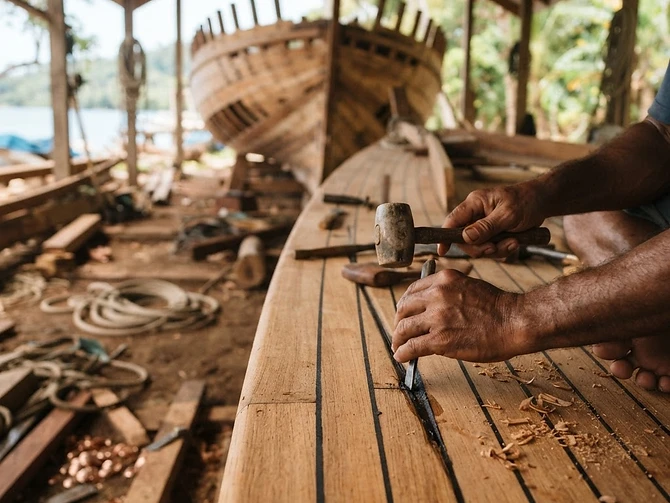
The scent of raw teak sawdust and marine epoxy is the only horizon I have known for weeks. We are hauled out on the hard in Luganville, Espiritu Santo, where the humidity clings to the skin like a warm, damp silk. My focus is entirely on the refit of Marigold, a 1950s ketch whose lines were carved from the same resilience that defines these islands. Watching the local shipwrights work—men whose hands move with the fluid, calculated grace of the currents outside the harbour—I am struck by how a refit is less an act of construction and more an act of excavation. We are peeling back layers of salt-encrusted history, revealing the original, honey-toned Burmese teak beneath. It is quiet, deliberate work, punctuated only by the rhythmic, hollow tap of a mallet and the distant, cooling breeze rolling off the Segond Channel. Every plank replaced is a dialogue with the vessel’s past, a physical commitment to preserving the integrity of a hull that has seen more latitudes than I have years.
The Larder of the Reef and the Galley’s Alchemy
Life aboard, even in the dusty quiet of the shipyard, is governed by the proximity of the Pacific. When the sun begins its slide behind the volcanic ridges, we take the tender to the Luganville waterfront to source our provisions, leaving the shipyard’s static geometry for the vibrant, chaotic pulse of the shore. The market here is a sensory education: mounds of vibrant tubers, the sharp, aromatic bite of island ginger, and the bright, waxy skins of island citrus that perfume the air. We hunt for the poulet fish—the local snapper with its distinct, clean flavour—and the heavy, mottled shells of fresh crustaceans landed by outrigger canoes.
Back on board, the galley transforms into a sanctuary of refinement. Our chef works with the day’s haul, searing the snapper in a seasoned cast-iron skillet with cold-pressed local coconut oil and a dusting of wild bush pepper foraged from the jungle edge near the Nanda Blue Hole. The simplicity is the point; the fish, firm and translucent, tastes of the deep, cold reef shelf just beyond the anchorage. It is a meal that bridges the gap between the labour of the refit and the eventual freedom of the passage, grounding us in the specific, unrepeatable ingredients of this archipelago.
The Horizon Reclaimed
As the final planks of the deck are caulked and the marine varnish begins to take on the deep, liquid glow of a sunset over the distant Maskelynes, the refit nears its conclusion. There is a specific threshold one crosses in yachting: the transition from being a vessel in progress to a vessel in command of the elements. Sitting in the cockpit of Marigold, a chilled glass of local kava-infused tonic in hand, the silence of the anchorage is absolute. We watch the light dim across the water, turning the wake of a passing local freighter into a ribbon of hammered silver. The yacht feels tighter, more responsive to the rising trade winds, ready to slip her lines and ghost toward the northern cays. We are no longer merely fixing a boat; we are preparing to re-enter the breathing, restless rhythm of the sea. As the moon rises, casting a pale, cold path across the deck, the only sound is the gentle slap of water against the freshly painted boot stripe, a quiet rhythm promising a thousand miles of blue.






