The air, thick with the scent of salt and sun-warmed teak, carried the distant, piercing cry of a sea eagle as our tender sliced through the turquoise expanse towards the northern reach of Cid Harbour. Even from a distance, the lines of Apsara, a Palmer Johnson 120, commanded the horizon with a quiet, muscular grace; her metallic hull acted as a perfect, shifting mirror for the sprawling Whitsunday sky. We had spent the night tucked into the lee of a granite headland, the soft, rhythmic rasp of the chain through the hawsepipe serving as our only clock, but as the sun crested the ridge, the true purpose of our passage began to reveal itself: a deep, sensory immersion into the archipelago’s gastronomic life.
The Ocean's Larder, Opened
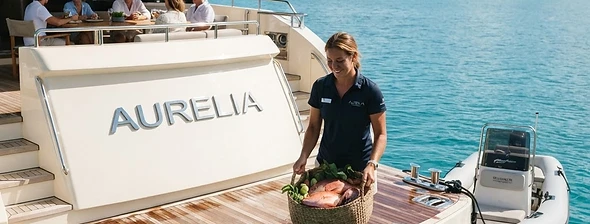
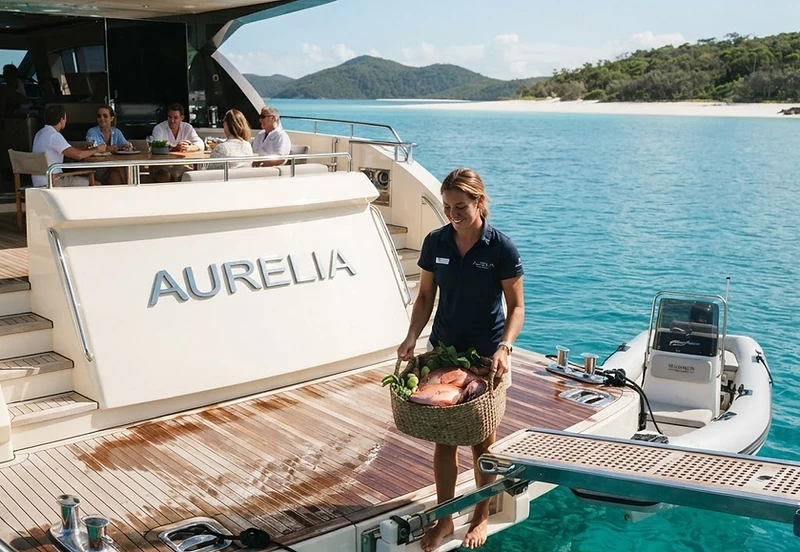
Our morning was not claimed by the manicured jetties of Hamilton Island, but by a splintered wooden pier where the local catch is still bartered in the salt-crusted silence of dawn. As the tender nudged against the weathered pilings, a local fisherman—his hands mapped with the same rough geography as the reef he works—was unloading his haul. Gleaming, silver-scaled snapper, jewel-toned coral trout with iridescent blue flecks, and a handful of heavy mud crabs were transferred to our crates, the brine still glistening on their carapaces. This was the raw reality of the Great Barrier Reef: unadorned, vivid, and profoundly tied to the current.
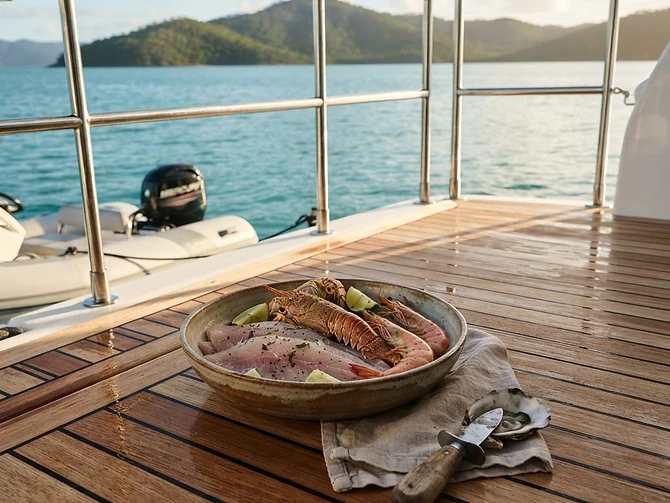
Back aboard Apsara, Chef Antoine surveyed the bounty with the focused economy of a mariner. He spoke of the coral trout’s 'clean, mineral finish'—a result of the fish feeding on the reef’s vibrant crustaceans—and how the crabs, steamed with a whisper of bruised lemongrass and native finger lime, would capture the acidity of the coast. There was no artifice in the galley; the menu was a conversation between the day’s yield and the fire. He integrated 'sugarbag,' an intensely floral wild honey harvested from the native stingless bees of the islands, into a vinaigrette for a salad of foraged sea parsley and succulents, bridging the gap between the tidal zone and the scrub-covered slopes.
From Sea Bed to Supper Table
As the sun began its long, honeyed descent, turning the Whitsunday passage into a sheet of hammered copper, the aft deck transitioned into an al fresco dining room. The table was set with heavy, unbleached linen; the only ornament was a single, bleached fan coral picked from the tide line. The opening course was the snapper, barely touched by the pan, served with a relish of desert lime and bush tomato, the fruit’s sharp acidity cutting through the richness of the catch. Then came the trout, accompanied by a purée of roasted local sweet potato that grounded the dish with a soft, earthy sweetness.
The true luxury was not found in the vessel’s speed or the gloss of her finish, but in the profound, quiet connection to place, tasted with every bite.
The mud crabs were the evening’s quiet centrepiece, served whole and requiring the ritual of the shell-cracker, forcing the pace of the meal to slow to the speed of the tide. A bottle of crisp, high-altitude Semillon from the Hunter Valley—a sharp, lean pairing—brought a necessary tension to the meal. Conversations drifted into the dark, punctuated by the slap of water against the swim platform and the distant, rhythmic creak of a neighbouring yacht’s rigging. This was not a meal in the traditional sense; it was an edible map of the Whitsundays, with every flavour serving as a waypoint in our journey.
A Lingering Taste of the Reef
As the constellations emerged, a dense, glittering tapestry above the masthead, the taste of the salt and the forest floor lingered in the evening air. The rhythm of the yacht—the gentle heave of the hull, the hum of the watermaker, the faint scent of the galley’s remnants—had woven together a perfect, singular experience. It was a firm reminder that the most lasting journeys are those that require us to be fully present, leaving us with a resonance that persists long after the anchor is weighed and the bow points toward the open sea.